Showing posts with label Heinz History Center. Show all posts

31 December 2015

Of Cabbages and Kings: a 2015 cultural diary

The Historical Dilettante
Yup, that's me.

When I was a kid back in the 1970s, I regularly read a column by long-time Pittsburgh Post-Gazette staff writer Win Fanning entitled "Of Cabbages and Kings."  Mr. Fanning covered the television beat and his curiously-titled column was replete with TV trivia and programming notes. I was intrigued by the by-line sketch of the bespectacled author chomping on a cigar, and with impeccable kid-reasoning I decided I ought to become a journalist (if I didn't become an archaeologist or a nurse or a veterinarian instead) so I could create my own perplexingly-titled column fronted by an enigmatic, cool self-portrait.


My career aspirations didn't quite turn out the way I planned. But I do maintain this oddly-titled blog, and I do have access to photography filters. No cigar or shades, though.


I ain't got nothing on Win. I know that.

Anyway, when I was older I realized that Fanning had titled his television errata column after a line in Lewis Carroll's poem The Walrus and the Carpenter. It's a dark poem recited by Tweedledum and Tweedledee to Alice, and features the aforementioned Walrus and Carpenter blithely chatting up some oysters before devouring them. Walrus leads off the discussion by announcing to his buddy and the listening oysters:
"The time has come," the Walrus said,
"To talk of many things:
Of shoes--and ships--and sealing-wax--
Of cabbages--and kings--
And why the sea is boiling hot--
And whether pigs have wings."
(Illustration by John Tenniel)
Carroll knew, of course, that life was filled with non-sequiturs and perplexing riddles to challenge both adults and little kids contemplating quirky TV columns. I wasn't raised in a literary or even very literate family. It was a surprise to my working-class parents that I was bookish, and I am grateful they recognized this as a (mostly) good thing and nurtured my interests as best they could. But no one I knew could put the likes of cabbages and kings in context, so I spent a lot of my youth with brow furrowed, wondering what such obscure references meant. Sometimes I'd stumble upon an answer, but a lot of the time I faked knowing things and hoped the answers would be revealed before I embarrassed myself.

As a grown-ass, educated woman I'm certainly now far better equipped (with Mr. Google by my side) to understand literary references and to even make my own. But I've never lost my cultural curiosity (pop or highbrow, depending upon my mood). I'm forever wanting to experience and know things, and to tap into the experiences of others.

With that as prologue, here's my point: it's the end of the year and all the cool kids are making their best-of lists. I've never been good at ranking but I still can't resist the lure of list-making. This, then, is my year-end hodgepodge. It's less "best-of" and more a partial recounting of the cabbages and kings that made my synapses fire and inspired me to learn this past year.

And so the time has come, the blogger said, to talk of many things....

Let's talk theater first. The year 2015 was a good one for seeing plays that made me think. Take, for example, My Fair Lady at Pittsburgh Public Theater. I took my daughter to see this production in January, not because it's a favorite of mine, but because she'd read George Bernard Shaw’s Pygmalion in school and we thought it'd be fun to see the derivative musical. I'd not have gone on my own, despite (or maybe because of) having watched the movie many times as a kid when it came around annually on one the networks (When I try to explain to my kids that we had three choices for screen entertainment back in the day, they stare at me with compassion and pity). My Fair Lady features vivid characterizations, witty lines and catchy tunes...but damn, this show makes me twitch. Time Magazine declared in a 2014 article about the 50th anniversary of the film that My Fair Lady "isn’t misogynistic—it’s about misogyny.” My teen agreed that this was true because she felt the show wasn't about a guy changing a girl, but rather about a girl struggling to maintain her personal integrity and sense of self in spite of the manipulations of a controlling guy. It's a fine but important distinction. When you back up and view it from that perspective, My Fair Lady becomes way more than a quaint period piece. Its themes reflect and transcend attitudes from many time periods, and its satire of class prejudices resonate with contemplative modern audiences who recognize their own social attitudes.

But with that said, we drew the line at revisionist theory proposing Eliza as a feminist archetype. True, she espoused choices and articulated what she would and wouldn't stand for. But we still found her limits cringe-worthy since she ultimately allowed herself to remain with a guy who consistently treated her badly. Neither my daughter nor I lust for vengeance, so we (regretfully) rejected the urge to imagine Eliza flinging those slippers at Higgins' head as the curtain fell. But we both dared hope that if Eliza really felt the boor was worthy of her time that she'd embark on a campaign of sensitivity training to rival Higgins' transformative efforts on her...and that she'd walk out the door for good if it wasn't successful.

Heady stuff for a musical, to be sure, but our post-mortem discussion enhanced the show for me. I learned that sometimes twitching in one's seat at a musical can be good for a soul (if you can sit still long enough to figure out what's so unnerving).

And then there were original productions, like Grist for the Mill, produced by Dog and Pony Show Theatricals. I get out to see live theater far less than during my pre-parenthood days, back when I actually worked in the seedy Pittsburgh drama underworld. I'm usually supportive if a friend is performing, but even then I must admit that part of my watching brain is distracted by assessing production values and another part of me is preoccupied with vague wishes that I was still walking the boards. But during this performance of a short story written and performed by local theater phenom Lissa Brennan, I was wholly present and riveted to her words and performance. Despite having known the playwright over many years, this was the first time I'd had the opportunity hear her voice as a dramatic writer. I loved the concept and execution of this piece. The fun Lissa had as writer/performer with language and storytelling was evident and energizing.

Maria Kolivaska Minnaji
The town of Braddock had been the literal and dramatic setting for Lissa's play. Having gathered enough intellectual grist for the mental mill, I wandered around the actual mill town afterwards and wondered about my own family history in the Westinghouse Valley. For a time, my great-grandmother ran a boarding house in East Pittsburgh for men working those insane shifts in the mills. I'm haunted by what I don't know about their lives. Details are forever lost. Not only were they busy surviving versus documenting, but my family makes a twisted virtue out of keeping personal history private. I came away resolved to continue pursuing my genealogical research.

I was drawn to other productions for different reasons. Back when I worked as a psychotherapist, I felt it crucial to maintain a supportive foundation by willingly bearing witness to my patients' painful histories. Psychologist Alice Miller has eloquently written about the empowering nature of what she termed an 'enlightened witness' in the lives of the abused. An enlightened witness supports a victim in the transition to becoming a survivor by sitting with the stories, and that in turn helps to mitigate powerlessness, preserve and pursue hope, and break the cycle of perpetual abuse. I can vouch for the value of sustained active listening, however 'New Age' that may sound, because I saw firsthand how it facilitated healing. Although I no longer work as a therapist, my cultural choices are often guided by a conscious decision to bear witness to mankind's internalized inhumanity through readings and presentations related to slavery and the Holocaust. I feel a moral responsibility to do this because it's crucial for me to understand the worst of history in order to combat modern-day injustices. Plus as a parent, I feel it's part of my job description to be informed enough to connect the dots with my kids.

And so I went to see For the Tree to Drop, produced by Pittsburgh Irish and Classical Theatre. This was the world premiere of a play also written by the talented and hard-working Lissa Brennan (Okay, seriously, not a stalker fan-girl...personal connections will tear me from the vast suburban cultural wasteland every time). Inspired by Antigone but set in the antebellum/early war-torn South, this play's focus on maintaining dignity and grace in the face of slavery's dehumanization echoed my long-held beliefs about the power of an enlightened witness.

Later in the year, we took our teen and tween to see The Diary of Anne Frank at Pittsburgh Public Theater so they could also bear witness. Anne Frank's diary tops the list of a half dozen formative books from my adolescence. I've visited Anne Frank Huis in Amsterdam and I think I've probably read every biography and analysis of her life and history that's been published. This was the second production of the play that I've seen, and while I have some personal issues with how Anne is written, I am pleased that her story continues to be told.

In addition to these and other local productions, I got to take in some theater while traveling. I am not much for the overblown emotionality of musicals, although I do appreciate the talent on display. But Gershwin is my man, so I was thrilled to take in a preview of An American in Paris on Broadway last spring in NYC. This is a far more morally ambitious production compared to the movie, thereby allowing a layering of modern sensibilities and circa-1951 post-war perspectives that I appreciated.

Cardinal Wolsey's and Henry VIII's Hampton Court Palace
I also spent a day enjoying Wolf Hall I and II produced by the Royal Shakespeare Company on Broadway, and even got to meet author Dame Hilary Mantel. I enjoyed the BBC production later in the year for its performances and production values, but I preferred the more stripped-down theatrical version because it laid bare the bones of the story. And the story is really the thing, not the scenery (or chewing thereof). Mantel crafted an entertaining story with historical precision that was accessible to even non-Tudor history buffs, but her genius was in telling a familiar tale from the perspective of an ordinary man who experienced an extraordinary rise to power. I enjoyed her writing and felt encouraged about the popularity of the stage and broadcast productions because I think they proved that with an engaging presentation, accurate history can intrigue and even entertain non-historians. (Plus I got to meet the author during intermission).

A different imaging of Tudor life was at the core of texts&beheadings/ElizabethR, a play I saw at the Folger Shakespeare Library. I went in thinking it would be a straightforward portrayal of Elizabeth's life through an examination of her writing, but I couldn't have been more wrong...or more pleased to be wrong! It circled around and reflected back on itself, initially disconcerting but always intriguing. The framing 'game' structure didn't work for me personally; the concept was interesting but I thought the execution clumsy and a bit too obvious. But even with that distraction, I'm still thinking about this show months later. The actresses mesmerized with their recitations and characters, but we weren't allowed to forget that they were acting when they switched to narrative formats, using modern language in asides. I found those switches distancing and jarring but I'll own that my historical pedantry and knowledge of the subject matter sometimes interfered with my being entertained. We never got close to really 'knowing' Elizabeth I in this play, but then no one ever really did in life, either. The score by Gina Leishman was sublime, as were the performances, and in those moments the production floated out of time and space. I hope a recording will be forthcoming. This was one production that challenged me out my comfort zone, and I was glad of it and left wanting more.

I don't tend to see a lot of movies but I took in a few this year. The 1942 classic Casablanca was live-scored by the Pittsburgh Symphony and I do so love that film, so off we went. In addition to the characters we've come to know and love, Casablanca, famously featured Morocco and Paris (albeit both created on a soundstage); WWII not just as the setting but as a cultural phenomenon; and the nobility and moral conflicts of La Résistance française even as such were playing out in real life in France. All of that outweighs the romantic schlock that drives the plot -- which is a good thing because otherwise I'd not be able to stand it! Plus there's the witty and infinitely quotable dialogue. And let's face it, Ingrid's costumes are fabulous.

I was worried that live scoring might prove distracting. Pittsburgh Symphony played along with the score, with the orchestra situated onstage directly beneath the projection screen and Guest Conductor Emil de Cou following the film on a monitor. It was impossible for the musicians to play throughout the entire film as they would have interfered with some key dramatic moments, so the original score dominated in certain scenes. Because of that, at times it didn't seem as though this was the best use of a full orchestra. As it turned out, the symphony didn't distract since our attention was thoroughly riveted by the film. My family thought the best moment was when the small Rick's Cafe band was augmented by the full PSO swelling into patriotic majesty during La Marseillaise.

This is an iconic film and always enjoyable as such, but the magic was enhanced for me by watching this film in the very movie house where Pittsburghers first saw it back in the day. What we now call Heinz Hall was built as Loew's Penn Theatre movie palace in the late 1920s. Casablanca premiered in the same building in Pittsburgh on January 23, 1943!

I like when things come full circle. Here’s looking at you, kid.
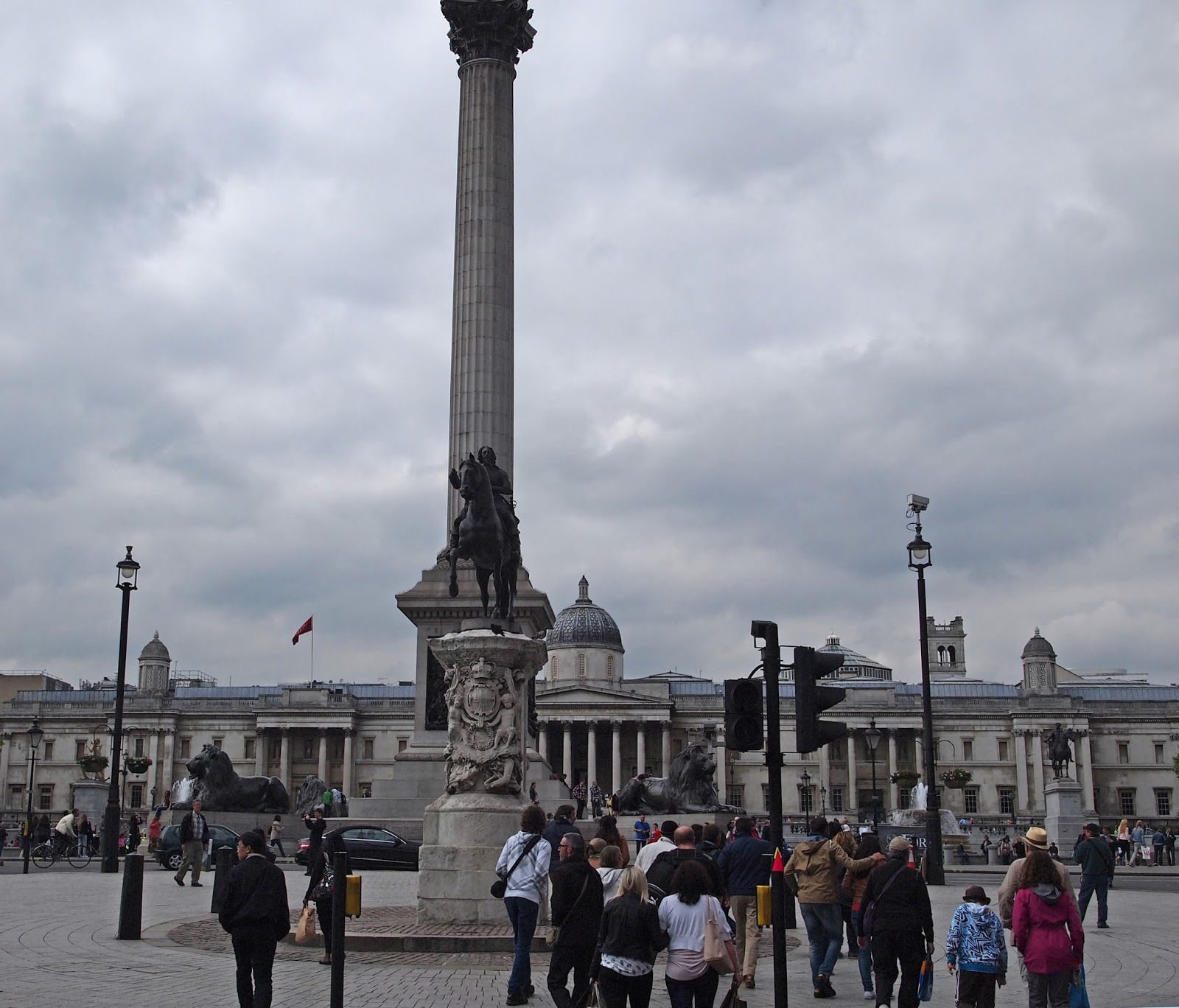
Trafalgar Square, National Gallery in background
A few of my alternate 427 careers have to do with museum curation, so I was hooked on the subject matter of National Gallery before ever seeing it. A New York Times review describes the documentary as being "....about art and process, money and mystery, and all the many, many people gazing and gawping..." which I guess pretty much sums it up. I loved this film for its behind-the-scenes peeks at conservation efforts; for the examples of people trying to use words to describe their reactions to art (including a group of visually impaired patrons who experienced embossed reproductions of artworks); and for the meta-conversations about making curation relevant to the public. But mostly I loved it for the long still shots of people looking at art. You wouldn't think (or at least I didn't) that looking at people looking at art would be fascinating, but it is. After I saw this movie, I resolved to spend some more time when in galleries not just soaking in art, but watching the people soak it in as well. Once I've reached a personal saturation point at a museum, I find myself trying to clear my visual palette by staring blankly at a wall. Now I also people-watch...and frankly, watching people looking at art is more interesting than looking at a blank wall.


Portrait of Adele Bloch-Bauer I, Gustave Klimt
I also saw Mr. Turner and The Woman in Gold Based based, respectively, on the lives of painter Joseph William Mallard Turner and Maria Altman (whose family won a seven year battle against the Republic of Austria for the return of Gustav Klimt's iconic painting of her aunt, Portrait of Adele Bloch-Bauer I). I enjoyed both films but my inner-historical pedant felt that while the portrayals rang true to the essence of what I'd read about each person, there were too many fabricated scenes and embroidered bits aimed at ratcheting up the drama quotient. Real lives that are compelling enough to get movies made about them ought to be portrayed as close to the facts as possible. I was particularly annoyed at how badly The Imitation Game altered the story of Cambridge mathematician Alan Turing for "dramatic purposes." I understand the argument that an entertaining if not entirely factual portrayal can serve to stimulate  interest and exploration. But I don't believe that's a strong enough argument when weighed against the need to respect and honor an individual and the historical record. (And this is why I've never been invited to work in Hollywood!)

I'm nothing if not contrary so therefore it shouldn't shock that I am intrigued by revisionist Shakespeare productions. The play's the thing so don't mess with the man's words, but I'm fine with innovative productions. Purist period reproductions, deconstructed, whatever -- go for it. But damn it, your staging and costuming choices need to make cohesive, consistent and internal sense. A local production of Othello was well-acted and staged but I felt it abandoned that thread of production continuity with random costuming choices. National Theatre Live's filming of Benedict Cumberbatch's Hamlet was dramatically impressive (and he redeemed himself in my eyes for his overwrought pseudo-Khan with this performance). But the costuming and some staging left me puzzled. The play's the thing! In related news, I'm now a third of the way through my goal of seeing all of Shakespeare's plays performed live (What? I'm totally counting that Hamlet).

I attended several adult education classes at Carnegie Museum of Art this year: Picturing Across the Atlantic: The Beginnings of American Art with art historian Isaac King; John White Alexander's Murals for Mr. Carnegie's Museum and Their Survival in the Smoky City with Curator of Education Lucy Stewart and Chief Conservator Ellen Baxter; and Lasting Impressions: Van Gogh, Gauguin, and Fin-de-siecle Paris with art historian Clarisse Fava-Piz. I know better, but I still feel like CMOA was spying on my art history interests when choosing subject matter for its adult education programs this year!

I'm fascinated by the emergence of art and culture in the fledgling United States and how such coincided with the creation of our founding stories, particularly narratives attached to George Washington. Dr. King wove all these factors into a fascinating tapestry.

Thomas Hart Benton's America Today
The mural lecture was of particular interest since I'd spent some time gazing at Alexander's staircase mural at the Carnegie last year when I wrote about Andrew Carnegie (I still like to think that's him up there). I enjoyed getting to know more about the artist and this work within the context of American Muralist tradition. Learning more about that tradition helped me better appreciate seeing Thomas Hart Benton's America Today mural, simultaneously on exhibit at The Met.

The Impressionist lecture series provided a great foundation for several art appreciation pilgrimages that I took later in the year. Since I usually avoid what's trendy, it's a little embarrassing that I claim among my favorite genres and artists one who'd also among the best-loved in popular culture. The world's obsession with Van Gogh has as much to do with gossiping about his dramatic life as it does with appreciating his actual art. There's a corresponding apologist attitude in art historian circles that tries to ward off speculation about Van Gogh's 'madness' in favor of solely focusing on the art. Good luck with that, I say, because I don't believe we do our collective understanding justice when we divorce any artist from his art, circumstances or times. That's not to say that every discussion about Van Gogh should begin and end with absinthe, ears and asylums! But a discerning study of his foreshortened life illuminates many of his artistic choices. My background as a psychotherapist specializing for a time in the treatment and research of bipolar disorder compels me to believe that Vincent Van Gogh's concurrent psychiatric and medical illnesses were pervasive and episodically dominating. He could function well enough for long periods and was not completely divorced from reality, but that reality was always filtered through the need to manage his episodes and symptoms. 

This particular lecture coincided with the Carnegie's Visiting Van Gogh: Still Life, Basket of Apples exhibit, and it also served as a nice primer prior to my family's summer trip to Paris and Auvers-sur-Oise.
La Mairie d'Auvers and The Town Hall at Auvers by Vincent Van Gogh

Auvers field and Wheat Fields near Auvers by Vincent Can Gogh

Église Notre-Dame d'Auvers


L'église d'Auvers-sur-Oise, vue du chevet by Vincent Van Gogh


My personal appreciation of art has its foundations not in artistic theory or personal attempts at creating, but in an understanding of art as an expression of personal interests and influences; as a manifestation of social, religious and cultural influences; and as a method of historical record-keeping. The lesser-known figures of the Impressionist era are as interesting to me as the big names, so I was delighted to visit Discovering the Impressionists: Paul Durand-Ruel and the New Painting at Philadelphia Museum of Art and Gustave Caillebotte: The Painter’s Eye at National Gallery. Caillebotte's collection formed the core of the Musée d'Orsay, which I visited later in the summer. If he's widely known for anything it's for his patronage of the Impressionist movement, but Caillebotte was a precise, meticulous painter of dramatic perspectives. It was a joy to see so much of his work in one exhibit. Durand-Ruel was a shrewd businessman whose commitment to the Impressionist movement nearly bankrupted him, but retrospectively seems a stroke of genius. His approach to selling art (literally and figuratively) influences the market to this day. It was awe-inspiring to see the assembled collection and realize how many different artists and visions he brokered.

Audubon's Aviary: The Final Flight (Part III of The Complete Flock) at New York Historical Society was a different kind of visual treat. The Historical Society owns Audubon's original bird watercolors and illustrations, and this particular exhibit showcased preparatory watercolors for the double-elephant-folio print edition of his The Birds of America. It was thrilling to see the great naturalist-artist's work up close and view some of his techniques. The images were displayed in the order in which they were engraved, thereby allowing us to view them sequentially in the order Audubon created them -- just as the original subscribers would have done. The University of Pittsburgh owns one of the 120 complete double elephant folios of John James Audubon’s Birds of America known to exist, and I like to stop in at Hillman Library to ogle whatever image is on display when I'm there. (You can peruse the online images HERE).

Cathedral Church of St. John the Divine
With Angels and Archangels: Spotlight on Angelic Images at The Cathedral Church of St. John the Divine was a tour led by Senior Cathedral Guide Tom Fedorek. I first become aware of St. John the Divine when I read Madeline L'Engle's adult novels A Small Rain and A Severed Wasp. Those books, with their themes of compassion, acceptance, and moving forward in spite of our imperfections, have long resonated with me. That the modern-day Gothic cathedral-in-progress which served as the setting really existed seemed too good to be true! Visiting it over the years has been a pilgrimage of grace for me, even though work has stopped on the building. I'm always intrigued by the stories I imagine are embedded in stone and glass and this thematic tour was, well, divine.

There have been other plays and movies and art,  wondrous travels that I'm still sorting through, a renewed if intermittent interest in poetry, and above all books and music (both listened to and performed). All of these things have been the embodiment of joy...my antidotes when exposed to bottomless social media rage...what I've used to fill myself when drained by a world gone mad with extremist rhetoric. This embarrassment of cultural riches is something I feel so very, very lucky to have experienced, and that privilege has prompted me to think about what I can give back to the world. I'll finish up my cabbaging and kinging by mentioning one last event that is also serving as a personal beginning.

The We Can Do It! exhibit at Heinz History Center examined the Pittsburgh homefront during WWII with a particular focus on this city's industrial output. It offered detailed perspectives on a particular time and place, and I hope some of the pieces will remain on permanent exhibit. 

My kids and father, We Can Do it, Heinz History Center
I'd volunteered at the museum beginning in 2011 but haven't been connected much following the untimely death this year of Volunteer Coordinator Sandra Baker, a fellow later-in-life historian whom I considered a friend and mentor. The program she nurtured has changed in a way that excludes me, and I need to redirect my historical energies. My late mother-in-law left behind a collection of letters written by her 17 year old self and her parents to one of her brothers serving in the Army Air Force during World War II. All four brothers served in the military in some capacity during that war, two in active combat in the European theater. The letters are a unique record of one family's experiences, but I think they are universally appealing. Inspired by the We Can Do It! exhibit, I'm hoping to transcribe these letters, perhaps with a goal toward publication.

I'm looking forward to the coming year. Perhaps I'll finally learn why the sea is boiling hot, and whether pigs have wings. Bonne santé!

04 April 2013

Building a Museum

Spring has been a long time in coming, so I decided that if I couldn't be greeted with cheery weather I'd ring in the season with Billy Bragg's new CD Tooth & Nail. Bragg is my favorite singer-songwriter; he drew me in with his political and social commentary in the late 1980s and I hung 
around for the love songs despite my anti-romantic streak. His first new release in five years is rich with personal reflections, patented wordplay, and that distinctive Bragg sound. He even gets a bit of whistling in. Of course, whistling makes everything better, especially when the Sherpa of Heartbreak pairs it with lyrics like "To the misanthropic, misbegotten merchants of gloom...."

With no slight intended to Billy's musicianship, I have to admit that ear-worms from this release have taken a temporary backseat for me to the essays he included with the deluxe CD. From 2008-2011, Bragg wrote a regular column for Q, a monthly music magazine published in the UK. His topics were free-ranging and all-encompassing (kind of like this blog, heh) and he's reprinted some of his favorites with this release. This line from the essay "Compiling a Discography" grabbed me:
As we grow older, each of us become curators of our own personal museum, full of items of no great financial value, yet cherished all the same. 
So there, we have Billy Bragg to blame for my latest flight of fancy: I've been mentally building my own personal museum. Mmm, okay, it's not Billy Bragg's fault. I'll admit that 'museum curator' has always been high on Sue's List of 427 Alternate Fantasy Career Choices. This is a natural extension of my grade school obsession of wanting to live in a museum, which we can blame on EL Konigsburg's novel From the Mixed-up Files of Basil E. Frankweiler.   Juvenile fantasies aside (uhm, okay, I still want to live in a museum....) I harbor no illusions that curating is an easy task. It is a multi-layered profession which places physical and/or digital objects at the mercy of a idealized balance of subjective judgement and specialist knowledge and skill.

Bragg's personal museum, referenced above in the context of compiling a discography for a website relaunch, would be more culturally relevant on a global scale than the personal museums most of us would compile. I mean, no one but me would likely appreciate the items I'd include in my collection. Things like, say, my beloved childhood companion, Chester O'Chimp.

Chester O'Chimp

Me and Chester
Chester's a little tatty around the edges but don't mock his appearance; he's looking good for a 45 year old talking plushy. Although he debuted in 1964 as part of a Mattel line of talking plushies called Animal Yackers, I got Chester as a birthday present a few years later when I turned three (he was probably on clearance). He's a furry 14 inches tall and when you pull his string, his mouth moves as he utters bon mots with an Irish accent. Yes, really. He says profound stuff like "Ah it's marvelous, 'tis, how we look so much alike" and "I'll be a monkey's uncle! Oh...I am."  For a chimpanzee with an Irish accent, Chester O'Chimp possesses a deadpan sense of humor and great comedic timing. I'm sure consorting with him during tender, formative years helped hone my refined sense of the absurd (because if a chimpanzee with an Irish accent isn't absurd, I don't know what is).

Somewhere along the way my Chester lost his trademark vest, which means he can no longer command $400 collector price tags on eBay. That's okay by me, as he's not for sale. Chester watches over me from his vantage point above my Star Trek memorabilia shelf.

Oh of course, yes, my Star Trek stuff would be included in the Museum of Sue. I have an original Enterprise play set somewhere, too. Mr. Spock was my philosophical godparent and I've been a fan of the original series since the age of 9. My own 9 year old son seems to have inherited my love of things Trek. My daughter is battling the emotional assault of adolescence and currently has a toxic aversion to Mr. Spock (but he loves her anyway, and so do I).

When it comes to sifting through childhood memorabilia, there's an assortment of well-loved dolls and paper doll books that I'd need to include in my museum. And I'll admit that I'm still a doll lover, though these days my doll play is characterized by creating elaborate realistic dioramas in 1:3 scale. That means mon musée is going to need some fancy display cases with professional lighting to showcase my collections, which is going to stretch the exhibitory budget. So since I'm blowing the budget on display cabinets, the rest of my personal museum will need to be a digital archive using existing share-ware. That means visitors to the Museum of Sue will need to BYOi (bring your own iPad) to access the library, photos, and soundtracks of my life. There will be an optional olfactory component, too, because I buy a new scent whenever I'm traveling to a special place since wearing the scent later evokes happy associations. That's right, the Museum of Sue will be a total sensory immersion experience.

The Cabildo, upper gallery overlooking Jackson Square
So much for what's in the museum; the next step is deciding where to house it. My favorite museums are in buildings that are architectural witnesses to history, because that adds another dimension to the experience. The Louvre and Cluny in Paris and The Cabildo in New Orleans are inspiring examples of museums in buildings re-purposed from their former usage.

Musée de Cluny, by John Phillips


There are fine purposefully-built museums, too. My favorites are those that are an architectural homage to the past, ranging from neo-classical to High Gothic stylings like at The Met, National Gallery in DC, British Museum, and the V&A. The museums of the 19th century have been subsequently expanded piecemeal and thus bear the imprint of multiple tastes and styles, but that adds to their charm. My hometown Carnegie Museum of Natural History is an imposing structure that's as interesting as the stuff it houses. Andrew Carnegie had four statues crafted for the entrance to his namesake Museum and adjacent Music Hall to symbolize what he called "The Noble Quartet" of Science, Art, Music, and Literature. I admit, I still feel humbled at the sight of Galileo, Michelangelo, Bach, and Shakespeare staring down at Forbes Avenue from their lofty pedestals.

Sculpture of Shakespeare by John Massey Rhind


The Museum of Sue needs a home, but since I've blown my imaginary budget I can't afford statuary. I'll have to settle for my parents' 1950s suburban ranch house, which is as iconic as I can get. Maybe I can scrounge up a gazing ball on a pedestal to put outside the front door.

It's fun to mentally while away the hours curating an imaginary museum. But I know that the real challenge is to get people to come through a museum's doors, tarry a while in real time, and maybe even come back. I spent a few years as the accidental managing director of a semi-pro theatre company and thereby learned the hard way about the challenges of marketing to and growing an appreciative audience. I spend a lot of time in museums now as a parent and self-avowed culture vulture. While I believe that there is charm to all of them, certain things seem to 'work' better in terms of audience appeal in today's technical age.

For instance, I recently had the experience of visiting a city museum in an historically signifcant building with some friends. This was a repeat visit for me so I was able to gravitate to my favorite sections, but it was new to them and they soon wearied due to information overload. That was as much about the presentation as it was volume of info. As we later reflected upon the experience, we agreed that a very high standard of literacy and a strong inclination toward detail-oriented cultural and historical immersion was presumed of this site's visitors. I'm not sure that expectation is in the best interest of a museum. I'm not suggesting dumbing down history, and certainly anyone who enters a history museum is there because she wants to (or in the case of a forced field trip, is expected to) learn. But surely something that blends the resources available to us today to make info more accessible is to everyone's benefit? Expecting people to read an endless parade of placards with details in fine print isn't realistic these days.

This museum featured a short video clip showcasing the early colonial history of its city, which I thought was interesting and well-done. But the screen was off to the side in a crowded room that most people breezed through, so it got little attention. And for those of us who wanted to watch, there was but one hard little bench. It wasn't a very inviting scenario. To its credit, the museum did offer guided audio-tours that hit some of the tour highlights. That kind of interface is pretty much expected of museums, although it's rapidly becoming low-tech in the struggle to keep apace with relevant technological advances.

Museum professionals are engaged in constant critical examination of the potential uses of technology in their field. The 2011 Horizon Report had as its goal an examination of "...emerging technologies for their potential impact on and use in education and interpretation within the museum environment." The Horizon Report acknowledged that today's patrons "....expect museums to provide a wide range of digital resources and content...." and that multi-media presentations "....are no longer seen as afterthoughts in interpretation but increasingly as necessary components of an interpretive plan." Of course not all museum funding is created equal so this multi-media trend is not to be found across all facilities; monies have to be found for basics like, say, modifying old buildings for high speed WiFi connections. I'm afraid in the city museum I described above, technology was an afterthought, but at least the video was well-done. Sometimes when technology is showcased it ends being well-intentioned but poorly executed. I've seen complementary multi-media presentations that were redundant to the main exhibit and did nothing to enhance the collection, and some which even distracted. Having technology simply for the sake of having technology isn't the way to go, either. To paraphrase James Carville, it's about the integration, stupid.

The Horizon Report asserted that mobile apps for iOS or Andoid based devices to enhance museum-going experiences are what museums need to be offering now. Future recommendations include the development of "augmented reality" technologies which use combinations of GPS, video, and pattern recognition to "....extend the museum and its mission beyond its physical setting." I love some of the applications of this technology: x-rays showing the layers of sketches or preparatory drawings beneath a completed painting, or video feed of what a landscape once looked like overlaid by its present reality, accompanied by historical tid-bits. The latter is my obsession when visiting any historical site: I want to see the layers of history in order to witness and analyze the architecture and social progression over time. I've used a couple of augmented reality apps when traveling and found them, though usually still in their early stages of development, a fun way of enhancing historical learning.  I've also spent a lot of time on the augmented reality viewer for the Western PA region, the Pittsburgh Mapping and Historical Site Viewer, developed as a labor of love and genius by Chris Owens to show how how Pittsburgh evolved from 1835 to the present day. And I'm looking forward to using the Museum of London's Streetmuseum app later this year. This app allows users to point their mobile devices at historical sites and see the feed from their cameras overlaid with historical notes and archival photos about what they are viewing. The technology literally allows the user to visualize past superimposed on present. For an historical geek weaned on Star Trek technology, augmented reality is a fantasy come true!

Museum experiences enhanced by creative curating range from the use of costumed interpreters to interactive high tech multi-media additions, but it's definitely all about finding a balance. For instance, I've seen costumed interpreters who were so rigidly wedded to their roles that they couldn't break character even in the face of obvious patron discomfort, and some who even harangued their audience for not playing along. I don't think alienating and weirding out patrons serves any useful purpose. Those actions certainly doesn't help to engage patrons or facilitate teaching history, although perhaps lessons on how to avoid rigid character actors may be learned!

Hanna's Town characters, summer court session 2012
I truly treasure the creative museum exhibits I've seen. When it comes to costumed interpreters, the volunteers and staff at Hanna's Town, a reconstructed historical town which
served as the county seat of colonial Westmoreland County, strike an excellent balance. They can talk knowledgeably and engagingly about the characters they represent, and segue seamlessly into 'being' those people when the patron's willingness to engage at that level is assessed.

My daughter and I had fun last summer ogling colonial garb in the "Fashions from Head to Toe" exhibit at the Textile Gallery of the Dewitt-Wallace Decorative Arts Museum in Williamsburg, Virginia. The artifact display was enhanced by a video showing how the ensembles and accessories were put together, and we were able to look at more images in the online gallery and view an overview video at our leisure when we got home.   It was a great combination of technology and real objects.

Using technology for crowdsourcing participation can be fun, too. Locally, the Carnegie Museum of Art's current Oh Snap! collaborative photography project allows visitors inspired by specific works in the current collection the opportunity to share their own work in online and designated galleries. I've submitted a couple of pictures and my son was inspired as well. I loved that he was enthused about looking at art and taking his own pictures as we toured the museum. It reinforced what Jake Barton, founder of a media design firm for museums and public spaces called Local Projects, recently stated: "People learn more if they're learning in directly engaging ways."

Another great use of technology can be found at From Slavery to Freedom, a long-term exhibit of the Heinz History Center. One enters the exhibit through the recreation of a slave ship hold, complete with sounds and poignantly rendered life casts.

Artifacts such as a 4-pronged neck collar restraint from Ghana and child-sized shackles are on display, and one can pause to listen to a speech by abolitionist Martin R. Delany. About two-thirds of the way through the exhibit is a touch-screen display created by Jon Amakawa that presents some prominent local stops on the Underground Railroad.


This YouTube video by user chico72 highlights some of the interactions:


(The link is HERE in case the embed doesn't show up). The touchscreen seems very popular with visitors, and I can attest to how mesmerizing it is. But it brings to mind how museums must carefully weigh their multi-media approaches to avoid the phenomenon of digital seduction, the process by which patrons are drawn to the screens instead of appreciating the historical objects around them. How easy it is to find one's back turned to an objet d'art in favor of watching a video showing how it was conserved, or to play with the interactive video versus reading genuine handwritten indenture and manumission documents from 19th century Pittsburgh.

There are those who have grave reservations about what is happening with museums and technology. Cultural critic-at-large for The New York Times Edward Rothstein posits that the proliferation of random patron cellphone photography by museum visitors can be reductionist and distancing: "The artwork, document or fossil is a tourist site; the photograph is our souvenir. And the looking -- for which museums were created -- becomes a memory before it has even begun." Rothstein tentatively applauded the use of museum apps that help patrons navigate collections, citing them as useful in providing a frame of reference for a collection. But he urged caution lest such guides distract attention with a reliance on "minimalist text bites." He also decried institutional programs that allow the tagging, voting, or 'liking' of artifacts as a kind of museum popularity contest that is ultimately "unilluminating....The result is a kind of scarcely literate cybergraffiti that does nothing to help reach a deeper understanding of the works or reveal their artistic traditions or cultural significance. The museum becomes a smorgasbord of objects, their importance a mystery."

Rothstein raises interesting points, but I can also see how 'liking' allows the casual museum-goer to feel more connected to the items she is viewing. Likewise, being able to scan a bar code with your cell phone's QR reader or use some other smart object technology to get more information about an object has definite advantages. Maintaining an extremity of opinion decrying the use of such technologies in favor of a solely passive museum experience is to flirt with a certain type of snobbery that benefits no one. As Nancy Proctor, head of mobile strategy and initiatives at the Smithsonian, noted: "For visitors, holding up their camera to scan an object of interest is a natural gesture — the same action as taking a photo. If that gesture triggers delivery of content to better understand something, it is a better, more organic experience."

When Arianna Huffington was asked to speak to a group of professionals in the field about using social media tools to enhance the museum-going experience, she framed the question as how best to use social media to support a presumed museum mission of inspiring "resonance and wonder" without "....undermining the essential art experience that allows us to connect with something larger than ourselves." As befits her role, Huffington is a huge advocate for incorporating new technology into existing mediums, but even she urged caution:
At their best, social media build community and enhance communication. In the case of museums, they can provide access to a much wider audience, and can extend the museum visit by allowing a user to continue the aesthetic experience after leaving the museum....But if museums forget their DNA and get their heads turned by every new tech hottie that shimmies by they will undercut the point of their existence. Too much of the wrong kind of connection can actually disconnect us from an aesthetic experience...It's great to see them taking advantage of new media tools to broaden access to the garden and increase the community around the garden. But we should never forget that while technologies will constantly change, the need to connect with great art never will.
Again, it seems to me the solution is all about carefully considered balance and integration. That's true even with the use of digital preservation as an archival tool. Keeping up with the advances in data storage is an on-going challenge for preservationists. The Horizon Report noted that "Digital preservation calls for a new type of conservationist with skills that span hardware technologies, file structures and formats, storage media, electronic processors and chips, and more, blending the training of an electrical engineer with the skills of an inventor and a computer scientist." I wish them luck in applying ever-changing technologies for collection management and conservation. In their spare time, they can pull my college honors thesis off that floppy disc I have lying around somewhere.

Billy Bragg closed his "Compiling a Discography" essay by stating "I guess the only difference between junk and treasure is our personal connection to it." If creative curating and technology can help museums forge personal connections between the collections they house and the public, so much the better. Otherwise the treasures of today will be consigned to the trash heap just like the architectural plaster casts of yesteryear. Ah, but that's another story for another blog entry....

In the meantime, look here, have some Billy from a live performance at WFUVRadio (Link is HERE in case the embed below doesn't show up). He won't be building you a museum but if you're really lucky, he'll sing a song (and whistle) about it. I wish I could get him to write a song about Chester O'Chimp....


______________________________________________________________________

FURTHER READING
Billy Bragg
From Picasso to Saracophagi, Guided by Phone Apps
How Tech is Changing the Museum Experience
How To Make a Spy Exhibit Boring
Jake Barton's Wired 2012 Talk on Technology in Museums 
Museums 2.0: What Happens When Great Art Meets New Media?

14 February 2013

Abraham Lincoln's Valentine to Pittsburgh

14 February, 1861

Some people get flowers for Valentine's Day, others get candy. On this day in 1861, Pittsburgh got a speech delivered in person by President-Elect Lincoln from the balcony of the Monongahela House, the poshest hotel in Pittsburgh.

Abe Lincoln's Pittsburgh Visit

As president-elect, Lincoln had set off on a whistle-stop tour of various cities and towns en route to Washington for his March inauguration. Since he'd received a huge majority of votes from Allegheny County, Lincoln was intent upon paying his respects to the county that had so thoroughly supported him. Pittsburgh was worth a visit.

A huge but sodden crowd greeted his train as it chugged into the Federal Street Station of the City of Allegheny on 14 February 1861.

Federal Street Station, c 1905. Detre Library & Archives, Heinz History Center
 

Lincoln and his family had arrived significantly later than expected because the train was behind schedule due to an accident on the rails. The Pittsburgh Daily Press commented that "If all the people congregated there had been cognizant of the protracted agony of waiting before them, they would have gone home and taken comfortable suppers...."

Pittsburghers damp in appearance but not in spirits awaited him, all possible ancestors of Steeler parking lot tailgators, weather be damned.

That Pittsburgh, Fort Wayne and Chicago railroad station near the corner of Stockton and Federal Streets is long gone. It was bulldozed in 1905 to make way for a new rail pass. But even without the actual station building to prompt commemoration, Pittsburgh remembers Lincoln's arrival and departure from the spot. An unassuming bronze plaque was placed in 1917 on the wall of the Post Office at the corner of South Commons and Federal Street. That's near enough to commemorate Lincoln's presence at the former station:

"Abraham Lincoln who arrived at this point in February 14 1861 remaining in Pittsburgh a few hours enroute to Washington DC for his inauguration."


Although today the rail line is elevated above that portion of the North Side, in 1861 the depot was situated at street level. On a biting February day, when a train passes by with whistle blaring and smoke furling, it's easy to conjure the ghostly frisson of anticipation of an antebellum crowd gathered 150+ years earlier.

They were rewarded for their long wait in the rain when Lincoln emerged, shook a few hands, and bussed some little ones on their cheeks. He then ducked into carriages with wife Mary and their three sons. The entourage crossed the Allegheny River and passed into Pittsburgh on the circa-1859 John Roebling suspension bridge, where today's Roberto Clemente bridge is at Sixth Street.

Lincoln family as they would have looked at the time of the Pittsburgh visit.
1867 mezzotint engraving, J.C. Buttre, publisher,
after a painting by Francis B. Carpenter.

Things started to get a little wild. The military was summoned for crowd control outside Pittsburgh's Monongahela House Hotel because people were "eagerly pressing about the Smithfield entrance."  Even though the weather was miserable and the hour late, the people of Pittsburgh demanded to hear the president-elect speak. Abraham Lincoln was obliged to stand on a chair outside an upstairs parlor in the Mon House lobby so he could be heard by the crowd below. The weary, wet President-Elect limited himself to a few wry but optimistic remarks before retiring for the evening:

I have great regard for Allegheny County, it is “the banner county of the Union,” and rolled up an immense majority for what I, at least, consider a good cause. By mere accident, and not through any merit of mine, it happened that I was the representative of that cause, and I acknowledge with all sincerity the high honor you have conferred on me. I could not help thinking, my friends, as I traveled in the rain through your crowded streets, on my way here, that if all that [those] people were in favor of the Union, it can certainly be in no great danger---it will be preserved.

1889 image of Monongahela House exterior from eastern side of Smithfield Bridge
James Benney Archives, Detre Library & Archives, Heinz History Center
Abe slept that night in the hotel's Prince of Wales room, which would in later years be referred to as the Lincoln Bedroom.

Staging of period bedroom with Mon House furniture. Photo courtesy Heinz History Center.

After rediscovering Monongahela House artifacts in a maintenance building in South Park in 2006, the Heinz History Center recreated the purported Monongahela House "Lincoln bedroom" for its Lincoln Slept Here 2009 exhibit. The exhibit used a number of items from a Monongahela House bedroom, including the bed Abe was said to have slept in, a wardrobe, bureau, dressing mirror, marble-top parlor table, chairs, wash stand and even a chamber pot. Docents liked to tell visitors how long lanky Abe would have had to sleep sideways to fit upon the half tester bed.

Whether Lincoln ever slept on this furniture is debatable. It doesn't show up attributed to his Pittsburgh stay until the 1920s, and by that point the Mon House Hotel had experienced several fires and re-decorations. But even if this wasn't THE bed, it's of a certain historical style, and no harm is done imagining Abe retiring there after a long rainy day's journey.


Stepping out to a balcony at 8:30 the next morning to face "an ocean of umbrellas" shielding what was reported to be the largest crowd assembled in Pittsburgh up until that point, Lincoln's speech touched on some of the most important issues facing the nation. He advised the people of Pittsburgh that self-interested politicians were making matters worse and advised everyone to "keep cool."
I repeat it, then - there is no crisis excepting such a one as may be gotten up at any time by designing politicians. My advice, then under such circumstances, is to keep cool. If the great American people will only keep their temper, on both sides of the line, the troubles will come to an end, and the question which now distracts the country will be settled just as surely as all other difficulties of like character which have originated in this government have been adjusted. Let the people on both sides keep their self-possession, and just as other clouds have cleared away in due time, so will this, and this great nation will continue to prosper as heretofore.
Sage advice to be sure, since two months later the nation lost its cool.

Antebellum and Civil War Pittsburgh

The natural association when thinking of Pennsylvania in the context of the Civil War is to recall the Battle of Gettysburg. Certainly that field of battle is worthy of lasting memory, for Gettysburg turned the tide of the war and gave rise to Lincoln's most famous speech.

But Pennsylvania's contributions to the Civil War neither began nor ended with Gettysburg. Allegheny County would live up to Lincoln's politically astute description as a “banner county” in the years to come. Pittsburgh’s strategic location at the confluence of major rivers and situated on key railroad lines made it a critical contributor to the Union war effort.

It's a challenge to imagine antebellum Pittsburgh. Our history from the Industrial Age into the modern era is well-documented, but we have comparatively few images or illustrations to show us what life was like in Civil War-era Pittsburgh. The lithographs below illustrate the antebellum Downtown area and Monongahela Wharf in some detail. In the first lithograph by Schuchman, you can see the aforementioned Roebling suspension bridge that Lincoln traveled across from Allegheny City to Pittsburgh. In the second lithograph, Roebling's very first suspension bridge across the Monongahela River is prominent. It led to Water Street and the Monongahela House Hotel. Everything along the Wharf area in the second lithograph has been replaced by the Parkway East roads.

View of Pittsburgh PA by William Schuchman, 1859

Ballou's Pictorial, 21 February 1857


When news of the attack on Fort Sumter reached Pittsburgh in April 1861, just a few short months after Lincoln's visit, a Committee of Public Safety consisting of 100 prominent Pittsburghers  immediately formed. Subcommittees began to recruit troops in response to President Lincoln’s call for 75,000 volunteers to serve the Union. Existing military companies and new volunteers combined. They began basic training at places such as Camp Wilkins in Pittsburgh’s Strip District, located between 29th and 32nd Streets from Penn Avenue to the railroad tracks. Nearly a dozen temporary military encampments of varying sizes sprang up around the city, as recruits gathered and crossed through this area en route to points south.

Over a four year period, nearly 26,000 men from Allegheny County responded to calls to arms. That’s 15% of the region’s total population of the time, second only to Philadelphia County in terms of the number of men who served from a particular region in the state.

This county raised over 200 companies of infantry, cavalry and artillery units in which those men served.

Along with at least one dog.

Carte de visite, Library of Congress

Dog Jack was a white and grey bull terrier. He was the mascot of the Niagara Fire Company of Pittsburgh, located at Penn Avenue near 15th Street in Lawrenceville. When the men of that company volunteered for service with the 102nd, they brought doggo Jack with them. Dog Jack charged front lines during battle, understood bugle calls and orders from the men in his regiment, and even sought out the wounded after battle. He was with his regiment from 1861 to 1863 and thus present at the siege of Yorktown and the battles of Williamsburg, Fair Oaks, and the Pines. Poor Dog Jack was even severely wounded at Malvern Hill.

For his troubles, Jack became a prisoner of war when captured by the Confederate Army at the battle of Salem Church VA. After being held for six months, Jack was exchanged for a Confederate soldier and returned with his regiment (one wonders how that particular Confederate soldier felt about the exchange).

Jack disappeared once his regiment returned to Frederick City VA in December 1864.

In addition to contributing men (and dogs) to the cause, Pittsburgh was a significant commercial and industrial center for the Northern effort. That seems like a a no-brainer because, after all, making stuff is what we do here in Pittsburgh. The region's economy revolved around the war effort and manufactories large and small operated under US Government Ordnance Dept contracts to contribute equipment to the Union cause. One of those, Fort Pitt Foundry, was located in the present-day Strip district between 12th and 13th Streets along the river, near where the Heinz History Center is today.

Fort Pitt Foundry from Harper's Weekly, August 1862

Sixty percent of all of the Union’s heavy artillery made under Government contracts came from this foundry alone, for a total of 23,000 individual pieces of heavy artillery.

Negley Brigade on the Ohio River
 
The Civil War even revitalized the local ship-building industry, which had declined from its heydey of the early 19th century. Wartime construction produced both sea-going and river vessels, and iron cladding produced in local mills protected four other warships and most Union ships built during this era.

Pittsburgh also provided nearly 20,000 blankets, 40,000 articles of clothing, 674 tents, and 4,000 sets of harnesses for the troops. To keep the fires of industry burning, some 5 million tons of coal were mined during the Civil War. The Pennsylvania Railroad was one of the busiest troop carriers, but all of the local railroads carried massive amounts of freight during the war years.

And of course, there was the Allegheny Arsenal in Lawrenceville, infamously known for the tragic explosion of September 17 1862 which killed 78 mostly young women munitions workers (see my blog HERE about that). The Arsenal produced much of the ammunition and military accoutrements used by Union infantry and cavalry troops during the war.

Library of Congress image

The Union government established a civilian organization called the Sanitary Commission in 1861 to raise funds to provide relief services to Union soldiers. The term 'sanitary' sounds hinky to our modern ears, but being sanitary was newly important in an era with a newly-realized importance of germ theory. Throughout the country, women worked to raise funds for wartime relief by organizing "Sanitary Fairs" in major cities. Pittsburgh's 1864 Sanitary Fair was one of the country’s most successful fundraising efforts for the troops. The Pittsburgh Sanitary Fair even inspired The Relief Polka by 19th century Pittsburgh musical luminary Henry Kleber. (Pity this piece of music is no longer in circulation; we could benefit from a little Relief Polka now and then).

There was even a Camp Wilkins Polka. But with military camp grub where it is on the hierarchy of fine cuisine, the related dance more likely resembled the Green Apple Two-Step.

Library of Congress image


Polkas notwithstanding, Pittsburgh's industrial impact on the Union war effort was so significant that there was a very real fear of invasion by Confederate troops looking to sabotage the industrial city. A ring of 37 earthwork fortifications was built around the city in June 1862 to guard against rebel raids. Most were never finished, only one was ever garrisoned, and the majority probably weren't even armed. These defenses were never called into use, but that didn’t mean they weren’t deemed necessary as rumors of a threatened Confederate invasion swirled. The earthworks survived for several decades but there is little trace of them today.

Confederate troops did eventually come to Pittsburgh, some 118 of them, as prisoners-of-war housed in the old Western Penitentiary in Allegheny City (where the National Aviary is now situated). 

There were certainly Confederate sympathizers in Pittsburgh. Confederate sympathies were undergirded by idealogies about the preservation of states' rights, but also reflected capitalistic self-preservation. Many wealthy individuals in Pittsburgh could trace the origins of their antebellum fortunes to products of Southern slave labor, given that the area's textime mills had imported and processed untold amounts of Southern cotton over the years.

Although the city's abolitionist activities have been well-documented, some prominent Pittsburgh families held slaves as late as 1857 under the classification of indentured servitude. An active branch of the controversial American Colonization Society had been established here as well. But because the city was dominated with efforts to support the Union, keeping a lower profile was prudent for those sympathetic to the Rebel cause. People of conscience were dedicated to the abolitionist cause, and Pittsburgh was a destination for slaves seeking freedom. The University of Pittsburgh has chronicled many of these stories HERE, and the current From Slavery to Freedom exhibit at the Heinz History Center details the historical struggle for equality of Pittsburgh's African American population.

Lincoln's Legacy

Abraham Lincoln didn't visit Pittsburgh out of love on Valentine's Day. He came here to acknowledge a political debt and to pay his respects. With war looming, making an appearance in a city that had so enthusiastically voted for him was a necessary political exercise. His public affirmation for that "banner county" of Allegheny sufficed for bouquets of roses and cupid-covered cards.

Pittsburgh was fortunate to have him here in good humor. After all, Lincoln endured the miserable February weather that Pittsburghers know all too well. He was greeted by admiring crowds that were probably quite threatening in their size and zeal in those days of minimal security for politicians (Hindsight being 20/20, in Lincoln's case such security scenarios don't end well).

The Pittsburgh Gazette described the crowd outside Federal Street station the next morning as being "....unequalled (sic) for numbers and density. There was a solid mass of humanity about the depot, almost impenetrable, and the enthusiasm exceeded anything we ever before witnessed." 

But the large crowds were respectful and well-managed. Only some pick-pockets in the Allegheny depot crowds marred the visit. The Gazette published a long list of victims of the thieves, but ultimately absolved them all:  

These larcenies are supposed to have been perpetrated by professional pickpockets, who arrived here before the special train got in. Four or five of our most experienced thieves left the city for Cleveland, yesterday, ahead of the special train, and they will no doubt make a nice "raise" in the Forest City.
The presidential cars were next headed back through Ohio, and then would re-enter Pennsylvania at Erie for the rest of the roundabout victory journey. Itinerant pickpockets staying one step ahead, city by city, to fleece crowds greeting the president-elect was some serious ground-level antebellum opportunism!

But not everyone was enthusiastic about Lincoln during his visit to Pittsburgh. Someone by the name of A.G. Frick penned obscene, threatening hate mail while Lincoln was here. Frick whipped himself into racist frenzy, while still conforming to the era's letter-writing formalities:
Sir,
Mr. Abe Lincoln
if you don't resign we are going to put a spider in your dumpling and play the Devil with you you god or mighty goddam sunnde of a bith go to hell and buss my Ass suck my prick and call my Bolics your uncle Dick god dam a fool and goddam Abe Lincoln who would like you goddam you excuse me for using such hard words with you but you need it you are nothing but a goddam Black n--g--
Your, &c.
Mr. A.G. Frick

PS ~ Tennessee Missouri Kentucky Virginia N. Carolina and Arkansas is going to secede Glory be to god on high
Letter cited in Dear Mr Lincoln: Letters to the President, Harold Holzer (ed.), 1993

Consummate politician that he was, Lincoln made the most of this short Pittsburgh visit with his characteristic eloquence. He wooed an already-besotted city with words of praise, appreciation and inspiration. He won over the merely curious but also played to his base. The Daily Post opined: 
On the whole he made a favorable impression upon the people, but as Allegheny is the boasted banner county of the banner state, it is also quite natural that those who gave the 10,000 majority for Mr. Lincoln....should be pleased with their representative man. -- Neither is Mr. Lincoln as ungainly in personal appearance, nor as ugly in the face, as has been represented. He is by no means a handsome man, but yet he possesses an intelligent countenance and a gentlemanly mien, and his facial features would not break a looking glass.

Lincoln forever impressed himself on the hearts and memories of Pittsburghers during this 15 hour visit, even though his 1861 Pittsburgh Valentine's Day Rest Stop would be his only time spent in Pittsburgh. The region was irate upon learning some years later that the city didn't merit a stop by Lincoln's funeral cortege as it made its sad way home to Illinois. 

But Lincoln has been commemorated in Pittsburgh monuments many times over. The bronze plaque at the former North Side train station and the preservation of furniture he allegedly used while here are examples of the city's enduring reverence for the slain president. There is also a stained glass window featuring Lincoln at the historic Smithfield United Church of Christ. Heinz Chapel at the Unviersity of Pittsburgh likewise has a window commemorating Lincoln's life.

Stained glass window, courtesy Heinz Memorial Chapel

The City-County Building houses a bronze plaque of Lincoln, one of several presidential memorials dedicated in 1919 by the Pennsylvania Women's Historical Society. There's even a mysterious sculpted relief of Lincoln's profile gracing the wall along Strawberry Way on the former Arbuckle Coffee Building (The sculptures aren't original to that building, having been added in 1936 from the front of a Civil War era building that once stood on Liberty Avenue). A display case at Soldiers & Sailors Memorial houses a pre-presidential bust and an 1865 life mask, which together present a vivid picture of how the strain of those eventful 4+ years aged the man. There's even a much-stolen and vandalized circa-1916 copper statue of the man that has stood for years along Lincoln Highway at Penn Avenue and Ardmore Boulevard in Wilkinsburg. 

Lincoln turns up in the most unexpected places. He's just cool like that.


______________________________________
For more information about Pittsburgh and the Civil War:
Butko, Brian and Nicholas P Ciotola. Pittsburgh: Industry and Infantry: The Civil War in Western Pennsylvania.  Historical Society of Western Pennsylvania. April 2003. 
Fox, Arthur B. Pittsburgh During The American Civil War, 1860 1865.  Chicora PA: Firefly Publications. 2009.