Showing posts with label Allegheny Arsenal. Show all posts

14 February 2013

Abraham Lincoln's Valentine to Pittsburgh

14 February, 1861

Some people get flowers for Valentine's Day, others get candy. On this day in 1861, Pittsburgh got a speech delivered in person by President-Elect Lincoln from the balcony of the Monongahela House, the poshest hotel in Pittsburgh.

Abe Lincoln's Pittsburgh Visit

As president-elect, Lincoln had set off on a whistle-stop tour of various cities and towns en route to Washington for his March inauguration. Since he'd received a huge majority of votes from Allegheny County, Lincoln was intent upon paying his respects to the county that had so thoroughly supported him. Pittsburgh was worth a visit.

A huge but sodden crowd greeted his train as it chugged into the Federal Street Station of the City of Allegheny on 14 February 1861.

Federal Street Station, c 1905. Detre Library & Archives, Heinz History Center
 

Lincoln and his family had arrived significantly later than expected because the train was behind schedule due to an accident on the rails. The Pittsburgh Daily Press commented that "If all the people congregated there had been cognizant of the protracted agony of waiting before them, they would have gone home and taken comfortable suppers...."

Pittsburghers damp in appearance but not in spirits awaited him, all possible ancestors of Steeler parking lot tailgators, weather be damned.

That Pittsburgh, Fort Wayne and Chicago railroad station near the corner of Stockton and Federal Streets is long gone. It was bulldozed in 1905 to make way for a new rail pass. But even without the actual station building to prompt commemoration, Pittsburgh remembers Lincoln's arrival and departure from the spot. An unassuming bronze plaque was placed in 1917 on the wall of the Post Office at the corner of South Commons and Federal Street. That's near enough to commemorate Lincoln's presence at the former station:

"Abraham Lincoln who arrived at this point in February 14 1861 remaining in Pittsburgh a few hours enroute to Washington DC for his inauguration."


Although today the rail line is elevated above that portion of the North Side, in 1861 the depot was situated at street level. On a biting February day, when a train passes by with whistle blaring and smoke furling, it's easy to conjure the ghostly frisson of anticipation of an antebellum crowd gathered 150+ years earlier.

They were rewarded for their long wait in the rain when Lincoln emerged, shook a few hands, and bussed some little ones on their cheeks. He then ducked into carriages with wife Mary and their three sons. The entourage crossed the Allegheny River and passed into Pittsburgh on the circa-1859 John Roebling suspension bridge, where today's Roberto Clemente bridge is at Sixth Street.

Lincoln family as they would have looked at the time of the Pittsburgh visit.
1867 mezzotint engraving, J.C. Buttre, publisher,
after a painting by Francis B. Carpenter.

Things started to get a little wild. The military was summoned for crowd control outside Pittsburgh's Monongahela House Hotel because people were "eagerly pressing about the Smithfield entrance."  Even though the weather was miserable and the hour late, the people of Pittsburgh demanded to hear the president-elect speak. Abraham Lincoln was obliged to stand on a chair outside an upstairs parlor in the Mon House lobby so he could be heard by the crowd below. The weary, wet President-Elect limited himself to a few wry but optimistic remarks before retiring for the evening:

I have great regard for Allegheny County, it is “the banner county of the Union,” and rolled up an immense majority for what I, at least, consider a good cause. By mere accident, and not through any merit of mine, it happened that I was the representative of that cause, and I acknowledge with all sincerity the high honor you have conferred on me. I could not help thinking, my friends, as I traveled in the rain through your crowded streets, on my way here, that if all that [those] people were in favor of the Union, it can certainly be in no great danger---it will be preserved.

1889 image of Monongahela House exterior from eastern side of Smithfield Bridge
James Benney Archives, Detre Library & Archives, Heinz History Center
Abe slept that night in the hotel's Prince of Wales room, which would in later years be referred to as the Lincoln Bedroom.

Staging of period bedroom with Mon House furniture. Photo courtesy Heinz History Center.

After rediscovering Monongahela House artifacts in a maintenance building in South Park in 2006, the Heinz History Center recreated the purported Monongahela House "Lincoln bedroom" for its Lincoln Slept Here 2009 exhibit. The exhibit used a number of items from a Monongahela House bedroom, including the bed Abe was said to have slept in, a wardrobe, bureau, dressing mirror, marble-top parlor table, chairs, wash stand and even a chamber pot. Docents liked to tell visitors how long lanky Abe would have had to sleep sideways to fit upon the half tester bed.

Whether Lincoln ever slept on this furniture is debatable. It doesn't show up attributed to his Pittsburgh stay until the 1920s, and by that point the Mon House Hotel had experienced several fires and re-decorations. But even if this wasn't THE bed, it's of a certain historical style, and no harm is done imagining Abe retiring there after a long rainy day's journey.


Stepping out to a balcony at 8:30 the next morning to face "an ocean of umbrellas" shielding what was reported to be the largest crowd assembled in Pittsburgh up until that point, Lincoln's speech touched on some of the most important issues facing the nation. He advised the people of Pittsburgh that self-interested politicians were making matters worse and advised everyone to "keep cool."
I repeat it, then - there is no crisis excepting such a one as may be gotten up at any time by designing politicians. My advice, then under such circumstances, is to keep cool. If the great American people will only keep their temper, on both sides of the line, the troubles will come to an end, and the question which now distracts the country will be settled just as surely as all other difficulties of like character which have originated in this government have been adjusted. Let the people on both sides keep their self-possession, and just as other clouds have cleared away in due time, so will this, and this great nation will continue to prosper as heretofore.
Sage advice to be sure, since two months later the nation lost its cool.

Antebellum and Civil War Pittsburgh

The natural association when thinking of Pennsylvania in the context of the Civil War is to recall the Battle of Gettysburg. Certainly that field of battle is worthy of lasting memory, for Gettysburg turned the tide of the war and gave rise to Lincoln's most famous speech.

But Pennsylvania's contributions to the Civil War neither began nor ended with Gettysburg. Allegheny County would live up to Lincoln's politically astute description as a “banner county” in the years to come. Pittsburgh’s strategic location at the confluence of major rivers and situated on key railroad lines made it a critical contributor to the Union war effort.

It's a challenge to imagine antebellum Pittsburgh. Our history from the Industrial Age into the modern era is well-documented, but we have comparatively few images or illustrations to show us what life was like in Civil War-era Pittsburgh. The lithographs below illustrate the antebellum Downtown area and Monongahela Wharf in some detail. In the first lithograph by Schuchman, you can see the aforementioned Roebling suspension bridge that Lincoln traveled across from Allegheny City to Pittsburgh. In the second lithograph, Roebling's very first suspension bridge across the Monongahela River is prominent. It led to Water Street and the Monongahela House Hotel. Everything along the Wharf area in the second lithograph has been replaced by the Parkway East roads.

View of Pittsburgh PA by William Schuchman, 1859

Ballou's Pictorial, 21 February 1857


When news of the attack on Fort Sumter reached Pittsburgh in April 1861, just a few short months after Lincoln's visit, a Committee of Public Safety consisting of 100 prominent Pittsburghers  immediately formed. Subcommittees began to recruit troops in response to President Lincoln’s call for 75,000 volunteers to serve the Union. Existing military companies and new volunteers combined. They began basic training at places such as Camp Wilkins in Pittsburgh’s Strip District, located between 29th and 32nd Streets from Penn Avenue to the railroad tracks. Nearly a dozen temporary military encampments of varying sizes sprang up around the city, as recruits gathered and crossed through this area en route to points south.

Over a four year period, nearly 26,000 men from Allegheny County responded to calls to arms. That’s 15% of the region’s total population of the time, second only to Philadelphia County in terms of the number of men who served from a particular region in the state.

This county raised over 200 companies of infantry, cavalry and artillery units in which those men served.

Along with at least one dog.

Carte de visite, Library of Congress

Dog Jack was a white and grey bull terrier. He was the mascot of the Niagara Fire Company of Pittsburgh, located at Penn Avenue near 15th Street in Lawrenceville. When the men of that company volunteered for service with the 102nd, they brought doggo Jack with them. Dog Jack charged front lines during battle, understood bugle calls and orders from the men in his regiment, and even sought out the wounded after battle. He was with his regiment from 1861 to 1863 and thus present at the siege of Yorktown and the battles of Williamsburg, Fair Oaks, and the Pines. Poor Dog Jack was even severely wounded at Malvern Hill.

For his troubles, Jack became a prisoner of war when captured by the Confederate Army at the battle of Salem Church VA. After being held for six months, Jack was exchanged for a Confederate soldier and returned with his regiment (one wonders how that particular Confederate soldier felt about the exchange).

Jack disappeared once his regiment returned to Frederick City VA in December 1864.

In addition to contributing men (and dogs) to the cause, Pittsburgh was a significant commercial and industrial center for the Northern effort. That seems like a a no-brainer because, after all, making stuff is what we do here in Pittsburgh. The region's economy revolved around the war effort and manufactories large and small operated under US Government Ordnance Dept contracts to contribute equipment to the Union cause. One of those, Fort Pitt Foundry, was located in the present-day Strip district between 12th and 13th Streets along the river, near where the Heinz History Center is today.

Fort Pitt Foundry from Harper's Weekly, August 1862

Sixty percent of all of the Union’s heavy artillery made under Government contracts came from this foundry alone, for a total of 23,000 individual pieces of heavy artillery.

Negley Brigade on the Ohio River
 
The Civil War even revitalized the local ship-building industry, which had declined from its heydey of the early 19th century. Wartime construction produced both sea-going and river vessels, and iron cladding produced in local mills protected four other warships and most Union ships built during this era.

Pittsburgh also provided nearly 20,000 blankets, 40,000 articles of clothing, 674 tents, and 4,000 sets of harnesses for the troops. To keep the fires of industry burning, some 5 million tons of coal were mined during the Civil War. The Pennsylvania Railroad was one of the busiest troop carriers, but all of the local railroads carried massive amounts of freight during the war years.

And of course, there was the Allegheny Arsenal in Lawrenceville, infamously known for the tragic explosion of September 17 1862 which killed 78 mostly young women munitions workers (see my blog HERE about that). The Arsenal produced much of the ammunition and military accoutrements used by Union infantry and cavalry troops during the war.

Library of Congress image

The Union government established a civilian organization called the Sanitary Commission in 1861 to raise funds to provide relief services to Union soldiers. The term 'sanitary' sounds hinky to our modern ears, but being sanitary was newly important in an era with a newly-realized importance of germ theory. Throughout the country, women worked to raise funds for wartime relief by organizing "Sanitary Fairs" in major cities. Pittsburgh's 1864 Sanitary Fair was one of the country’s most successful fundraising efforts for the troops. The Pittsburgh Sanitary Fair even inspired The Relief Polka by 19th century Pittsburgh musical luminary Henry Kleber. (Pity this piece of music is no longer in circulation; we could benefit from a little Relief Polka now and then).

There was even a Camp Wilkins Polka. But with military camp grub where it is on the hierarchy of fine cuisine, the related dance more likely resembled the Green Apple Two-Step.

Library of Congress image


Polkas notwithstanding, Pittsburgh's industrial impact on the Union war effort was so significant that there was a very real fear of invasion by Confederate troops looking to sabotage the industrial city. A ring of 37 earthwork fortifications was built around the city in June 1862 to guard against rebel raids. Most were never finished, only one was ever garrisoned, and the majority probably weren't even armed. These defenses were never called into use, but that didn’t mean they weren’t deemed necessary as rumors of a threatened Confederate invasion swirled. The earthworks survived for several decades but there is little trace of them today.

Confederate troops did eventually come to Pittsburgh, some 118 of them, as prisoners-of-war housed in the old Western Penitentiary in Allegheny City (where the National Aviary is now situated). 

There were certainly Confederate sympathizers in Pittsburgh. Confederate sympathies were undergirded by idealogies about the preservation of states' rights, but also reflected capitalistic self-preservation. Many wealthy individuals in Pittsburgh could trace the origins of their antebellum fortunes to products of Southern slave labor, given that the area's textime mills had imported and processed untold amounts of Southern cotton over the years.

Although the city's abolitionist activities have been well-documented, some prominent Pittsburgh families held slaves as late as 1857 under the classification of indentured servitude. An active branch of the controversial American Colonization Society had been established here as well. But because the city was dominated with efforts to support the Union, keeping a lower profile was prudent for those sympathetic to the Rebel cause. People of conscience were dedicated to the abolitionist cause, and Pittsburgh was a destination for slaves seeking freedom. The University of Pittsburgh has chronicled many of these stories HERE, and the current From Slavery to Freedom exhibit at the Heinz History Center details the historical struggle for equality of Pittsburgh's African American population.

Lincoln's Legacy

Abraham Lincoln didn't visit Pittsburgh out of love on Valentine's Day. He came here to acknowledge a political debt and to pay his respects. With war looming, making an appearance in a city that had so enthusiastically voted for him was a necessary political exercise. His public affirmation for that "banner county" of Allegheny sufficed for bouquets of roses and cupid-covered cards.

Pittsburgh was fortunate to have him here in good humor. After all, Lincoln endured the miserable February weather that Pittsburghers know all too well. He was greeted by admiring crowds that were probably quite threatening in their size and zeal in those days of minimal security for politicians (Hindsight being 20/20, in Lincoln's case such security scenarios don't end well).

The Pittsburgh Gazette described the crowd outside Federal Street station the next morning as being "....unequalled (sic) for numbers and density. There was a solid mass of humanity about the depot, almost impenetrable, and the enthusiasm exceeded anything we ever before witnessed." 

But the large crowds were respectful and well-managed. Only some pick-pockets in the Allegheny depot crowds marred the visit. The Gazette published a long list of victims of the thieves, but ultimately absolved them all:  

These larcenies are supposed to have been perpetrated by professional pickpockets, who arrived here before the special train got in. Four or five of our most experienced thieves left the city for Cleveland, yesterday, ahead of the special train, and they will no doubt make a nice "raise" in the Forest City.
The presidential cars were next headed back through Ohio, and then would re-enter Pennsylvania at Erie for the rest of the roundabout victory journey. Itinerant pickpockets staying one step ahead, city by city, to fleece crowds greeting the president-elect was some serious ground-level antebellum opportunism!

But not everyone was enthusiastic about Lincoln during his visit to Pittsburgh. Someone by the name of A.G. Frick penned obscene, threatening hate mail while Lincoln was here. Frick whipped himself into racist frenzy, while still conforming to the era's letter-writing formalities:
Sir,
Mr. Abe Lincoln
if you don't resign we are going to put a spider in your dumpling and play the Devil with you you god or mighty goddam sunnde of a bith go to hell and buss my Ass suck my prick and call my Bolics your uncle Dick god dam a fool and goddam Abe Lincoln who would like you goddam you excuse me for using such hard words with you but you need it you are nothing but a goddam Black n--g--
Your, &c.
Mr. A.G. Frick

PS ~ Tennessee Missouri Kentucky Virginia N. Carolina and Arkansas is going to secede Glory be to god on high
Letter cited in Dear Mr Lincoln: Letters to the President, Harold Holzer (ed.), 1993

Consummate politician that he was, Lincoln made the most of this short Pittsburgh visit with his characteristic eloquence. He wooed an already-besotted city with words of praise, appreciation and inspiration. He won over the merely curious but also played to his base. The Daily Post opined: 
On the whole he made a favorable impression upon the people, but as Allegheny is the boasted banner county of the banner state, it is also quite natural that those who gave the 10,000 majority for Mr. Lincoln....should be pleased with their representative man. -- Neither is Mr. Lincoln as ungainly in personal appearance, nor as ugly in the face, as has been represented. He is by no means a handsome man, but yet he possesses an intelligent countenance and a gentlemanly mien, and his facial features would not break a looking glass.

Lincoln forever impressed himself on the hearts and memories of Pittsburghers during this 15 hour visit, even though his 1861 Pittsburgh Valentine's Day Rest Stop would be his only time spent in Pittsburgh. The region was irate upon learning some years later that the city didn't merit a stop by Lincoln's funeral cortege as it made its sad way home to Illinois. 

But Lincoln has been commemorated in Pittsburgh monuments many times over. The bronze plaque at the former North Side train station and the preservation of furniture he allegedly used while here are examples of the city's enduring reverence for the slain president. There is also a stained glass window featuring Lincoln at the historic Smithfield United Church of Christ. Heinz Chapel at the Unviersity of Pittsburgh likewise has a window commemorating Lincoln's life.

Stained glass window, courtesy Heinz Memorial Chapel

The City-County Building houses a bronze plaque of Lincoln, one of several presidential memorials dedicated in 1919 by the Pennsylvania Women's Historical Society. There's even a mysterious sculpted relief of Lincoln's profile gracing the wall along Strawberry Way on the former Arbuckle Coffee Building (The sculptures aren't original to that building, having been added in 1936 from the front of a Civil War era building that once stood on Liberty Avenue). A display case at Soldiers & Sailors Memorial houses a pre-presidential bust and an 1865 life mask, which together present a vivid picture of how the strain of those eventful 4+ years aged the man. There's even a much-stolen and vandalized circa-1916 copper statue of the man that has stood for years along Lincoln Highway at Penn Avenue and Ardmore Boulevard in Wilkinsburg. 

Lincoln turns up in the most unexpected places. He's just cool like that.


______________________________________
For more information about Pittsburgh and the Civil War:
Butko, Brian and Nicholas P Ciotola. Pittsburgh: Industry and Infantry: The Civil War in Western Pennsylvania.  Historical Society of Western Pennsylvania. April 2003. 
Fox, Arthur B. Pittsburgh During The American Civil War, 1860 1865.  Chicora PA: Firefly Publications. 2009.

18 September 2012

Allegheny Arsenal Explosion, 1862

Each year this nation stops to mourn the lives lost during the terrorist attacks of 11 September 2001. For most of us, witnessing the events of that day forever altered the fabric of our lives, usually to the point of ripping holes into what we'd thought were comfortable, seamless garments. I was struck recently by a question asked by my teenage daughter. She was a toddler the day the planes hit, and doesn't remember her world changing. But as she watched 9-11 coverage she wondered aloud if we would always have commemorations on that dreadful day, and what they would be like when she became an adult. Would people still remember those who were killed by name, or would the remembrances become far less personal, more a day for obligatory flag-flying?

That was one of those moments that conscientious parents dread, because I couldn't definitively answer her question. The reality is that historical precedent dictates that even life-changing events will be remembered differently as time passes.

Consider: in 1862 a total of 78 civilians, most of them women and girls engaged in munitions work, were killed in an explosion at the Allegheny Arsenal in the Lawrenceville section of Pittsburgh.

Pittsburgh Daily Post, 18 September 1862

You'd be forgiven if this was news to you; for decades, such history was neglected in local school curricula. And it also was understandable that the event was overshadowed even at the time by news of the Battle of Antietam. Fought near Sharpsburg, Maryland that same day, more than 23,000 men were killed, wounded, or went missing. No article about Antietam fails to mention that 17 September 1862 was the bloodiest single day in American military history. The loss of 78 civilians some 180 miles north in Pittsburgh paled in comparison, and the Battle of Antietam even pushed the Arsenal story to page 3 in one local newspaper.

Still, the Arsenal deaths represented the worst loss of civilian life during the entire Civil War. Those victims deserve present-day honor as well.

The Allegheny Arsenal was initially designed as a supply depot during the War of 1812 for the US military during its ill-conceived attempt to invade the region we now call Canada. The military presence at the Forks of Ohio (as Pittsburgh was initially known) had progressed since the colonial era from Fort Pitt at the Point, to Fort Lafayette along the Allegheny River. The latter had been deemed inadequate and closed in 1814. Renowned architect Benjamin Henry Latrobe was commissioned to design the main building at the new Pittsburgh Arsenal. His proposed structure was greatly altered to this final form:


Allegheny Arsenal, circa 1870-1909, gelatin silver print. University of Pittsburgh Historic Photographs

The Arsenal typically employed between 100-200 people a day in various outbuildings, but production of what were termed 'military accoutrements' ramped up once the Civil War began. Nearly 1,100 employees passed by these imposing Arsenal gates each day on their way to work.

Gateway to Arsenal, circa June 1937.  Pittsburgh City Photographer Collection, University of Pittsburgh

As so often happens in wartime, many women had come to do what would in times of peace be considered men's work. Of course, in times of peace, there would not be quite the same insatiable demand for Minié balls and powder-filled cartridges.


Powder cartridges, Heinz History Center Collection

Modern representation of powder cartridge, Heinz History Center display

On 17 September 1862 there were 156 women and girls, plus some men and boys, at work in the laboratory out-buildings of the Arsenal. They were rolling .54 and .71 caliber cartridges and filling cannon shells with highly combustible black powder.

Winslow Homer engraving of women and girls rolling cartridges at a federal arsenal in Massachusetts. Harper's Weekly, July 1861.

An average day of such work would yield 800 rolled cartridges per person, for wages starting at 50¢ a day for the youngest and inexperienced. Contrast this with the 43¢ a day that Union privates received, with payment delayed for months at a time while their desperate families waited for such income. It's easy to understand why these jobs were attractive to the poor, mostly Irish immigrant girls and women of Pittsburgh. Many of Pittsburgh's poorest and most vulnerable families were left grieving the loss of their wives and daughters -- and the wages they'd earned -- when the Arsenal went up in flames.

Contemporary newspaper accounts spared no details about what horrors greeted Pittsburghers rushing to the scene. Skip the following description from the Daily Post if you are sensitive to graphic descriptions:

Of the main building nothing remained but a heap of smoking debris. The ground about was strewn with fragments of charred wood, torn clothing, balls, caps, grape shot, exploded shells, hoes, fragments of dinner baskets belonging to the inmates, steel springs from the girls’ hoop skirts, cartridge paper, sheet iron, and melted lead. Two hundred feet from the laboratory was picked up the body of one young girl, terrible mangled; another body was seen to fly in the air and separate into two parts; an arm was thrown over the wall; a foot was picked up near the gate; a piece of skull was found a hundred yards away, and pieces of intestines were scattered about the grounds. Some fled out of the ruins covered with flame, or blackened and lacerated with effects of the explosion, and either fell and expired or lingered in agony until removed. Several were conveyed to houses in the borough and to their homes in the city. Of these, four or five subsequently died.

Some victims simply vanished without a trace in the blaze. Less than half of the bodies were identifiable. The unidentifiable remains were buried in a mass grave at Allegheny Cemetery, and 15 Catholic girls were laid to rest in the adjacent St. Mary's Roman Catholic Church Cemetery.

The cause of the Arsenal explosion has never been fully determined. A coroner's inquest began immediately that evening. Long deliberations eventually determined that a spark from the combustion of either an iron horseshoe or iron-rimmed wagon wheel was ignited when the metal contacted black powder dust, which had been routinely swept onto the macadamized road in front of the Arsenal. Those roads happened to contain a material called churt, which in certain combinations contained flint. The spark that was ignited spread to the many 100 pound barrels of black powder stacked all around the Arsenal premises, and an inferno ensued.

This remains the accepted version of events, but the reasons behind the explosion and the sequence of events have always captivated and mystified. Many questions remained after that original 1862 civil inquest, which cited negligence on the part of Arsenal administrators for not stringently enforcing safety regulations. A military board of inquiry was held a month later, which exonerated the Army officials and instead blamed the wagon driver and another (deceased) employee for negligence.

In 2012 a great deal of local press coverage marked the 150 anniversary of the Arsenal explosion (see the end of this entry for partial list of coverage), and a short video was produced by the Pittsburgh Post-Gazette. My daughter and I attended a lecture at the Heinz History Center presented by Jim Wudarczyk and Tom Powers of the Lawrenceville Historical Society. We returned to the History Center a week later to attend a mock cold case inquiry presided over by former Allegheny County Coroner Cyril Wecht to determine the explosion's probable cause.

At the modern mock inquiry, expert witnesses were called to reconstruct history. We learned about munitions, the roles and lives of Civil War era women, the history of the Arsenal, and various military issues. All the while, a young lady with nimble fingers dressed in period costume sat to the side and rolled cartridges, just as Arsenal girls and women would have done 150 years ago.


Kate Lukascewicz portrays an Arsenal employee. Heinz History Center, September 2012

The jury in this mock trial found that the Army officials in charge were negligent in assuring the safety of the facility, much as the original coroner's inquest had done.

While the case testimonies were fascinating, what moved us was a brief commemoration in honor of those who had died. Members of the audience had been given index cards with a victim's name. Each stood and read their name aloud. My daughter was given Susan McKenna's name. We knew nothing about Miss McKenna, although we later learned that she was 18 at the time of death and that her remains were identified by a set of teeth. She was buried at St. Mary's Cemetery.

For a few moments my vibrant and beautiful 13 year old stood in silence to honor this 150 year old ghost whose life had been abruptly cut so short.

And in those moments, I think we found the answer to the questions she'd pondered about the nature of commemorations. So long as caring people honor the past and seek to learn from it, those who suffered and died will always be remembered.

The nature of the commemorations may change, but respect can always be paid. This was brought home to us when Marie Gray, a descendant of Arsenal blast victim May Collins, noted how sad it was that these victims had not received acknowledgement as heroes and patriots, and attested to how meaningful she found the History Center's belated tribute to be.

It is never too late to remember.

My daughter and I later drove to Allegheny Cemetery in Lawrenceville to visit the burial site of the explosion victims. We found Susan McKenna's name engraved on the memorial along, with other names we'd come to recognize.


This is actually the second memorial on the burial site, the original obelisk with its listing of 40 or so names having deteriorated and been replaced.

Original Allegheny Arsenal memorial. From The Allegheny Cemetery Its Origin and Early History


An engraving on the current memorial reads:
Time and its destructive elements obliterated the inscription and names on the original monument erected on this plot in 1863, which was in memory of the victims who lie buried here. The present monument was erected to keep ever sacred the memory of all seventy eight who lost their lives in this explosion.

This memorial was dedicated in 1928, having been raised by the Sons of Union Veterans of the Civil War and that organization's Lady's Auxiliary. All 78 victims are listed on the memorial, although only 39 coffins are buried beneath. Some fifteen people were buried on the other side of the fence in St. Mary's Cemetery. Three victims were buried at the circa-1812 Washington Burial Ground (where today's Main and Fisk Streets, Government Way and the Carnegie Library exist today). The borough voted to relieve their grieving families of the burden of burial expenses two weeks later.

Lawrenceville Borough monthly meeting minutes, October 1862
Courtesy of Pittsburgh City Archives


The victims buried there would have been reinterred at Allegheny Cemetery in the late 1880s when the Washington burial ground was repurposed.

According to a May 1928 Pittsburgh Press article, a full list of victims was compiled through research and outreach to surviving relatives. It is as complete as such research could make it, although variations in given names and recorded names exist.

I am far less interested in the causes of the explosion than I am in the lives of the victims -- lives that were so cruelly cut short. The best way, I think, to honor those who were lost that day is to pause for a moment, as we did that weekend, to read their names.

The inscription on the current memorial was copied from the original, and is followed by the list of names:
_______________________________________
Tread softly this is consecrated dust, forty-five pure patriotic victims lie here. A sacrifice to freedom and civil liberty, a horrid moment of a most wicked rebellion. Patriots! These are patriots graves, friends of humble, honest toil, these were your peers. Fervent affection kindled these hearts, honest industry employed these hands, widows and orphans tears have watered this ground. Female beauty and manhood's vigor commingle here. Identified by man known by Him who is the resurrection and the life, to be made known and loved again, when the morning cometh.
Elizabeth Ager

Mary Algeo

Mary Amarine

Hannah Baxter

Barbara Bishop

Joseph E. Bollman (father)

Mary A. Bollman (daughter)

Rose Brady

Ellen Brown

Alice Burke 

Sarah Burke

Catherine Burkhart

Bridget Clare

Emma Clowes  

Mary Collins

Melinda Colston

Mary Cranan

Agnes M. Davison

Mary A. Davison

Mary A. Donnelly

Ann Dillon

Kate Dillon

Kate Donahue

Sarah Donnell

Mary Donnelly

Magdalene Douglas

Mary A. Dripps

Catherine Dugan

Nancy Fleming

Catherine Foley

Susan Fritchley

Sarah George

David Gilliland

Virginia Hammill

Sidney Hanlon

Hester Heslip

Mary J. Jeffrey

Mrs. Mary J. Johnson

Annie Jones

Catherine Kaler 

Margaret Kelly

Uriah Laughlin

Eliza Lindsay 

Hannah Lindsay

Adaline Mahrer

Ellen Manchester

Elizabeth Markle

Elizabeth J. Maxwell

Sarah A. Maxwell

Ella McAfee

Kate McBride

Maria McCarthy

Susan McCreight

Ellen McKenna

Susan McKenna

Grace McMillan

Andrew McWhirter

Mary Ann McWhirter

Catherine Miller  

Philip Miller

Mary Murphy

Melinda Neckerman

Alice Nugent

Margaret O'Rourke

Mary Riordon

Martha Robinson

Mary Robinson

Mary S. Robinson 

Nancy Ross

Ella Rushton

Eleanor Shepard (mother)

Sarah Shepard (daughter)

Elizabeth Shook

Ellen Slattery

Mary Slattery

Robert Smith

Lucinda Truxall

Margaret A. Turney

_______________________________________________


In September 1913, survivors of the Arsenal explosion were gathered at the dedication of a bronze tablet erected by the Historical Society of  Western Pennsylvania. That tablet today hangs in the Allegheny Arsenal Middle School.

Survivors identified from back row L to R: Miss Elizabeth J. McCandless, Mrs. George W. (Mary) Gardner, Mrs. Sophia Pearson,  Mrs. E.H. (Elizabeth D.) Carothers, Mrs. Wilson (Elizabeth) Conner, George W. Prenter, Mrs. Elizabeth A. Brown, Mrs. Elizabeth McAllister, Mrs. Mary McGraw. 
Bottom L to R: Mrs. Mary A. Wallace, Mrs. Mary Kruso, Mrs. Mary J. Durning, Mrs. Mary Quinn, Mrs. Sarah Millbach, Mrs. Mary Jeffrey
Pittsburgh Gazette Times, 25 September 1913


It was natural to remember these victims on the 150th anniversary of this event. But I hope that when the 151st anniversary comes 'round, or the 160th, 167th, or the 243rd, that we will pause to remember and honor these folks again.

I also hope that one of the oldest sections of the Arsenal, the powder magazine that dates to circa 1817, will be preserved and maintained as an architectural witness to this tragedy. The magazine now houses restrooms and a maintenance room for the Arsenal Park ballfield and playground, which are today situated near the explosion site.

Allegheny Arsenal Powder Magazine. Source: Wikipedia Commons.

It is in bad condition and very much in need of repairs. There are three other surviving buildings from the Arsenal complex, but this powder magazine is the oldest and the one physically closest to the explosion.

Sometimes all we have left to honor and preserve from the past are a few names, consecrated dust, and an old empty building. But it is never too late to remember.

My daughter on her middle school Civil War heritage day, 2013.
he chose to dress as a young Arsenal worker, not as a southern belle as did most girls in her class.


______________________________________________
For further information about the Allegheny Arsenal:
1862 newspaper account painted vivid picture of tragedy 
184 38th Street
After 150 years, cause of Allegheny Arsenal explosion may never be known
Allegheny Arsenal 150 Years Later (NPR interview)
Allegheny Arsenal Exploded 93 Years Ago
Allegheny Arsenal Explosion and the Creation of Public Memory
Allegheny Arsenal Explosion: Pittsburgh's Worst Day During the Civil War
Arsenal Explosion Recalled by Completion of New Monument
Events to recall Arsenal Explosion
Event to mark 150th Anniversary of Allegheny Arsenal Tragedy (KDKA-TV clip) 
Historic Pittsburgh Arsenal Needs Care, Official Says  
'Jury' Finds Negligence in Deadly 1862 Blast 
Mock Jury Cites Military in Deadly 1862 Allegheny Arsenal explosion 
Neglected Lawrenceville park finally has a few friends: Group works toward making 'underused' Arsenal site more inviting
Pittsburgh's Bloodiest Day
Real Heroes Remembered: Allegheny Arsenal tragedy claimed 78 workers in 1862
The Next Page: The Allegheny Arsenal Explosion Pittsburgh's Civil War Carnage
With Allegheny Arsenal Explosion as Background, Consecrated Dust Blends History and Fiction 
Women in Civil War Arsenals Project (Facebook page)
Fox, Arthur B. Pittsburgh During the American Civil War 1860-1865. Firefly Publications. 2009.
Frailey Calland, Mary.  Consecrated Dust: A Novel of the Civil War North. Dog Ear Publishing. October 2011.
Giesberg, Judith Anne. Army at Home: Women and the Civil War on the Northern Home Front. The University of North Carolina Press. September,2009.
Wudarczyk, James. Pittsburgh's Forgotten Allegheny Arsenal.  Closson Press, April 1999.  Reprint October 2009.

I am available to present an hour-long lecture about
the Allegheny Arsenal explosion. 
Please email me at historicaldilettante@gmail.com for more information.

09 June 2012

Forgotten History: The Latrobe Family

Pittsburgh has always been this nation's industrial center. Before we were the Steel City we were the Iron City, and arguably we could also have called ourselves the City of Glass or even the Steamboat City.

All of those titles illustrate Pittsburgh's role in shaping this country, often quite literally in terms of infrastructure production. Still, unless it's about the making of steel, we tend toward a communal inferiority complex when it comes to recognizing our central place in national history. 

Everyone, at any point in time who aspired to national prominence has had a connection to Pittsburgh.  Some stayed here, some strayed; some got rich and some didn't. The list of important Americans whose careers were shaped between these three rivers is mind-boggling.

Take, for example, Benjamin Henry Boneval Latrobe, one of the first formally-trained, professional architects in the United States.

(He was also, it must be said, a hottie).

Benjamin Henry Boneval Latrobe, 1804, by Charles Willson Peale


Latrobe has been described as the "Father of American Architecture" and credited with professionalizing architecture in this country. The way he thought about building design had a profound effect on architects up until the Civil War era. He spent at least a year of his life in Pittsburgh, but that time period is usually glossed over in biographies of this man.

Charles Frederick von Breda portrait of Latrobe, c. 1790


Born to a Moravian minister in a small town near Leeds, England, Latrobe acquired extensive education and traveled throughout Europe. Following the death of his first wife, Lydia Sellon, he left his two surviving children and immigrated to the United States in 1796 to make his fortune. Charming and quickly connected to all the right people, and armed with stellar design and engineering skills, Latrobe was able to quickly launch a career in a country longing to establish its own grand architecture.

Latrobe knew everyone who was everyone. Here's a profile sketch he "stole" of President George Washington in 1796 while dining at Mount Vernon.

Latrobe's sketch of President Washington, 1796. Courtesy of the Frick Art Reference Library.
Original in Mt. Vernon Ladies Association collection. 

Latrobe is credited with introducing Gothic Revival style to American domestic architecture, and with creating private and public masterpieces. He also became friendly with Thomas Jefferson and is considered to be a major influence on Jefferson's design for the University of Virginia. The two men shared architectural interests and ideas, but tension existed over the predominance of Greek revival symbolism which Latrobe popularized in his designs. The White House Historical Association notes that Jefferson often contributed his own design ideas, which stressed their working relationship. Latrobe wrote on one such occasion “I am sorry that I am cramped in this design by his prejudices in favor of the old French books, out of which he fishes everything..." That's not at all surprising, given Jefferson's Francophilia.

Latrobe's White House plans, circa 1807. Library of Congress Prints and Photographs Division.

Despite their differences of architectural opinion, in 1803 Jefferson appointed Latrobe to the position of "Surveyor of Public Buildings" and charged him with constructing the south wing of the Capitol Building in Washington DC. This was a much needed appointment for Latrobe, who was constantly plagued with money troubles. He also had a reputation of being a high-strung perfectionist who could be difficult to work with.

The life of an architect and engineer during this period in history was an itinerant one: you went where the work was. Latrobe worked steadily, receiving commissions for public and private buildings and infrastructure in Baltimore, Washington DC, and Philadelphia. But he needed a new gig in 1813 following the Congressional termination of his position as Surveyor of Public Buildings in DC. The War of 1812 had interrupted building projects in the cash-strapped nation, and Pittsburgh seemed to be the place to go for various reasons.

In coming to Pittsburgh, Latrobe was following a path laid out a few years earlier by his eldest daughter Lydia and his son-in-law Nicholas Roosevelt (of the Oyster Bay branch of that family). That couple had married some years earlier, a union that was against Latrobe's wishes given that Nicholas Roosevelt was his own contemporary in age and a close friend. Roosevelt had become enamored of Latrobe's daughter Lydia when she was only 12 years of age. Latrobe found the romance between his friend and the young daughter of his first marriage at best laughable and ultimately preposterous. He incredulously wrote to Roosevelt "Were you really serious?" when he broached the subject of marriage.

Serious they were. Despite various restrictions and multiple delays, the unlikely couple married in 1809 when Lydia was 17 and Roosevelt 41 years of age. Benjamin Latrobe was well-established enough in Washington society that Dolley Madison attended their wedding.

Lydia Latrobe Roosevelt, from Mr. Roosevelt's Steamboat by Mary Dohan


Latrobe had finally given his blessing to this match and passed along a formal letter of introduction to the newly-wed Nicholas Roosevelt, who came to Pittsburgh in 1809. Roosevelt had been hired to make a flatboat survey voyage down the Ohio and Mississippi Rivers on behalf of Robert Fulton and Robert Livingston. The trip was meant to determine the feasibility of navigating those waters and hopefully position Pittsburgh as a center of large-scale steamboat construction. Roosevelt agreed to go for a $600 fee -- and so did Lydia Latrobe Roosevelt!

Traveling some 2500 miles during Lydia's second and third trimesters of pregnancy, the couple sailed the Ohio and Mississippi Rivers and back in six months. Lydia is said to have designed and furnished comfortable living quarters aboard the flatboat. Their adventures were the stuff of legend and included encounters with potentially hostile Natives and definitely hostile alligators.  Lydia gave birth to their first child, a daughter named Roseta, in January 1810 after the couple returned to New York from their trip.

Nearly two years later, the Latrobe-Roosevelt family set off again, this time on a side-wheeler steamboat. Nicholas, an 8-months pregnant Lydia, toddler Roseta and their Newfoundland dog Tiger left Pittsburgh on the first steamboat voyage ever. Their ship, New Orleans, had been constructed at a yard at the bottom of Boyd's Hill along the banks of the Monongahela River (below where Duquesne University would later be built). This journey took 12 weeks. The Great Comet of 1811 kept them company along the way -- as did little Henry Latrobe Roosevelt, born shortly after they set out October 30, 1811. It's fair to say that the era of steamboat travel was also born on this voyage that originated from Pittsburgh. From 1811 to 1888, boatyards along the Monongahela River produced more than 3,000 steamboats.

Despite the success of the New Orleans, the relationship between the Latrobe-Roosevelts and Robert Fulton was a fractious one. Benjamin Latrobe stood up for his son-in-law in the ensuing business battles. While perhaps wary of Fulton, he remained excited about the future of steam travel and on 13 October 1813, the financially pressured Latrobe moved to Pittsburgh.

Latrobe had hopes of prospering in a steamship partnership with Robert Fulton. The relationship made sense, for Latrobe was an early proponent of steam power, having constructed various steam-powered waterworks in US cities to pipe water into homes. However, a lack of capital, managerial conflicts, competition from established steamboat builders, and a sluggish national economy doomed this Pittsburgh steamboat partnership.

As an agent for Fulton's Mississippi Navigation company, Latrobe engaged in very public disputes over steamboat technology patent rights, writing letters like this one that were published in Pittsburgh's newspapers:

Pittsburgh Weekly Gazette, 22 July 1814


But for all that, Latrobe didn't much appreciate Pittsburgh. He wrote to a friend that "Mud and smoke are the great evils of this town. Whoever can make up his mind to breathe dirt, and eat dirt, and be up to his knees in dirt, may live happily and comfortably here." 

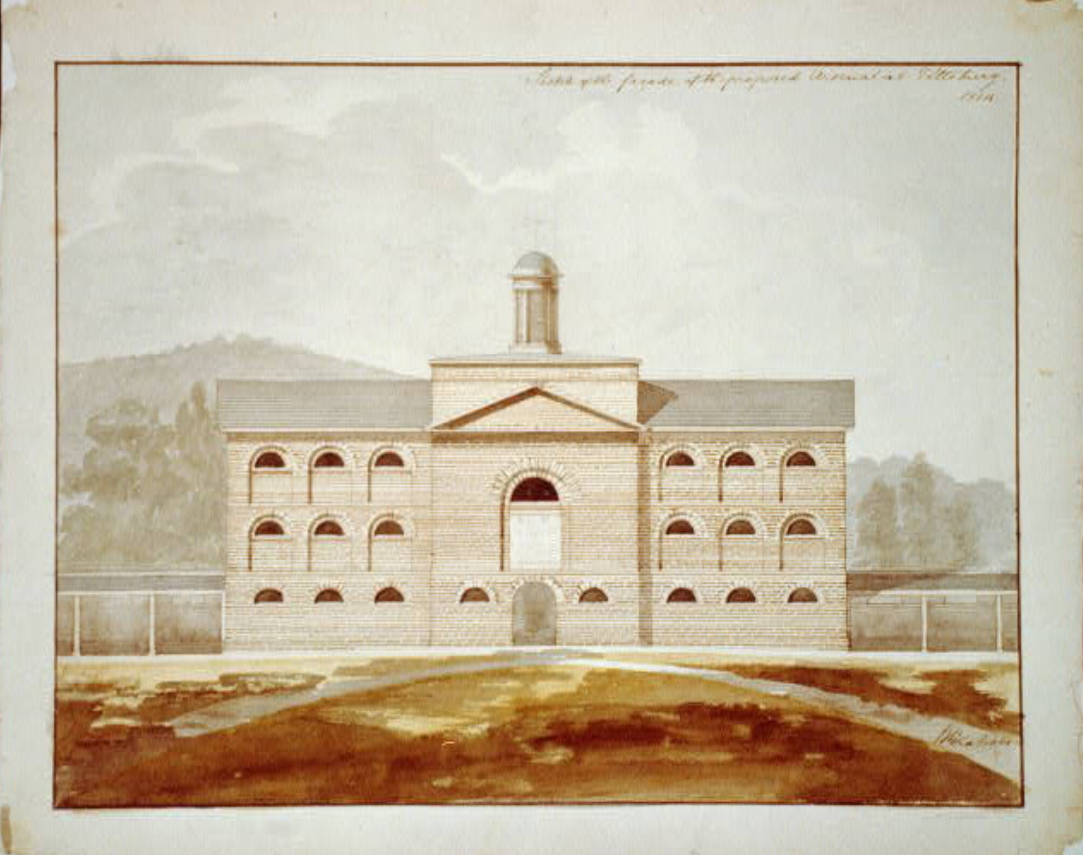
Happy and comfortable Latrobe was not, but at least he kept busy. During the year he reluctantly lived in Pittsburgh he designed and built a theater for the Circus of Pepin and Breschard, and at least three private homes presumably incorporating his favored Greek Revival style (none are known to survive). He also expanded an existing church, built steam engines, and even designed a barge. Latrobe was also commissioned to design the United States Arsenal (later known as the Allegheny Arsenal) building in the Lawrenceville section of Pittsburgh. What was eventually constructed differed significantly from his original plans, which are housed at the Library of Congress. Today nothing remains of any of Latrobe's Pittsburgh structures.


"Sketch of the facade of the proposed Arsenal at Pittsburg. 1814. BHLatrobe." Library of Congress Prints and Photographs Division


Latrobe and family moved back to DC to oversee reconstruction of the Capitol following the fires set by British troops in 1814.  Meanwhile, his son by his first marriage, Henry Sellon Boneval Latrobe, had become a civil engineer known for his railway bridges. In 1811, the senior Latrobe had accepted a franchise to design waterworks systems for the city of New Orleans. His son Henry had then secured the commission for the project, and moved there to began construction. Unfortunately a little war with the British intervened, so Henry fought during the War of 1812. He also found time to design a lighthouse and work on New Orleans' Charity Hospital and the French Opera House. Henry contracted yellow fever in 1817 and died in New Orleans at age 25.

A little more than a year after his son's death, and fresh from bankruptcy proceedings, Benjamin Latrobe left DC for a fresh start and to complete the job his eldest son had started. Benjamin traveled to New Orleans to complete his son's work on the water supply system, and his family joined him the following year. In New Orleans, Latrobe designed the Louisiana State Bank and the central tower with clock and bell of the Saint Louis Cathedral. This tower collapsed in 1850 during reconstruction, but the bell was reused in the new building and remains there today.

But like his son, and so many other visitors to the city, Benjamin Latrobe contracted yellow fever. He died in New Orleans on 2 September 1820. Both father and son were buried in a communal lye pit, a typical method of interment during Yellow Jack outbreaks. The Latrobes are remembered with a memorial marker in Saint Louis Cemetery #1 that was erected by their descendants. 

Latrobe Memorial, St Louis Cemetery #1, New Orleans LA


Latrobe and his second wife Mary Elizabeth Hazlehurst had one surviving daughter, Julia E. Latrobe, who never married. Although she lived to the age of 86, Julia seems not have left anything as a legacy beyond a circa-1812 manuscript in which she recorded dance steps and reminiscences of her childhood, and various party invitations and greeting cards. These items are in the collection of the Maryland Historical Society.

There were two surviving Latrobe sons. 

John Hazelhurst Boneval Latrobe was a Maryland attorney who was retained as counsel for the Baltimore & Ohio Railroad. He had aspired to a career in architecture, but abandoned this idea due to family financial circumstances following his father's death. He was, however, a talented landscape artist and art patron, and illustrated and wrote a drawing manual under the pseudonym E. Von Blom. He was also known to be a prominent supporter of the African colonization of Liberia, a well-intentioned but misguided antebellum movement. John H. B. Latrobe kept a journal called "Southern Travels" written during a two-month period in late 1834. In it, he chronicled his travels with his wife Charlotte from New York to Natchez (where wife had family), and the return trip by stagecoach to their Baltimore home.

John H. B. Latrobe, c.1860-90, photo from Brady negative. Library of Congress Prints and Photographs Division.

Youngest son Benjamin Henry Latrobe, Jr initially studied law under big brother John, working on cases involving his late father's property disputes. He then assisted his brother in drafting provisions for the original Maryland charter of the B&O RR, which involved surveying and field work. This awakened latent mathematical abilities that he decided to pursue. Junior, as he was sometimes known, eventually became chief engineer of the Baltimore & Ohio Railroad, laying out the line between Washington DC and Baltimore and designing the Thomas Viaduct outside the latter city. He had a distinguished career as a civil engineer, and was the guiding force in extending the B&O into Pittsburgh by absorbing a Connellsville railroad company.

Benjamin Henry Latrobe II
 

While the Pittsburgh buildings constructed by Benjamin H. B. Latrobe are gone, Western Pennsylvania residents have an abiding connection to the Latrobe family: the town of Latrobe.

Latrobe, Pennsylvania birds-eye view map circa 1900.
Library of Congress Geography and Map Division.

Ironically, the town has but a tangential connection to the family. According to the Latrobe Historical Society, Oliver Barnes purchased a 140 acre farm in Derry Township in 1851 for the Pennsylvania Railroad, which wanted to connect the eastern part of the state with Pittsburgh and planned to build railroad yards. Pplans changed and the yards were built instead in Derry, so Mr. Barnes acquired the land for himself. He laid out streets and lots and named his new town Latrobe in honor of his friend and railroad associate, Benjamin Henry Latrobe, Jr.  None of the Latrobe men are known to have set foot in the town bearing their surname.

New Orleans, Latrobe's eternal home, remembers him in other ways. Near the French Market arch at Ursulines Street is a small park dedicated to Benjamin Latrobe. The site of this park is actually the former waterworks that father and son designed and created. The park incorporates architectural remnants from the works into its sculptures and fountains.

 
And although the Louisiana State Bank Building at Royal and Conti in the French Quarter no longer functions as such, the building was designated a National Historic Landmark in 1983. It has been home to many commercial enterprises over the years. As of 2014 a wedding and events business operated there on Royal, called Latrobe's.


__________________________________
Further reading:
Baker, Jean H. Building America: The Life of Benjamin Henry Latrobe. Oxford University Press. January 2020.
Eaton, Leonard. Houses and Money: The Domestic Clients of Benjamin Henry Latrobe. William L Bauhan. January 1988.
Hamlin, Talbot. Benjamin Henry Latrobe. Oxford University Press; 1st edition. 1955.
Latrobe, Benjamin Henry. The Journals of Benjamin Henry Latrobe 1799-1820. Yale University Press. 1980.
Latrobe, John H. B. Southern Travels: Journal of John H. B. Latrobe. Historic New Orleans Collection; First Edition. 1986.
The Versatile Benjamin Latrobe
Sutcliffe, Andrea J. Steam: The Untold Story of America's First Great Invention. Palgrave Macmillan. 2004.