|
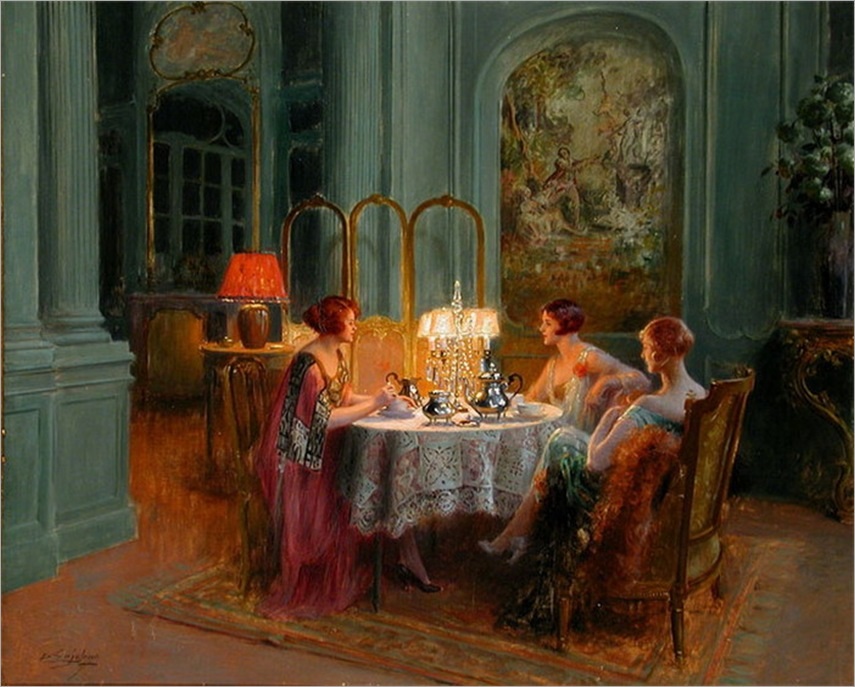
Three Elegant Ladies, Alice Barber Stevens, private collection
|
|
Gossip. Scold. Scandalmonger. Talebearer. Busybody.
History has given us plenty of words to describe someone who talks about
somebody else. Most of those words are weighted with judgement, especially
against women. Extreme measures and regulations have even been designed historically to shut
women up.
But guess what – restrictions never work. People will always talk about
other people. That’s because at its most basic, gossip is about communicating
and connecting. Sharing information about other people creates a bond. Everyone talks about everyone else, in some way, at some
time. We simply find each another too interesting not to do so.
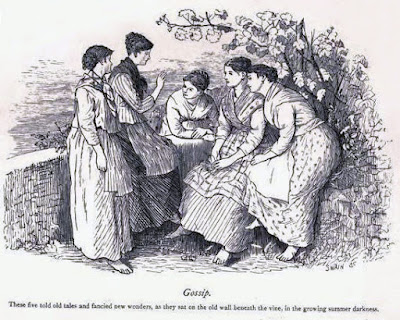 |
| Gossip by Randolph Caldecott in "North Italian Folk" by Mrs. Comys Carr, 1878 |
If knowledge is power, gossip is high voltage. And the Tesla coil of
social currency is gossip revealing human behavior outside of accepted
norms.
In late 18th and early 19th century America, an era
known to us as the Gilded Age, society was thought to function best as a well-oiled machine operating
according to complex social rules. It didn't always work that way, of course, given that this was an era characterized by extremes of both wealth and poverty.
Gilded Age rituals of female upper class Society (yes, with a capital S, for
Self-importance) were especially conducive to telling tales on each other. And the more scandalous the story, the better!
The Débutante Season
“It’s odd, if you think of it,” pondered a syndicated
columnist writing for the New York Tribune in November 1898:
 |
Image from vintage postcard
|
“….that December should be the
buds’ month – that the death of the old year should herald the beginning of the
new life of the young girl. But so it has been for generations of buds and
blossoms. From the 1st of December to the 1st of January
the older women step back, postpone their entertainments and hold themselves in
readiness to welcome the buds, that find in the chill of early winter the
atmosphere to coax their flowering.”
In the 19th and early 20th century,
when such things mattered to the self-defined People Who Mattered, the December
holiday season was known as the débutante season. Young
ladies of standing emerged from private life to be planted in the hothouses of
Society, where they were expected to bloom.
America’s wealthiest were borrowing from British upper-class tradition in pushing their nubile daughters to make formal entrance into Gilded Age Society. The “bud” emerged after years of genteel schooling in which she learned enough to hold her own in polite, cosmopolitan conversation (though not enough
to make her an unwedable intellectual). Once she was deemed to have mastered the era’s etiquette and manners, acquired householding and entertaining skills, and manifested the qualities of pure, chaste, refined and modest womanhood, a young lady was ready to “come out” and be fêted at myriad events throughout the winter
holiday season.
Thus the bud was displayed, a blossoming rose in a crystal vase positioned to catch the light.
Which is to say: appearances mattered very, very much.
A débutante’s preparations began months in advance, for a glow-up of epic proportions. Her life was all about dress fittings, accessory purchases, and fastidious grooming. The era's standard of beauty centered around the glory of a woman's luxuriant long hair, dressed just so. She should also be blessed with bright eyes and clear pale skin, with the flush of youth upon her face (ideally tinted with innocence but, oh, let’s be honest. Subtle powders and cosmetic blushes were sometimes necessary). Rosy lips were only just pinked, as if bitten in tender excitement. Eyebrows were plucked to enhance a natural shape, and shapewear of the day manipulated
figures to accentuate curves (or create them where none existed).
The “coming out” for a daughter of Society started with an event orchestrated by her parents or guardians in December. This was her official debut, but she then would be honored guest (either on her own or with other debs of that season) at myriad débutante galas, dinners, house parties, balls, Christmas cotillions, private club dinners, and at afternoon card and tea parties. There were also mixed group visits (chaperoned, of
course) to the theater, opera, and art galleries.
 |
Ballroom illustration by Alice Barber Stevens, The Ladies' Home Journal, January 1899
|
Not only was the young lady on display at such events but so,
too, was her family demonstrating its wealth and social status within the community. With a daughter’s public emergence, the family signaled that the next generation was prepared to take up its gauntlet of pedigree and privilege.
So, yes, December was Débutante season. And it was one, long, exhausting
performance.
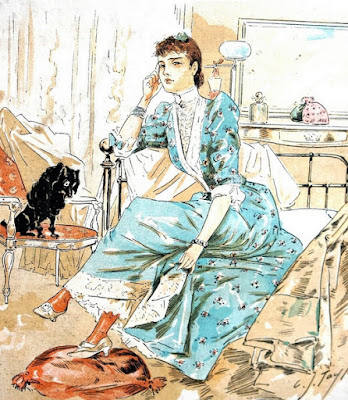 |
| Weary debutante in The Close of the Season, Charles J. Taylor for Puck Magazine, 1890 |
Marriage was a hoped-for goal of the process, to be sure. The coming-out season showcased a young lady's readiness to take on the tasks of true
womanhood, even by those buds for whom no proposals were forthcoming, or who
wished to be left alone to bloom as they chose.
A Bud Emerges
Gilded Age cities glittered with wealthy people flitting from one invitation-only event to another, from December through New Year’s week, all centered around the newest debutantes and encompassing their families and friends. On winter breaks from school, young ladies traveled to attend their friends’ débutante events, placing themselves on display in the process. Eligible gentlemen also home from school for the holidays were especially welcome at these gatherings, often scoring last-minute invitations with ease. Wealthy families made note of debuts elsewhere even if they did not
attend, scouring the marriage markets for suitable prospects for their
darlings. Top tier cities like Boston and New York were the renowned centers of American Gilded Age society, but Pittsburgh had its own close-knit social circle.
Probably more than one Pittsburgh family perused society column mentions in 1905 and read about a New York City débutante, Katherine Varnum Kendall. She came out in style on 27 December of that year, shining at an
afternoon reception hosted at her family’s elegant brick townhouse at the southern edge of Manhattan’s posh Gramercy Park neighborhood.
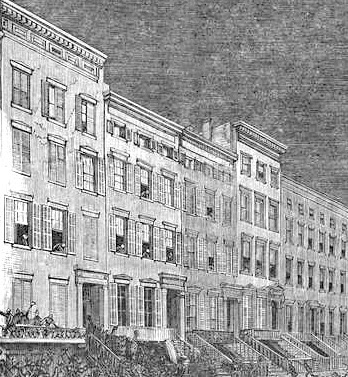 |
Block of Gramercy Park containing Kendall home, mid-1870s, later remodeled.
New York Public Library, Miriam & Ira D. Wallach Division of Art, Prints & Photographs |
As part of the festivities, invited guests attended a
theater party followed by dinner at the exclusive Sherry’s Restaurant at 44
th
Street and Fifth Avenue.
Seventeen-year-old Katherine was considered a “great belle.”
Her successful launch into society reflected well on her parents, Wall Street
broker William Beale Kendall and the former Kate Varnum Whitney, both of Boston
and both with impeccable pedigrees.
 |
New York Times, February 1907
|
In looking back on the season just completed in January 1906,
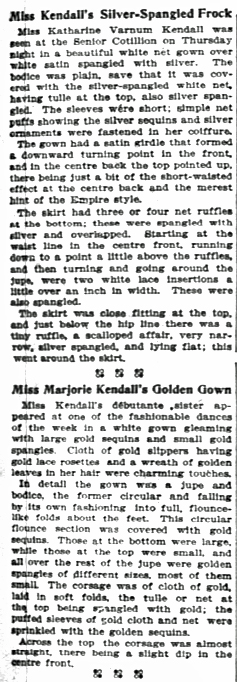
the New York Times singled out Katherine’s debut reception gown. It was described as an appropriately
innocent frock made of “especially girlish white chiffon cloth.” The paper
couldn’t let it go at that, however, devoting considerable space to Katherine’s fashionable confection:
Both the skirt and the bodice were
so fashioned as to suggest the petals of a flower. The bodice had a
round-necked, unlined yoke of Duchess lace, and from this a plain, ungathered
flounce of white chiffon cloth, cut in deep, almost pointed scallops, drooped
over the shirred bodice three-fourths of the way to the girdle, which was of
white satin. Each of the scallops had an edge of white silk ribbon braid, and
in the centre of each point a white rose was embroidered in silk. The sleeves
were short, gathered puffs of the chiffon cloth, and over each drooped three of
the embroidered, bordered, petal-shaped points of the cloth.
Not enough detail? Here’s more!
The skirt is shirred at the top
every inch till it gets below the widest part of the hips. It is of round
length, and opens at the side, to show a series of five lace flounces, varying
from seven to four inches in width, set on to the yellow liberty silk
foundation. At the sides of the skirt openings the yellow chiffon cloth is embroidered
in silver scallops. The lower lace flounce runs all the way around the skirt.
On the chiffon cloth front near the bottom is embroidered a cluster of roses
and leaves in silver. There are yellow velvet roses, dewdropped with crystals,
for the coiffure.
Katherine’s wardrobe created quite the sensation.
In February 1907 the Times published a column about “Miss Kendall’s Silver-Spangled
Frock” and another about her younger sister Marjorie’s golden gown.
The Kendall girls
had drip.
An Uncomfortable Distraction
The Kendall family likely breathed a sigh of relief at
this favorable, if over-the-top, publicity. Two years earlier the family had
been tainted by association by gossip surrounding the tragic demise of the
fiancé of Katherine’s aunt, Helen Whitney.
If that sounds convoluted, well, it was. But remember: even hints
of impropriety could affect social standing.
Katherine’s aunt was Helen Whitney, sister of her mother, Kate
Varnum Whitney. Helen didn't find love until her advanced years, becoming engaged at
the ripe old age of 47. Her fiancé, 55-year-old Frank Griswold Tefft, was a
divorced scion of a dry goods empire who had an adult son from his previous
marriage. Frank divided his time between the Tefft family home in Gramercy
Park and Griswold Lodge, a summer estate in the Berkshires. He was especially
devoted to that country home inherited two years earlier from a
brother. Spinster Helen mostly lived with the Kendall family in Gramercy Park
but she took summer lodgings near Frank.
Alas for true love: like his brother before him, Frank Tefft
had diabetes and Bright’s disease (an archaic term for what we know today as
various kidney conditions). According to published accounts, Frank died at the
Berkshire home in November 1903 on the day he was to announce his engagement to
Helen. She had been with Frank in his final illness, and his will named her as
executor and primary beneficiary.
That was a problem.
Adult son Erastus T. Tefft contested his father’s will,
alleging that Helen Whitney’s “undue influence” had essentially disinherited
him.
After the funeral Helen was comforted at Griswold Lodge by
her Kendall sister and brother-in-law, all garbed in the era’s requisite
mourning attire to honor their various tenuous relationships with Frank Tefft. But
Erastus’ legal challenges allowed him to take possession of his father’s home. Helen,
evicted, returned with the Kendalls to Gramercy Park.
Over the next 18 months the Tefft case was thoroughly covered
in Massachusetts and New York newspapers. Matters were initially settled in
Helen’s favor owing to revelations of long-time estrangement between father and
son. Erastus appealed, and high-powered attorneys argued Frank’s mental
competency before the Massachusetts Supreme Court. Frank’s mental status was
dissected as Erastus’ attorneys argued that he was not “of sound and disposing
mind” due to his failing health. Long-winded testimony from Frank’s personal
valet even brought Katherine’s mother, Kate Kendall, into the fray with hints
of possible inappropriate influence as a witness to Frank’s revised final will and
testament.
Finally in May 1905 Helen Whitney prevailed, having been “a
cool and businesslike witness for her case”. Frank’s finances had always been a mess,
however, and there would not be much left from his estate once creditors made
their claims.
Helen did little to sort matters before suddenly dying in November
1906.
Griswold Lodge was destroyed by fire in March 1907.
And that was the end of that.
Well, not quite. Society has the collective memory of an
elephant. As it unfolded, this saga would have been passed from gossip to
gossip, each probing and savoring the details with the intensity of a sommelier
sloshing his wine. It wasn’t the kind of tale that could tank a family’s
prospects, but it would have provided an uncomfortable distraction.
Unrelated but positive attention to Katherine Kendall’s debut restored
luster to the family name and was a welcome return to sober respectability. Younger
sister Marjorie Kendall’s debut came a year later in 1907, slightly delayed owing to a
social pause for the requisite mourning following Aunt Helen’s untimely
passing.
And in the midst of all that came the announcement of Katherine’s
engagement to a Pittsburgh boy.
A Son of the
well-known Pittsburg family of that name
Like every Gilded Age metropolis, Pittsburgh’s distribution
of wealth was disproportionate to its population, even if not on the scale of
New York or Boston. The upper echelon of Pittsburgh’s Society was smaller, but it
hummed along to a tune with predictable rhythms, rules, and hierarchies. As in
other cities, there was Old Money and New Money here – quite a lot of money,
actually. While not ranged in opposition, with Old Money “silk hat millionaires”
looking down upon New “shirt sleeve millionaires,” there were occasional
side-eyes cast at the pretensions of Pittsburgh’s nouveau riche. Mostly, though,
Pittsburgh’s monied class got around its differences through intermarriage, Old to New,
thereby replenishing itself with cash-rich local blood. Everyone knew everyone, because everyone was
pretty much related. If some of the Old blue blood was tinged with iron and steel from the fortunes of New money, well, that's what unspoken social hierarchies were for.

 Founding families like Denny and O'Hara dominated Pittsburgh’s social hierarchy. Both descended from patriarchs who made
names and fortunes during colonial frontier and
Revolutionary eras, became major landowners, and took on civic, charitable, and
business leadership roles in early Pittsburgh. Politics figured into this mix, but although James O’Hara was chief burgess of Pittsburgh in 1803 and Ebenezer
Denny the newly incorporated city’s first mayor in 1816, political office
was the least important ingredient in their recipes for success.
Founding families like Denny and O'Hara dominated Pittsburgh’s social hierarchy. Both descended from patriarchs who made
names and fortunes during colonial frontier and
Revolutionary eras, became major landowners, and took on civic, charitable, and
business leadership roles in early Pittsburgh. Politics figured into this mix, but although James O’Hara was chief burgess of Pittsburgh in 1803 and Ebenezer
Denny the newly incorporated city’s first mayor in 1816, political office
was the least important ingredient in their recipes for success.
Simply put,
Pittsburgh would not have developed into a 19th century powerhouse
of industry without the foundational influence of Denny and O’Hara visions,
fortunes, and connections.
These two families were united in 1817 by the marriage of Ebenezer’s
son Harmar Denny and James’ daughter Elizabeth O'Hara. While not all their dozen
children survived into adulthood, those who did perpetuated family standing,
both in deed and progeny.
They also reused names, in that charmingly confusing 19th
century way, which is how in subsequent generations one of Harmar’s grandsons was
graced with the name Harmar Denny Denny (perhaps to distinguish him from an
uncle, Harmar Denny, although that hardly seemed necessary since said uncle had
become a Jesuit priest).
We will assume the reduplicated names did no
lasting psychic harm, since Harmar Denny Denny named his eldest son Harmar Denny Denny, Jr. (The name
lapsed in the next generation after infant Harmar Denny Denny III died).
His other son was mercifully called after his
mother’s side of the family, named Archibald Marshall Denny. This was the
lad who would win Katherine Varney Kendall’s heart.
The Denny boys were brought up in an atmosphere of privilege
in a home on Ridge Avenue, which was the “millionaire’s row” of old Allegheny
City, twin to Pittsburgh before it was annexed in 1907. A description of
Archibald Marshall Denny’s catered third birthday party from Pittsburgh society
columns gives a hint of his doted-upon upbringing:
….the children’s party will be a
very pleasant affair for the little people. Archibald’s brother, Harmar, who is
4½ years old, also comes in for a share of the honor. A room full of
interesting toys will be at the disposal of the little guests and a fish pond
will furnish them a happy amusement. Each child has a hook and line and fishes
over a screen for a toy. Supper will be served by Hagan at 6 o’clock.
Harmar D. Denny, Sr.’s lineage and assets were as
representative of Old Money in 19th century Pittsburgh as one could get. He
spent his life managing family wealth and real estate holdings and serving
various pillar-of-the-community roles. The Denny boys attended
Allegheny Preparatory School, a short-lived private school for the monied set
that their father was instrumental in founding. Both boys were active in sports, including swimming and diving.
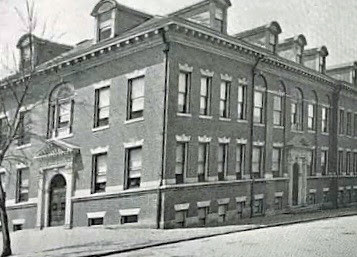 |
Allegheny Preparatory Academy from 1904 yearbook
|
Each boy then boarded at the exclusive St. Paul’s School
for Boys in Concord, New Hampshire. Harmar, Sr. had attended Pennsylvania
Military Academy and actively served in the National Guard, which was
sufficient in his era to give him respectable credentials. But as the world
required more of young men in the waning years of the 19
th century,
he and wife Elizabeth wanted their sons to received top notch educations according
to East Coast Society standards. Oldest son Harmar was a stellar student at Yale, and younger
son Archibald Marshall was expected to follow in his footsteps.
Various newspapers noted that in 1906 the Denny family
summered in Maine. Coincidentally,
the Kendall family also summered on the Maine coast's fashionable Gilded Age
retreats for the wealthy.
At some point a summer romance bloomed
between the girl from New York and the boy from Pittsburgh. Marshall, as he seems to
have been familiarly called, was a tall, slender young man with
grey eyes and brown hair. Katherine was described as a “vivacious girl, full of
laughter and high spirits.”
On 12 December 1906, New York Times announced
their engagement, publishing Katherine’s photograph a few weeks later in its pictorial supplement.
The announcement added that there were no immediate plans for marriage since Marshall
was still a student at St Paul’s School, and that "he will probably finish at Yale before the wedding.”
Pittsburgh papers made no mention of the engagement but, no matter, New York had spoken. A suitable match had been
made between two young people from respectable families.
Marriage, thought the
parents, could wait.
Miss Kendall and Mr. Denny Thought Differently
Even after the Times announced his engagement, nothing
seemed to interrupt Marshall’s fun in Pittsburgh. Local Pittsburgh papers still
included him in attendance at holiday parties, charity balls, and other events for the “younger set” throughout the 1906-7 season.
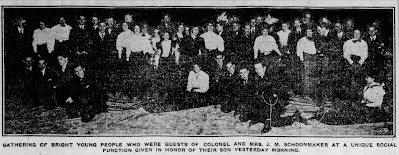 |
Marshall attended this January 1907 "Fashionable Ice Cotillion" at Duquesne Garden, 5 January 1907. Pittsburgh Post.
|
He went back to school at St. Paul’s in mid-January 1907. The Kendall family launched younger daughter Marjorie as a late season débutante. Papers in their respective cities announced that the Dennys and the Kendalls were spending their summers in Maine again.
And then, on 28 September 1907, the New York Herald
breathlessly announced a (gasp!) secret marriage.
New York, September 28
– New York society will be greatly surprised to learn of the secret marriage
yesterday of Miss Katherine V. Kendall, daughter of Mr. and Mrs. William Beale Kendall,
of No 12 Gramercy park, to Mr. Archibald M. Denny, the son of Mrs. and Mrs. Harmar
D. Denny, and a member of a prominent and wealthy family of Allegheny, Pa.
To intimate friends of the
families only Miss Kendall and Mrs. Denny announced their engagement more than
a year ago, but it was not made publicly, and their parents had not favored an
early marriage on account of the youth of both, Miss Kendall having been
introduced to society only recently.
But Miss Kendall and Mr. Denny
thought differently, and after a summer spent at York Harbor, Me., they could
not bear the thought of a separation even for another winter. Mr. Denny only
returned from Maine a few days ago and joined his parents, who are stopping at
a New York hotel.
A member of the bride’s family
said tonight that they would have preferred a handsome wedding for Miss
Kendall, but that the more conventional way the young people had chosen was
entirely satisfactory.
Thing is, there was nothing conventional about this, nothing
at all.
Why would two young people with everything in their favor rush a marriage that would have united Pittsburgh and New York society like nothing previously?
Unless...unless...they HAD to get married....
Of course, nothing like that could be speculated upon in public. But the press scented a story and pursed it like bloodhounds at the chase, outdoing each other in reports about what was known and not known. Every article made sure to include some statement about the wealth and lineage of the families involved. If they didn't quite get the facts straight, well, that was all right. Readers were still hooked.
New York Tribune fleshed out the story a few days after it broke:
Miss Katharine Kendall and
Archibald M. Denny were married on Saturday at the Church of St. Mary the
Virgin, in West 46th street, shortly after the departure of the
bride’s parents….for Lenox. Mrs. and Mrs. Kendall had wished to delay the
wedding until the spring, owing to the youth of the bride, but the latter was
unwilling to wait so long, and on Saturday evening dispatched a telegram to
Lenox informing her parents that she had been married in the afternoon,
receiving their forgiveness and blessing over the wire. Miss Annie Livingston
Best and her fiancé, Elizur Yale-Smith, who are to be married on November 6,
officiated as witnesses of the ceremony and as bridesmaid and best man.
Philadelphia Inquirer weighed in reprovingly (and misspellingly):
Special to The Inquirer
PITTSBURGH, Sept. 30.
– Instead of going back to his studies, at Yale College, as he was supposed to
do, Archibald M. Denny, son of Harmer Denny, of this city, eloped....Young Denny is 19 years of age, his bride, Catharine, is about
the same age. They were married at a parsonage. The Dennys own the greater part
of the lower section of Pittsburg. It has been announced that the young couple
will take a wedding trip and have been forgiven. Young Denny had a military
career cut out for himself, for his paternal grandfather, Major Harmer Denny,
was a great soldier against the British and Indians in 1812. His entry into
West Point as a student is blocked.
What did Yale think? Well, New Haven's Morning Journal-Courier tsk'd over the groom's rejection of a Yale education, and implicated stalwart brother Harmar, Jr. by association.
Archibald M. Denny of Allegheny, PA., will not follow in the
footsteps of his brother, Harmar Denny Denny, who is a prominent member of the
academic senior class at Yale, for yesterday the news of his elopement with
Miss Katherine V. Kendall of New York leaked out. Young Denny has given up the
idea of coming to college, and will go to work in Pittsburg. He is only
nineteen years old, and his bride a year younger.
Fearing that they could not obtain their parents' consent to
their marriage on account of their youth, the young couple slipped out of Miss
Kendall’s home in New York last Saturday and were married by the Rev. Dr.
Wilson of the Church of St. Mary the Virgin.
A telegram to the bride’s parents, announcing the marriage,
brought a reply with the parental forgiveness. When Miss Kendall made her debut
last winter Mr. Denny was studying at St. Paul’s school preparatory to entering
Yale.
Mr. Denny is descended from one of the wealthiest and most
famous families of Pittsburg. His ancestors went to Pittsburg when the place
was a wilderness and acquired great tracts of real estate, much of which the
family still holds.
Everyone loves a scandal. News traveled far and wide, with extra-value drama like Meadville
Evening Republican's attention-grabbing headline and get-away vehicle:
Pittsburgh, Pa., Oct 1. – All
efforts of the parents on both sides to check the courtship of Archibald M.
Denny, of Pittsburg, and Miss Katherine V. Kendall, of New York, proved
unavailing as it is given out here at the home of the wealthy young groom that
the couple eloped in an automobile to the residence of a minister last Saturday
afternoon in New York and were married instead of going to school as had been
ordered. Young Denny is heir to a vast fortune and a Yale student with a career
at West Point ahead. The young lady was the daughter of William Beals Kendall,
of No. 12 Gramaroy [sic] Place, New York, and it was in the absence of her parents
Saturday afternoon that Denny in his big touring car came and took her away.
Even the Washington Post got in on the action, albeit with a more sympathetic report:
The marriages in society that
have resulted most unhapily [sic] were those performed with the greatest pomp.
Without wedding cake, stiff satin, and the reception ordeal, Miss Katherine
Varnum Kendall and Mr. Archibald Marshall Denny were married on Saturday
afternoon with two sympathetic witnesses, Miss Annie Best and Mr. Elizur Yale
Smith, whose wedding will take place on November 6.
Miss Kendall is a daughter of
Mr. and Mrs. W. Beals Kendall, of Gramercy Park. Her great-great-uncle was Ger.
James Varnum, of revolutionary fame. On the paternal side she is a
granddaughter of the late Isaac Kendall and a great granddaughter of the late
William Beals, owner and editor of the Boston Post for about forty years. Her
mother, Mrs. Kendall, was Miss Kate Varnum Whitney, of Boston. Mr. Denny is the
younger son of Mr. and Mrs. Harmar D. Denny, and a member of one of the oldest
and wealthiest families in Pittsburg. The Denny home is on Ridge avenue, the
fashionable residence district of Allegheny. They have a country residence at
York Harbor, Me., where Mr. and Mrs. Kendall also spend their summers.
There was certainly no way Pittsburgh papers could ignore
all this. On 29 September 1907, headlines blaring, the Press reprinted the Tribune’s breaking
story. By contrast, the Post printed
a sedate version on 1 October, the day the Denny parents were
expected back in Pittsburgh:
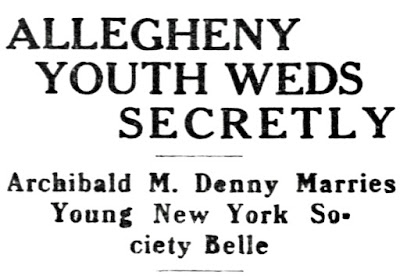 |
Pittsburgh Press, 29 September 1907
|
Putting Out Fires of Inflamed Passion
So how do you get ahead of such drama?
Well, first you hide. If indeed the newlyweds took an impromptu
wedding trip, they did so discreetly. It was probably a relief to their families to have them out of sight for a while.
Meanwhile, New York papers officially published the marriage notice.
Someone from one of the
families, presumably in New York, poured their version of the truth into a
sympathetic ear at the
New York Times in an attempt to take control of the
story. The following was accordingly published in a
Times column
on 13 October 1907:
Mrs. Archibald Marshall Denny….was
Miss Katherine Beals Kendall, and her romantic elopement with Mr. Denny was
told in THE TIMES of the morning after it occurred. A lot of nonsense was
written about this elopement. As a matter of fact, the couple, who were very
young, had been engaged three years, and, while their engagement was mentioned
in these columns about a year ago, no formal announcement was to have been made
by the Kendalls until much later. Mr. Denny had left St. Paul’s School to go
into business, and, being tired of waiting for parental consent to an early
wedding, the two seized the opportunity afforded them by the absence of Mr. and
Mrs. W. Beals Kendall from the city to get Miss Annie Livingston Best and her fiancé,
Elizur Yale-Smith, who are to be wed
Nov. 6, to accompany them to the church, where they were married. This was at 5
o’clock in the afternoon, and a dinner followed, telegrams announcing their
wedding having been sent to Pittsfield, Mass., where the Kendalls were, and to
Allegheny, Penn., where Mr. Denny’s parents reside, and forgiveness having been
wired back, all went well. There was no running away from school, as Mrs. Denny
had made her debut eighteen months before. The Dennys are among the best-known
and richest people of Western Pennsylvania, and had no more objection to the
match than the W. Beals Kendalls had, both, however, thinking the two too
young.
Mrs. Denny, through her father,
is a granddaughter of the late Isaac Kendall, a prominent shipping merchant of
Boston, and a great granddaughter of the last William Beals, for many years
publisher of The Boston Post. Her mother, before her marriage, was Miss Kate
Whitney of Boston. She is about nineteen and Mr. Denny is about twenty-one.
Taking control of the narrative was critical as another débutante season loomed. Its myriad Society gatherings could mean a potentially unchecked wildfire of gossip raging about both families. Newspapers around the country were still publishing wire service reports well into December 1907 about how the "son of Horner Denny" engaged in a "furious automobile drive" for his "runaway wedding", detailing how "young Denny dashed up in an automobile to the school his sweetheart attended in New York. In a jiffy she was out and speeding away with him. Before the spin was finished they were man and wife."
The families did not dignify any of that with responses, choosing to ignore rather than protest. The newlyweds quietly moved into the Denny family home on Ridge Avenue, far from sister Marjorie Kendall's upcoming Christmas season in Manhattan. It was bad enough that Marjorie's debut had been postponed due to Aunt Helen's untimely death. Having the unconventional Denny bride crossing paths in New York with her sister the budding deb simply wouldn't do!
With the newlyweds on a wedding trip (or at the very least hiding out from Society), controlling the narrative meant holding heads high. It must have been decided that to douse the flames of gossip, Katherine needed to be boldly and conspicuously present. So the Dennys closed ranks and likely called in favors. By December, a concerted effort was underway to introduce and welcome young Katherine as the newest member of this storied Pittsburgh family. There were daily press mentions throughout the 1907 Pittsburgh débutante season showcasing luncheons, card parties, receptions, and galas, all organized for the new Denny bride.
Pity the poor Pittsburgh débutante of 1907, forced to compete with Katherine Kendall Denny, whose presence would have sucked up all the oxygen in the room! Anyone who was anyone in Pittsburgh society turned out to meet and greet Katherine, driven as much by solidarity with the Denny clan as their own curiosity.
The grandest event among dozens was a high profile reception given by Katherine's new mother-in-law, doyenne of Pittsburgh society Elizabeth Marshall Denny. This was a "charmingly appointed" and "very beautiful affair...with the environment of one of the most attractive homes on the North Side" where "all society stirred itself to make her welcome and to do honor to the new member of one of Pittsburg's oldest families."
Finally, after a whirlwind introduction to Pittsburgh, in February 1908 Katherine went back to New York to visit her family. She came back a few weeks later but since the Pittsburgh social scene was always quiet in spring, she remained out of the news. The couple then joined Katherine's family to get away in early summer, not in Maine per usual but at a resort town on the New Jersey shore.
And then in August came the announcement that everyone must have been waiting for.
Did you do the math? You can bet everyone else did.
According to the birth announcement, baby Archibald Marshall Denny, Jr. was born fully eleven months after his parents eloped.
So...they didn't HAVE to get married?
For all the tongues that wagged in multiple cities, for all the scrutiny that must have been directed at Katherine's waistline when she walked into those endless social events in Pittsburgh, for all the whispered suspicions about, well, just how old was that baby REALLY (because honestly, who knew for sure?)....nothing happened.
So there's no real kicker to this story. We can wonder if Marshall and Katherine had regrets about their early start, about their impetuous courtship
and marriage, but the public record is silent about that. It does reveal
that their 43 years together seem evenly divided between, first, Pittsburgh, and
then, Massachusetts. While Marshall may have intended to enter business
when he disdained college, it's not clear that he ever really settled on
what that was supposed to mean. Katherine, at least, maneuvered and bloomed in Society circles wherever
she was planted. Two more children would
follow: Katherine in 1910 and son Kendall in 1912. The couple watched their children grow, tragically lost their youngest son at 25, and knew their grandchildren and great-grandchildren. Descendants of all three children are alive today.
That unconventional marriage decision, whether for love or necessity or a little of both, paused Society for the briefest of moments. It was a scandal, and then...it wasn't. Society continued to spin smoothly on its axis, at least for a while longer. The
challenges of the modern era fragmented those old world values
and ways of reacting.
But one thing hasn't changed. We still like to talk about each other.
 |
High Tea and Gossip, Delphin Enjolras, before 1945, private collection
|


.png)