Showing posts with label Thomas Jefferson. Show all posts

25 July 2012

The winners write history. What happens to the losers?

Having spent the last couple of years focusing on United States colonial and Revolutionary history on our family vacations, I've often wondered about the fates of those on the losing sides of war. When an ARTICLE showed up on my Facebook feed a few months ago about the preservation of Camp Security, a Revolutionary era POW camp located east of the City of York, PA in Springettsbury (then Hellam) Township, I dug around online for more info about those who supported and fought for British colonial interests. 
Camp Security was built in 1781 primarily to detain British troops and their families who were surrendered by General Burgoyne at Saratoga, New York. 

Surrender of General Burgoyne by John Trumbull

On October 17, 1777 British General John Burgoyne surrendered his army of 5000+ according to the terms of the Convention of Saratoga, which specified that the captured troops would be sent back to Europe following a parole if they pledged not to return to the colonies to continue fighting. But the Continental Army under the command of General George Washington did not trust that these terms would be honored, and therefore stalled the prisoner release, eventually forcibly removing them to remote locales. In addition to distrust about the terms of the Convention being honored, there was perhaps also an element of retaliation for the notoriously poor treatment by the British of Continental POWs. 
Thus it was that in 1779 some 3700 Convention Army prisoners, including many from Brunswick-Lüneburg under the command of Major General Riedesel, were marched 700 miles. This journey took them from Boston, through the York/Lancaster area, to Albemarle Barracks in Charlottesville VA near Thomas Jefferson's Monticello. Along the way, lore has it that some Hessians were helped to escape by German residents of the eastern Pennsylvania counties they passed through, who sympathized with countrymen pressed against their will into foreign service by their princes. 
The men proceeded on foot and their wives and children in wagons. This march took over three months, and the last leg was particularly harsh since winter had set in. Upon arrival, the prisoners discovered that only half the huts has been completed, and many of those were roofless. There was no food and no infrastructure in place. The men themselves eventually cleared an area six miles in circumference, building hundreds of huts, two churches (Anglican for the British and Lutheran for the Hessians), a tavern (huzzah!), theater and billiard hall.

Ablemarle Barracks, 1789 sketch.

It was better than nothing, but no posh resort. In his journal,Lieutenant August Wilhelm Du Roi of Brunswick wrote:

Each barrack is 24 feet long, and 14 feet wide, big enough to shelter 18 men. The construction is so miserable that it surpasses all that you can imagine in Germany of a very poorly built log house. It is something like the following: Each side is put up of 8 to 9 round fir trees, which are laid one on top the other, but so far apart that it is almost possible for a man to crawl through ... The roof is made of round trees covered with split fir trees...a great number of our men preferred to camp out in the woods, where they could protect themselves better against the cold than in the barracks.

The prisoners remained in Charlottesville until October 1780. Security concerns prompted by the defection of the general in charge of their camp and the advancement of British troops through the South led to the prisoners being marched north again, this time over the  Appalachian Trail. They stayed briefly at Winchester, Virginia and at Fort Frederick in Maryland (from which 40 Hessians were paroled to Fort Roberdeau in Sinking Spring Valley on the Bedford County frontier in order to mine and smelt lead for the use of the Continental Army). Congress then ordered the group to move yet again to the security of interior Pennsylvania. This entailed another brutally difficult march over rough terrain in bad weather, and many died along the way. 
They were joined by British captured at Cowpens, South Carolina and eventually British and Hessian prisoners captured at Yorktown, Virginia.  The president of Pennsylvania (there have been seven presidents and 46 governors of Pennsylvania to date) ordered that the prisoners be split. Most Hessian POWs were moved outside of Reading, and the British were housed at what became known as Camp Security. Outside of the stockade in which prisoners were kept (particularly those last captured from Yorktown), a second village called Camp Indulgence was built to house some non-commissioned officers, women and children. 
The prisoners were lucky to be alive at this point. A contemporary account described them thusly:
I never had the least idea that creation produced such a sordid set of creatures in human figure-poor, dirty, emaciated men, great numbers of women who seemed to be but beasts of burden, having a bushel basket on their backs by which they were bent double. The contents seemed to be pots and kettles and various sorts of furniture. Children peeping through the gridirons, some very young infants who must have been born on the road, the women in bare feet, clothed in dirty rags.
At its peak, Camp Security housed 1500 individuals. It was guarded by York County militia and Continental troops until the war ended in 1783. The Camp Security website indicates that the longest-held prisoners and their families engaged in making lace, spoons, and buckles, and were even granted passes to York to sell these items to the local communities. There are also accounts that some prisoners were paroled to local farmers as indentured servants, to help with farming during what was essentially a wartime manpower shortage. A contemporary account of life at Camp Security was provided in the published wartime journal of Sergeant Roger Lamb, an Irishman who served with Burgoyne and who later escaped from Camp Security. His account indicates that with the passage of time, these troops and their families became accustomed to their lives and imprisonment, and did not try to escape:
I was astonished at the spirit of industry, which prevailed among them. Men, women and children were employed making lace, buckles, spoons, and exercising other mechanical trades, which they had learned during their captivity. They had a very great liberty from the Americans and were allowed to go round the country and sell their goods, while the soldiers of Cornwallis' army were closely confined. I perceived that they had lost the animation, which ought to possess the breast of the soldier. I strove by every argument to rouse them to their lethargy. I offered to head any number of them, and make a noble effort to escape into New York and join our comrades in arms; but all my efforts proved ineffectual.
After the struggles and forced marches of their early years of imprisonment, it seems only natural that the prisoners and their families finally felt safe and well-treated enough that they weren't willing to consider venturing forth unprotected to pursue other fates, even if it meant their freedom. They knew the war wouldn't last forever, and were content to wait things out rather than take matters into their own hands whilst living in the midst of enemy territory. Or perhaps they were simply exhausted and only the will to survive was left in them.
Meanwhile the near-by market town of Reading, Pennsylvania had a population of some 300 families of German descent. A section had been set aside there for barracks to house 400-500 men, mostly officers. But by October 1851, the area housed as many as 1050 Hessian soldiers. Laura L. Becker of Clemson University has speculated that the primarily German residents of Reading lost their earlier sympathies and were resentful of their countrymen, noting "One German officer wrote that the German-Americans of Reading "could hardly hide their anger and hostile thoughts.""  Many of these former Hessian captives stayed in the area after the war ended and were referred to as "Brunswickers and Hanauers" in local church records. Becker notes that "....the expression "Du bist ein Hesse" was an insult in Reading well into the nineteenth century." 
What happened to all these folks? From the Convention Army sent to Ablemarle Barracks, General Riedesel and his wife were transferred to New York. He spent a year on parole there before being exchanged for American General Benjamin Lincoln, and returned to Europe in late 1783. British commander William Phillips was also sent to Virginia with the Convention Army, and at one point during his captivity was entertained in the Monticello home of Thomas Jefferson -- quite a civilized POW experience! Jefferson described him as the proudest man of the proudest nation on earth."  Phillips was also included in the exchange for Lincoln. He returned to fighting for the British but contracted typhus and died a few months before the battle at Yorktown. 
As for the surviving soldiers and remaining officers, a camp epidemic raged in the winter of 1782-1783 and many were then buried on site. After the Treaty of Paris was signed in 1783, some former prisoners stayed in the United States, but others returned to their former homes abroad or moved to Canada. As noted above, many of the Hessians who were refused transport back to Germany settled in the Reading area. The land occupied by Camp Security was returned to its owner, and the encampment slowly deteriorated over time and returned to the wild. It's thought that older homes in the York area were probably built in part from harvested lumber from the site.  This York home, for example, is reportedly intact from the Camp Security stockade complex:  

The Camp Security site is one of, if not the last, remaining undisturbed Revolutionary War prisoner-of-war camps. In May 2012, the non-profit group The Conservation Fund announced its purchase of a 47-acre property that was the primary site of Camp Security, assuring preservation for future archeological excavation and documentation. There is much to be explored: the stockade and cemetery sites have yet to be determined on the property. And in another of those neat bits of historical connectivity that I love, a new historical marker was placed just last week in Charlottesville VA to mark the site of the Ablemarle Barracks. 
It is good to know that the struggles of these prisoners will not pass unheeded into history. We may never know their individual stories, but the findings from exploration at Camp Security should yield fascinating information about their daily lives.  That info would have been lost had a housing sub-division been built on the land.
____________________________________________________
Selected bibliography and further reading:
 Chase, Philander (1983). "Years of Hardships and Revelations: The Convention Army at the Albamarle Barracks, 1779-1781". The Magazine of Albemarle County History (Charlottesville, VA).
 du Roi, August Wilhelm. Journal of Du Roi the Elder: Lieutenant and Adjutant, in the Service of the Duke of Brunswick, 1776-1778.

09 June 2012

Forgotten History: The Latrobe Family

Pittsburgh has always been this nation's industrial center. Before we were the Steel City we were the Iron City, and arguably we could also have called ourselves the City of Glass or even the Steamboat City.

All of those titles illustrate Pittsburgh's role in shaping this country, often quite literally in terms of infrastructure production. Still, unless it's about the making of steel, we tend toward a communal inferiority complex when it comes to recognizing our central place in national history. 

Everyone, at any point in time who aspired to national prominence has had a connection to Pittsburgh.  Some stayed here, some strayed; some got rich and some didn't. The list of important Americans whose careers were shaped between these three rivers is mind-boggling.

Take, for example, Benjamin Henry Boneval Latrobe, one of the first formally-trained, professional architects in the United States.

(He was also, it must be said, a hottie).

Benjamin Henry Boneval Latrobe, 1804, by Charles Willson Peale


Latrobe has been described as the "Father of American Architecture" and credited with professionalizing architecture in this country. The way he thought about building design had a profound effect on architects up until the Civil War era. He spent at least a year of his life in Pittsburgh, but that time period is usually glossed over in biographies of this man.

Charles Frederick von Breda portrait of Latrobe, c. 1790


Born to a Moravian minister in a small town near Leeds, England, Latrobe acquired extensive education and traveled throughout Europe. Following the death of his first wife, Lydia Sellon, he left his two surviving children and immigrated to the United States in 1796 to make his fortune. Charming and quickly connected to all the right people, and armed with stellar design and engineering skills, Latrobe was able to quickly launch a career in a country longing to establish its own grand architecture.

Latrobe knew everyone who was everyone. Here's a profile sketch he "stole" of President George Washington in 1796 while dining at Mount Vernon.

Latrobe's sketch of President Washington, 1796. Courtesy of the Frick Art Reference Library.
Original in Mt. Vernon Ladies Association collection. 

Latrobe is credited with introducing Gothic Revival style to American domestic architecture, and with creating private and public masterpieces. He also became friendly with Thomas Jefferson and is considered to be a major influence on Jefferson's design for the University of Virginia. The two men shared architectural interests and ideas, but tension existed over the predominance of Greek revival symbolism which Latrobe popularized in his designs. The White House Historical Association notes that Jefferson often contributed his own design ideas, which stressed their working relationship. Latrobe wrote on one such occasion “I am sorry that I am cramped in this design by his prejudices in favor of the old French books, out of which he fishes everything..." That's not at all surprising, given Jefferson's Francophilia.

Latrobe's White House plans, circa 1807. Library of Congress Prints and Photographs Division.

Despite their differences of architectural opinion, in 1803 Jefferson appointed Latrobe to the position of "Surveyor of Public Buildings" and charged him with constructing the south wing of the Capitol Building in Washington DC. This was a much needed appointment for Latrobe, who was constantly plagued with money troubles. He also had a reputation of being a high-strung perfectionist who could be difficult to work with.

The life of an architect and engineer during this period in history was an itinerant one: you went where the work was. Latrobe worked steadily, receiving commissions for public and private buildings and infrastructure in Baltimore, Washington DC, and Philadelphia. But he needed a new gig in 1813 following the Congressional termination of his position as Surveyor of Public Buildings in DC. The War of 1812 had interrupted building projects in the cash-strapped nation, and Pittsburgh seemed to be the place to go for various reasons.

In coming to Pittsburgh, Latrobe was following a path laid out a few years earlier by his eldest daughter Lydia and his son-in-law Nicholas Roosevelt (of the Oyster Bay branch of that family). That couple had married some years earlier, a union that was against Latrobe's wishes given that Nicholas Roosevelt was his own contemporary in age and a close friend. Roosevelt had become enamored of Latrobe's daughter Lydia when she was only 12 years of age. Latrobe found the romance between his friend and the young daughter of his first marriage at best laughable and ultimately preposterous. He incredulously wrote to Roosevelt "Were you really serious?" when he broached the subject of marriage.

Serious they were. Despite various restrictions and multiple delays, the unlikely couple married in 1809 when Lydia was 17 and Roosevelt 41 years of age. Benjamin Latrobe was well-established enough in Washington society that Dolley Madison attended their wedding.

Lydia Latrobe Roosevelt, from Mr. Roosevelt's Steamboat by Mary Dohan


Latrobe had finally given his blessing to this match and passed along a formal letter of introduction to the newly-wed Nicholas Roosevelt, who came to Pittsburgh in 1809. Roosevelt had been hired to make a flatboat survey voyage down the Ohio and Mississippi Rivers on behalf of Robert Fulton and Robert Livingston. The trip was meant to determine the feasibility of navigating those waters and hopefully position Pittsburgh as a center of large-scale steamboat construction. Roosevelt agreed to go for a $600 fee -- and so did Lydia Latrobe Roosevelt!

Traveling some 2500 miles during Lydia's second and third trimesters of pregnancy, the couple sailed the Ohio and Mississippi Rivers and back in six months. Lydia is said to have designed and furnished comfortable living quarters aboard the flatboat. Their adventures were the stuff of legend and included encounters with potentially hostile Natives and definitely hostile alligators.  Lydia gave birth to their first child, a daughter named Roseta, in January 1810 after the couple returned to New York from their trip.

Nearly two years later, the Latrobe-Roosevelt family set off again, this time on a side-wheeler steamboat. Nicholas, an 8-months pregnant Lydia, toddler Roseta and their Newfoundland dog Tiger left Pittsburgh on the first steamboat voyage ever. Their ship, New Orleans, had been constructed at a yard at the bottom of Boyd's Hill along the banks of the Monongahela River (below where Duquesne University would later be built). This journey took 12 weeks. The Great Comet of 1811 kept them company along the way -- as did little Henry Latrobe Roosevelt, born shortly after they set out October 30, 1811. It's fair to say that the era of steamboat travel was also born on this voyage that originated from Pittsburgh. From 1811 to 1888, boatyards along the Monongahela River produced more than 3,000 steamboats.

Despite the success of the New Orleans, the relationship between the Latrobe-Roosevelts and Robert Fulton was a fractious one. Benjamin Latrobe stood up for his son-in-law in the ensuing business battles. While perhaps wary of Fulton, he remained excited about the future of steam travel and on 13 October 1813, the financially pressured Latrobe moved to Pittsburgh.

Latrobe had hopes of prospering in a steamship partnership with Robert Fulton. The relationship made sense, for Latrobe was an early proponent of steam power, having constructed various steam-powered waterworks in US cities to pipe water into homes. However, a lack of capital, managerial conflicts, competition from established steamboat builders, and a sluggish national economy doomed this Pittsburgh steamboat partnership.

As an agent for Fulton's Mississippi Navigation company, Latrobe engaged in very public disputes over steamboat technology patent rights, writing letters like this one that were published in Pittsburgh's newspapers:

Pittsburgh Weekly Gazette, 22 July 1814


But for all that, Latrobe didn't much appreciate Pittsburgh. He wrote to a friend that "Mud and smoke are the great evils of this town. Whoever can make up his mind to breathe dirt, and eat dirt, and be up to his knees in dirt, may live happily and comfortably here." 

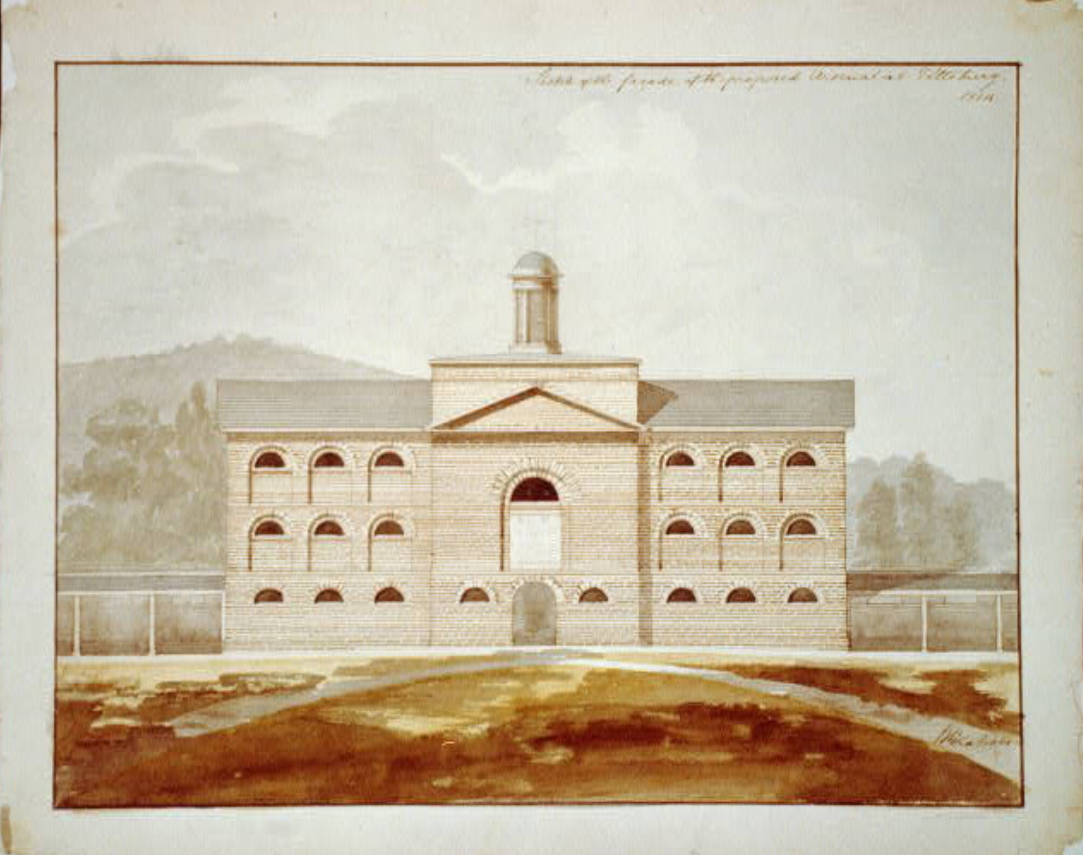
Happy and comfortable Latrobe was not, but at least he kept busy. During the year he reluctantly lived in Pittsburgh he designed and built a theater for the Circus of Pepin and Breschard, and at least three private homes presumably incorporating his favored Greek Revival style (none are known to survive). He also expanded an existing church, built steam engines, and even designed a barge. Latrobe was also commissioned to design the United States Arsenal (later known as the Allegheny Arsenal) building in the Lawrenceville section of Pittsburgh. What was eventually constructed differed significantly from his original plans, which are housed at the Library of Congress. Today nothing remains of any of Latrobe's Pittsburgh structures.


"Sketch of the facade of the proposed Arsenal at Pittsburg. 1814. BHLatrobe." Library of Congress Prints and Photographs Division


Latrobe and family moved back to DC to oversee reconstruction of the Capitol following the fires set by British troops in 1814.  Meanwhile, his son by his first marriage, Henry Sellon Boneval Latrobe, had become a civil engineer known for his railway bridges. In 1811, the senior Latrobe had accepted a franchise to design waterworks systems for the city of New Orleans. His son Henry had then secured the commission for the project, and moved there to began construction. Unfortunately a little war with the British intervened, so Henry fought during the War of 1812. He also found time to design a lighthouse and work on New Orleans' Charity Hospital and the French Opera House. Henry contracted yellow fever in 1817 and died in New Orleans at age 25.

A little more than a year after his son's death, and fresh from bankruptcy proceedings, Benjamin Latrobe left DC for a fresh start and to complete the job his eldest son had started. Benjamin traveled to New Orleans to complete his son's work on the water supply system, and his family joined him the following year. In New Orleans, Latrobe designed the Louisiana State Bank and the central tower with clock and bell of the Saint Louis Cathedral. This tower collapsed in 1850 during reconstruction, but the bell was reused in the new building and remains there today.

But like his son, and so many other visitors to the city, Benjamin Latrobe contracted yellow fever. He died in New Orleans on 2 September 1820. Both father and son were buried in a communal lye pit, a typical method of interment during Yellow Jack outbreaks. The Latrobes are remembered with a memorial marker in Saint Louis Cemetery #1 that was erected by their descendants. 

Latrobe Memorial, St Louis Cemetery #1, New Orleans LA


Latrobe and his second wife Mary Elizabeth Hazlehurst had one surviving daughter, Julia E. Latrobe, who never married. Although she lived to the age of 86, Julia seems not have left anything as a legacy beyond a circa-1812 manuscript in which she recorded dance steps and reminiscences of her childhood, and various party invitations and greeting cards. These items are in the collection of the Maryland Historical Society.

There were two surviving Latrobe sons. 

John Hazelhurst Boneval Latrobe was a Maryland attorney who was retained as counsel for the Baltimore & Ohio Railroad. He had aspired to a career in architecture, but abandoned this idea due to family financial circumstances following his father's death. He was, however, a talented landscape artist and art patron, and illustrated and wrote a drawing manual under the pseudonym E. Von Blom. He was also known to be a prominent supporter of the African colonization of Liberia, a well-intentioned but misguided antebellum movement. John H. B. Latrobe kept a journal called "Southern Travels" written during a two-month period in late 1834. In it, he chronicled his travels with his wife Charlotte from New York to Natchez (where wife had family), and the return trip by stagecoach to their Baltimore home.

John H. B. Latrobe, c.1860-90, photo from Brady negative. Library of Congress Prints and Photographs Division.

Youngest son Benjamin Henry Latrobe, Jr initially studied law under big brother John, working on cases involving his late father's property disputes. He then assisted his brother in drafting provisions for the original Maryland charter of the B&O RR, which involved surveying and field work. This awakened latent mathematical abilities that he decided to pursue. Junior, as he was sometimes known, eventually became chief engineer of the Baltimore & Ohio Railroad, laying out the line between Washington DC and Baltimore and designing the Thomas Viaduct outside the latter city. He had a distinguished career as a civil engineer, and was the guiding force in extending the B&O into Pittsburgh by absorbing a Connellsville railroad company.

Benjamin Henry Latrobe II
 

While the Pittsburgh buildings constructed by Benjamin H. B. Latrobe are gone, Western Pennsylvania residents have an abiding connection to the Latrobe family: the town of Latrobe.

Latrobe, Pennsylvania birds-eye view map circa 1900.
Library of Congress Geography and Map Division.

Ironically, the town has but a tangential connection to the family. According to the Latrobe Historical Society, Oliver Barnes purchased a 140 acre farm in Derry Township in 1851 for the Pennsylvania Railroad, which wanted to connect the eastern part of the state with Pittsburgh and planned to build railroad yards. Pplans changed and the yards were built instead in Derry, so Mr. Barnes acquired the land for himself. He laid out streets and lots and named his new town Latrobe in honor of his friend and railroad associate, Benjamin Henry Latrobe, Jr.  None of the Latrobe men are known to have set foot in the town bearing their surname.

New Orleans, Latrobe's eternal home, remembers him in other ways. Near the French Market arch at Ursulines Street is a small park dedicated to Benjamin Latrobe. The site of this park is actually the former waterworks that father and son designed and created. The park incorporates architectural remnants from the works into its sculptures and fountains.

 
And although the Louisiana State Bank Building at Royal and Conti in the French Quarter no longer functions as such, the building was designated a National Historic Landmark in 1983. It has been home to many commercial enterprises over the years. As of 2014 a wedding and events business operated there on Royal, called Latrobe's.


__________________________________
Further reading:
Baker, Jean H. Building America: The Life of Benjamin Henry Latrobe. Oxford University Press. January 2020.
Eaton, Leonard. Houses and Money: The Domestic Clients of Benjamin Henry Latrobe. William L Bauhan. January 1988.
Hamlin, Talbot. Benjamin Henry Latrobe. Oxford University Press; 1st edition. 1955.
Latrobe, Benjamin Henry. The Journals of Benjamin Henry Latrobe 1799-1820. Yale University Press. 1980.
Latrobe, John H. B. Southern Travels: Journal of John H. B. Latrobe. Historic New Orleans Collection; First Edition. 1986.
The Versatile Benjamin Latrobe
Sutcliffe, Andrea J. Steam: The Untold Story of America's First Great Invention. Palgrave Macmillan. 2004.

01 June 2012

Forgotten History: Albert Gallatin and Fort Lafayette

Connecting local figures and places with major players on a grander scale delights this historical dilettante's heart. I am intrigued, for example, by the stories of a forgotten fort in downtown Pittsburgh and a Swiss financier who lived in Western Pennsylvania. Both the man and the fort would have been well known in their era to today's far more recognizable historical luminaries Thomas Jefferson and Meriwether Lewis. 

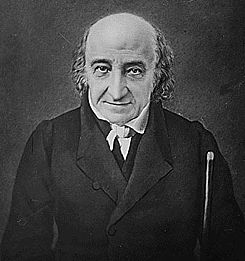
Albert Gallatin was born in 1761 in Geneva and eventually settled in southwestern Pennsylvania.  Living to the ripe old age of 88, he had quite a lot of time and seemingly boundless energy and insight to contribute to the formative years of the early United States.  Gallatin served as Secretary of the Treasury under Thomas Jefferson and was instrumental in securing the purchase of the Louisiana Territory due to his financial acumen. It is not an exaggeration to say that we have Albert Gallatin to thank for the Louisiana Purchase and the incorporation of New Orleans into the Union (although this was not something the Creoles of the time appreciated).

Albert Gallatin. Or Maybe George C. Scott. You decide. Source: Wikipedia Commons

The website for Gallatin's Friendship Hill home states that Gallatin felt that acquiring Louisiana
....was good for the country, especially the area around Friendship Hill. It provided the United States and western Pennsylvania with an ocean port, New Orleans. Now, the residents of western Pennsylvania could easily ship their goods down river on keelboats to New Orleans. 
There is implied self-interest in this massive, nation-changing acquisition: Gallatin encouraged the purchase of the Louisiana territory so Western PA would have access to an ocean port. Granted, it wasn't easy access, but still. Such self-interest is usually at the heart of most nation-building decisions.

Anyway, Gallatin didn't stop with buying up Louisiana. He spearheaded the building of what was once called the National Road (now Route 40) which coincidentally started in Cumberland MD not far from his home. He thus granted himself easier access to Washington DC.

Self-interest, thy poster child may just be Albert Gallatin....

Gallatin's love of maps probably spurred him to instigate explorations of the new Louisiana territory such as the Louis and Clark expedition that departed from the shores of the Allegheny River near the mouth of the Ohio at Fort Lafayette (sometimes called Fort Fayette).


Lewis & Clark's Excellent Adventure: loading kegs and party supplies onto a longboat at Fort Lafayette. Painting by Robert Griffing.


Fort Lafayette was established to replace the deteriorating Fort Pitt and functioned from 1792–1814 to protect Pittsburgh from Native attacks and as a supply outpost for Fort McIntosh further up the Ohio River in Beaver County.

Meriwether Lewis was hung up at Fort Lafeyette for nearly six weeks due to "the unpardonable negligence of my boat builder," as he complained in a letter to Thomas Jefferson when explaining the delay in starting the secret expedition that Jefferson and Gallatin had charged him with. It seems that poor Meriwether had labor problems. Imagine, labor problems, in Pittsburgh.
....the positive assureances given me by the boat-builder that she should be ready on the last of the then ensuing week, (the 13th): however a few days after, according to his usual custom he got drunk, quarrelled with his workmen, and several of them left him, nor could they be prevailed on to return: I threatened him with the penalty of his contract, and exacted a promise of greater sobriety in future which, he took care to perform with as little good faith, as he had his previous promises with regard to the boat, continuing to be constantly either drunk or sick. I spent most of my time with the workmen, alternately presuading and threatening, but neither threats, presuasion or any other means which I could devise were sufficient to procure the completion of the work sooner than the 31st of August; by which time the water was so low that those who pretended to be acquainted with the navigation of the river declared it impracticable to descend it; however in conformity to my previous determination I set out.... (Letter to Thomas Jefferson, September 8, 1803, Thomas Jefferson Papers, Library of Congress) 

Drunken ship-builders notwithstanding, Lewis eventually got his boat made and set off with William Clark to change the nation's destiny by exploring and mapping its newly expanded interior.

This map from 1796 shows the location of the Fort along the Allegheny River, and describes it thusly:
Fort Lafayette contains two Barracks, three hexagonal towers in wood, having artillery a power magazine. The inclosure is composed of large pointed stakes closed together 15 or 16 feet high, the fort is square, of weak defense, and even as nothing against cannon.


Even as nothing....and indeed, nothing remains to remind us of Fort Lafayette

Well, okay, almost nothing.

Fort Lafayette is at least recalled by means of an historical marker at Penn and Ninth Street in the downtown Cultural District, and is mentioned in another more recent marker at the edge of the Strip District which commemorates the bicentennial of the Lewis and Clark expedition. But these are the only physical remnants in Pittsburgh to mention this architectural witness to history.

Albert Gallatin fared a bit better. His country estate in Fayette County near the Pennsylvania-West Virginia border is maintained by the National Park Service as the Friendship Hill National Historic Site; his personal papers are a treasure trove of early republic history; his interests in Native American cultures led him to found the American Ethnological Society (although his legacy related to Native cultures was firmly in favor of assimilation); he was interred at Trinity Churchyard in lower Manhattan; and he has been honored with many place-names.

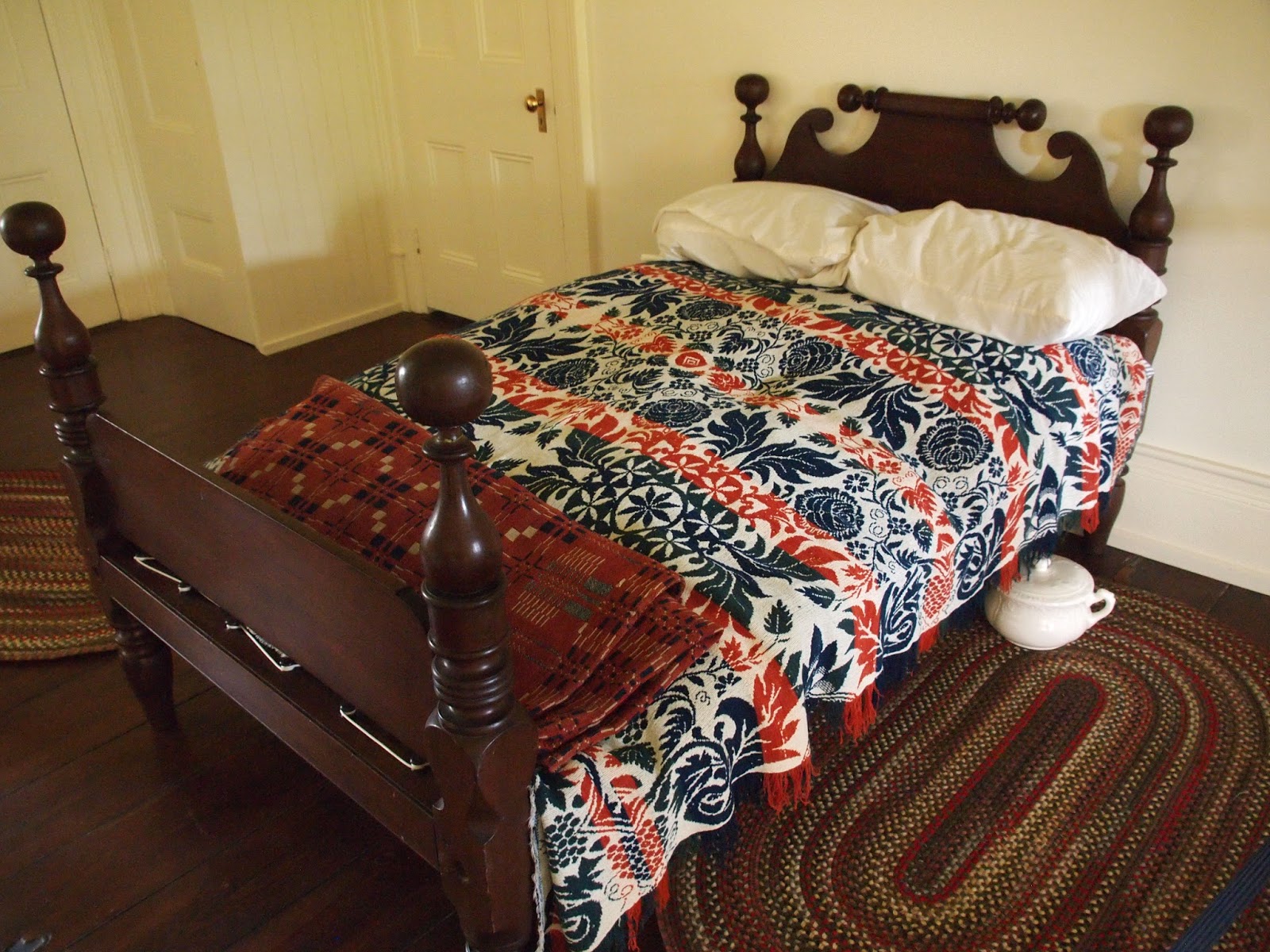
Some images below from Friendship Hill, Gallatin's home outside of Port Marion, PA between the Monongahela River and Route 166 in Springhill Township.  The home was constructed in three phases over a 39 year period beginning in 1786. Gallatin never spent much time there and abandoned it entirely by 1825, selling it in 1832. The house endured subsequent additions and passed through several owners until its purchase by The National Park Service in 1979. The property was restored at a cost of  $10 million and opened to the public in 1992.