The Coleman Industrial Home for Colored Boys was a Pittsburgh orphanage established in 1907 by Samuel A. and Luella Coleman, to provide a home for "homeless, friendless, and neglected colored boys."
Homeless.
Friendless.
Neglected.
These words might have described the lives of those Black boys, but Sam and Luella Coleman wanted to make sure those words didn't define their future.
Institutional Child Care in Pittsburgh
To understand why the Colemans did what they did, we need to understand their facility in the context of social welfare at that time. The history of child care in this country has long included both formal and informal provision, and it involved a range of charitable and custodial arrangements. The trend in Pittsburgh, as it was nationally in the latter half of the 19th century, was to remove children who previously had been languishing in almshouses in favor of placing them in specialized care facilities.
Not all children living in such care homes were there because they'd lost both parents. Many so-called "half-orphans" were in placement because a surviving parent was unable to provide for them. Others had living but impoverished parents who strategically chose orphanages as hopefully temporary residential child care while they worked to become self-supporting enough to reconstitute their families again. Today, educated by decades of research documenting the negative developmental impact of institutional child-rearing, we recoil from the idea of orphanages. But not so very long ago orphanages were seen as stabilizing influences in the lives of those "homeless, friendless and neglected" children from disenfranchised populations. Ideally, they were places that should prepare them and provide "industrial" training to provide them with skills so they would become productive, self-reliant adults.
Children were very often placed in facilities according to preferences such as religion. In Pittsburgh, specialty care homes further provided for the specific needs of blind, deaf, and disabled youth.
But race was a defining factor which didn't afford choice. The ground-breaking Pittsburgh Survey of 1914 noted that
The colored people of Pittsburgh did not seek institutional care of their children to any great extent except in the case of illness. They usually had strong home ties and were willing to adopt a lower standard of living than the white population before giving up their children.
Such strong community ties were certainly real. But saying that Black Pittsburghers were willing to endure impoverished conditions rather than give up their children implies that there was an element of choice that in fact did not exist. What was left unrecognized in 1914 was the cultural aversion to formal family separation for a population shaped by slavery's legacy of familial separation. Poor Black parents also held out as long as they could before surrendering their children -- probably longer than their white counterparts -- because the stakes were higher for them. They knew it would be harder for them to get back on their feet and get their kids back. Societal barriers to gaining financial security for adults of color were devastating. Black families knew that once they gave their kids up, they were probably consigning them to a lifetime of institutional care.
Between 1910 and 1930, Pittsburgh’s general population grew from 321,616
to 669,817. Its Black population doubled, too, from 25,000 to 55,000.
And as Black migration to northern cities increased in the early 1900s,
pressure grew for institutions to provide care for disadvantaged Black
youth.
Yet while there were plenty of Pittsburgh orphanages in the early 1900s, only a few accommodated Black youth. A list compiled from data collected during the 1910 US Census shows that of twenty children's homes identified within city limits, only 7 admitted "colored children." Of those, five included children from all races. Only two were specifically designated for Black youth. There was the large Home for Colored Children on the North Side.
And there was Coleman Industrial Home for Colored Boys in the Hill.
Coleman Industrial Home for Colored Boys
Although Coleman opened in 1907, it wasn't chartered and incorporated with the City of Pittsburgh until January 1911. Over that four year period it grew from informally providing homes for 5 boys to caring for 39 youth, aged 5-15 years.
Samuel A. and Luella Coleman personally took on the task of providing shelter, sustenance and training for orphaned boys of color in the community, and for those identified as delinquent under the jurisdiction of Allegheny County's Juvenile Court. Because of that court affiliation the small Coleman home enjoyed the support of the Pittsburgh juvenile justice system as well as the Pittsburgh Teachers Association. Crucial support was also provided from local churches like Ebenezer Baptist, John Wesley AME Zion, Central Baptist, and Bethel AME. Community organizations like the "Negro Elks" (Lodge No. 17) identified Coleman as one of its beneficiaries.
And like most orphanages, Coleman relied on support from individual benefactors. Annual "subscriptions" were solicited at $5 per donation, while $100 bought the satisfaction of having a "life membership" donation acknowledgement by the charity.
During its nearly 40 years of existence, the Coleman Industrial Home had two primary locations in the Hill: 2816 Wylie Avenue and 1721-23 Bedford Avenue. Addresses of 2500 Breckenridge Street and 3046 Center Avenue have also been associated with the home but not confirmed. There were other locations in its earliest, unofficial years which have not been adequately recorded; LaPlace Street was one of those. In May 1912 the Colemans rented an additional home on Wylie Avenue, intending it to serve as an infirmary to isolate residents with tuberculosis, the scourge of industrial cities at that time.
 |
| Coleman Industrial Home for Colored Boys at 2816 Wylie Avenue. Pittsburgh Press, 3 December 1911 |
Daily Life at Coleman
The boys who came to live with the Colemans may have been relinquished by parent/s who could no longer care for them. They may have lost their parents to death or abandonment. They may have been referred by the juvenile court system. Regardless of how they arrived, the Colemans endeavored to teach all their charges industrial and housekeeping trades and "good manners" so they could become productive members of society. Hence the name of the facility: the Coleman Industrial Home.
Under the Colemans' supervision, the boys attended Pittsburgh Public Schools as well as Sunday school at local churches.
Dressed in military-style uniforms, the boys were taught military parade drilling by Captain Grafton Miller, who later married Luella's sister (although it is not clear if he ever actually served in the US military). There was also music. The boys sang, and they played in brass and ragtime bands under the direction of Professor Henry G. Waters using instruments purchased from fundraising.
Since the home had no endowment, it regularly held creative fundraisers such as barbecues, lawn fetes, and dinners. Coleman was also one of many charities that raised money on city streets on designated tag days, which were municipally-authorized days when cash could be solicited in the streets. Wearable tags given out by organizational representatives to acknowledge donor generosity. The Coleman boys sold flowers on such tag days.
But the most popular fundraising efforts were musical performances by the boys to generate money from community supporters. Meet the Coleman Industrial Home Band:
 |
| Pittsburgh Press, 8 September 1912. |
Sometimes the band was booked for outside musical performances or parades for which the institution was either paid or allowed to collect donations from the crowd.
 |
| Examples of fundraising efforts Pittsburgh Gazette Times, 24 October 1912 |
 |
| Example of request Pittsburgh Post, 4 December 1913 |
 |
| Gertrude Gordon, early headshot Pittsburgh Post-Gazette |
Publicity for fundraising efforts was crucial for their success. Events and requests for tangible goods like clothing for the "inmates" were regularly published in the Pittsburgh Courier, an African-American weekly newspaper that began publishing in Pittsburgh in 1907. Coleman's needs were also well publicized in the Afro-American Notes society page sections of mainstream Pittsburgh newspapers. In a break with traditionally segregated print news, Coleman was occasionally profiled in the general news pages and the Pittsburgh Press often published stories about Coleman, which can be attributed primarily to Gertrude Kelley's interest. Kelley was one of the first Pittsburgh female journalists to actually have a byline. She wrote for the Press under the nom de plume of Gertrude Gordon from 1908-1927. While she may have seemed like an unlikely ally, the Coleman Industrial Home was actually perfect for the kind of soft-touch appeal stories known as "sensation news" that Gordon specialized in as a "sob sister" journalist of her era. She emphasized what we'd recognize today as the "human angles" in her features. To her credit, Gordon seemed to have a genuine interest in the home and was personally charmed by Samuel and Luella Coleman. She promoted their work with lavish praise, noting the home's very specific needs in her frequent articles.
After a fundraising drive in 1912, the Colemans had enough money to purchase tools for an on-site workshop where the boys could be taught such skills as shoe-mending, tailoring, sign-painting, decorating carpentry, sign hanging, cleaning and pressing clothes. But a few months later in late January 1913, a fire that started in a third floor bedding and clothing storage room badly damaged their rented 10-room Wylie Avenue house. The facility by that point housed over fifty boys. Fortunately no one was injured, although the Colemans were reportedly in ill health as a result of the fire. All of the clothing that had been donated in the preceding months for winter wardrobes was ruined but the community rallied with donations, fundraising, labor, and events where the boys played and sang. Such was the community esteem for the Colemans that they were quickly able to take ownership of two 52x113 foot lots at 1721-23 Bedford that included a two-story, 15 room mansard brick home. The home did not come equipped with bathrooms.
In October 1914, a one-day city-wide sale of geraniums on the streets raised $2000 for the home.
The Colemans and Their Boys
What we know about the Colemans comes from a biography written by Press reporter Gertrude Gordon, and from subsequent public archive research.
Samuel A. and Luella Dodson Coleman moved to the Herron Hill neighborhood in 1907. Each had been born into slavery and liberated as a result of the Emancipation Proclamation. A 1911 Press story about the home noted that on Thanksgiving, Samuel gave "....a feelingly heart to heart talk with the boys about his childhood days in slavery and what he had to be thankful for."
 |
| Luella Coleman, 1912 Pittsburgh Press |
 |
| Samuel A. Coleman, 1912 Pittsburgh Press |
Historical records reveal that Luella Dodson (or Dotson) was born sometime between 1850-1855 (no official birthdate documented) in Frankfort Kentucky to Mary Smith and Leonard Dodson (Dotson), also from Kentucky. She had at least two sisters or half-sisters. One, Charity Ray, lived in Pittsburgh and married Captain Grafton Miller at the Coleman home in 1916. The other, Mrs. Ann Allen, lived in St. Paul, Minnesota.
Samuel was also born in Kentucky, 20 April 1850, to Soney Coleman and Louisa Ross. He lived in Frankfort in 1870 with his mother and sister, Nanny, where he worked as a plasterer.
Their common roots in Frankfort, Kentucky notwithstanding, Gertrude Gordon wrote that the couple met in Indianapolis and married there in the early 1870s. In 1880 they lived in Saginaw, Michigan, where Samuel was a painter and Luella kept the home. By 1890 the Colemans had returned to Indianapolis where Luella worked as a hairdresser and Samuel was an artist. They also lived for a time in Chicago. At some point, the couple said they decided to devote their lives to "uplift work." Mr. Coleman was described by one Pittsburgh newspaper as a staunch believer "....in vocational training--in permitting a child to take up only the work which appeals most to him--guided by an older judgment."
When he first came to Pittsburgh, Samuel's profession was described as decorator. He was also described by Press reporter Gordon as "an artist and china painter," a popular decorative art of the time.
The couple was known to have one adult child, a daughter named Jessie. But in the 1900 census 17 year old Jessie was listed as their grand-daughter, born in Michigan. In the 1880 census, the Coleman's 14 year old daughter's name is Carrie. Her age, if accurate, would have Carrie born well before the Colemans later claimed to have met and married. In the 1910 census, Luella is listed as the mother of one living of two total children.
It is possible that all of these things are true, in a fashion, with flexibility allowed for dates in an era and culture when accuracy was not critical. There may have been complicated relationships as a result of family fracturing. A young Luella may have had a daughter who died young, either with Samuel or another man. Perhaps the Colemans subsequently chose to raise a granddaughter, or even took in another girl as their own child. Or perhaps the census takers were simply mistaken, or unable to document complex family relationships on template forms.
However Samuel and Luella chose to constitute their family, they celebrated their 40th wedding anniversary in grand style at the facility in 1912 with a community-sponsored celebration orchestrated by Press reporter Gordon. The gala featured performances by the Coleman residents, who referred to Luella as "Mother" and Samuel as "Pap". Daughter Jessie even came to visit from Chicago. A few years later in one of her features on the home, Gertrude Gordon described Jessie as "....a finely educated, cultured young girl" whose "gentle influence" along with that of her mother assured that the boys were cared for "....in an atmosphere of refinement and restraint."
The Coleman Boys
No records could be found detailing admissions to Coleman Industrial School. But public records research yields snippets of information about some of them. Here are the 23 boys listed as "boarders" on 21 April 1910, the day the census-taker came to visit:
John Orams (14)
Van Robert Withers (12)
Claude Arthur Withers (10)
Geo O Washington (13)
Godfrey Terry (13)
Blain Chapman (12)
George Robinson (11)
General Robinson (13)
William Saunders (9)
Robert Smith(12)
Lewis D John (15)
Henry Cahill (8)
Norman Walson (10)
Walter Reed(12)
Clarence Gray (16)
George W Burrell (13)
Harry Everett (11)
Paul Harris(8)
Henry Smith (9)
Archie Washington (9)
Heber Pryor (16)
William Foster (9)
Leslie Denter (8)
The 1910 United States Census recorded where an individual and his parents had been born. Of the 23 boys listed that day, 13 were native Pennsylvanians. Others had been born in West Virginia, Ohio, Virginia, and Washington DC. The majority of the boys had parents who had been born in Virginia. Although what we know as the Great Migration hadn't officially started yet from a demographic perspective, these boys were part of a mobile black population that traveled north seeking opportunities for themselves and their children.
Other boys simply had "United States" listed for parental birthplace, which makes sense given that many of them likely had scant information about their birth parents. Some boys may have been born to formerly enslaved individuals, for whom there was even less limited information.
Three of the boys were listed as "Mulatto." Although the Census Bureau's attempts at racial categorization have historically been inconsistent, census results have always been used as tools to maintain social and political order -- which in this era were still blatantly organized around racial distinctions. Categorizations such as "Black" and "Mulatto" were socially significant, with the latter officially in use from 1850-1930. But racial status was ultimately the personal interpretation of individual census takers, who could record determinations based on assumptions regarding skin color and other aspects of appearance.
All but one Coleman resident in 1910 attended school. That young man, age 13, had been employed for at least the past year as an office boy at a tailor shop.
What were these boys' stories? By using the above 1910 resident list as a guide, research in available public records archives and newspapers allows us a glimpse of their lives. Some Coleman boys flourished into adulthood. Others did not. A few examples:
One of the boys listed on the 1910 census came from a family of at least five children. He was a Juvenile Court referral to Coleman in 1910 aged 11-12 following his first run-in with the law for "larceny." A history of recidivism followed: another 1911 larceny charge landed him at Thorn Hill Industrial School for Boys, a reform school in Allegheny County's Marshall Twp. In 1913 he spent 30 days in Allegheny County Jail for assault and battery. In 1914 he was sent to the Allegheny County Workhouse for three months after being arrested as a "suspicious person." In 1917 he was sentenced to 10 years on a charge of larceny, serving 21 months at the Pennsylvania Industrial Reformatory in Huntingdon County and 14/18 months of his sentence at the Allegheny County Workhouse. He entered Farview State Hospital for the Criminal Insane, reason unknown, around 1923 when he was 25. He remained there for 21 years, 11 months and 15 days. He died in March 1944 after suffering from tuberculosis for six years.
Henry Cahill, born 1901 in Virginia to Anna Cahill and an unknown father, left Coleman to became a porter at a local hotel in Pittsburgh. Such service industry jobs represented respectable career paths for young men and women of color. Cahill died of tuberculosis at age 18 in 1920 at the public Leech Farm Tuberculosis Hospital, located above Washington Boulevard.
The Withers boys Abraham and Rosa Ann Withers of Virginia had nine children. When the widowed Rose died in 1910 in Pittsburgh, their five surviving children were scattered. Fourth child Van Robert was twelve, and fifth child Claude Arthur was ten-years-old when they came to live at Coleman Home. An older brother who was interred at the County Workhouse died a few years later of tuberculosis at Marshalsea, one of the local poor farms. The living circumstances of their 14-year-old sister were not documented, but their six-year-old youngest sister was placed in a different Pittsburgh orphanage. Despite these traumatic separations, Van and Arthur managed to forge ahead in life. Van served with distinction from 1915 through 1920 along the Mexican border in the 24th Infantry, one of several segregated Buffalo Soldier Army regiments for Black enlisted men. Upon discharge, Van and his brother Arthur had some juvenile run-ins with the law to clear up. Van eventually moved to Ohio, where he married and died in 1942. Arthur also settled in Ohio, where he lived and worked until his death in 1974. The brothers were able to maintain ties with their two surviving sisters and extended families.
 |
| Arthur and Van Withers. Photo used with permission from niece Linda Lopez. |
Godfrey Terry (1897-1967), originally from Roanoke Virginia, was described in the Pittsburgh Courier as a "young and brilliant student" from Coleman. He was one of its most accomplished students. Orphaned at age 11, for four months he "slept in alleys and rear yards" until he was arrested as a "vagabond" and remitted to Coleman by Juvenile Court. He was one of the first children taken in by Samuel and Luella, who essentially raised him and seemingly informally adopted him. Terry remained at Coleman well into adulthood, listed as a resident at age 23 in the 1920 census. He graduated with high honors from Minersville Public School in the Hill, and took the rigorous academic course of studies at Pittsburgh Central High. Terry graduated in 1919 from University of Pittsburgh's Dental School. He maintained a dental practice in the Hill District, where he lived with his wife Edna and daughter Lila. He was often mentioned as one of the school's talented vocal performers, and sometimes directed the vocal ensembles in performances. As an adult, he lent his fine baritone voice at community social gatherings and Coleman fundraisers. When Luella Coleman died, Godfrey Terry (although misnamed as Cherry) was mentioned as an "adopted son" in her obituary, and this was also his relationship to Samuel in the 1920 census.The Colemans did their best to help their boys, even allowing articles like this next one from the Press to be published in hopes of finding a good home for one of their charges. This article is cringe-worthy by modern standards, but keep in mind that its goal was to secure a loving adoption for a six year old little boy who'd only ever known institutionalized home care. The ethos of the time meant dignity had to be sacrificed to get his story told. We can imagine that Gertrude Gordon was behind this article; it certainly "reads" like her writing.
Kenny "Klook" Clarke (1914-1985) was undoubtedly Coleman's most famous student, although his residency there was from a slightly later era. Kenneth Clarke Spearman was born in Pittsburgh's Mercy Hospital. In Klook: the Story of Kenny Clarke, biographer Mike Hennessey described Clarke's father Charles Spearman as a native of Georgia who was known as "a trombone player of indeterminate skill but a ladies' man of some distinction." His Pittsburgh-born mother Martha Grace Scott was an accomplished pianist who taught her youngest son to play. It's doubtful Clarke had any real memory of his father, who abandoned the family early on; his mother died when he was around 5 or 6. He and older brother Charles were subsequently placed at Coleman by an uncle. They lived at the home until moving to a church apartment when Kenny Clarke was around 11 years old. During his time at Coleman, Clarke was likely cared for by Samuel Coleman and his daughter Jessie. He was mentored by the school's music teacher, Mr. Moore. Impressed by the child's precocious talents and music-reading ability, Moore at first encouraged Kenny to become part of the marching band and to try brass and wind instruments. But Moore soon recognized young Kenny's affinity with the snare drum. Kenny Clarke went on to a storied musical career, and is credited with shaping the bebop style jazz drumming that we know today. The technique that he called "dropping bombs" was so revolutionary, what with keeping time on the ride cymbals and providing accents on the bass drum, that some players found it too distracting and wouldn't play with him.
Kenny "Klook" Clarke, former Coleman student

 |
| Pittsburgh Press, 27 August 1914 |
Pittsburgh papers would occasionally print detailed information to keep the public informed about the children who were being admitted to this and other orphanages. In 1916 the Post noted that three new residents were the sons of William Sheppard, who had perished in a mill accident the summer before. A year later when the Press publicized Coleman's latest need for food, clothing and money, the paper mentioned five new residents from one family whose mother had been found dead in their Hill District home, and whose father was an invalid who could not care for them.
Working Together to Make It Work
 |
| Pittsburgh Newsboys Home Collections of the Pennsylvania Department Carnegie Library of Pittsburgh |
The holidays were always a time of generosity toward urban poor. According to newspaper accounts, Coleman reaped the benefits of holiday largesse. In 1910 the school received private donations of five turkeys, a ten pound roast pork, cranberries, sweet potatoes, onions, and "50¢ to buy the bread." The boys feasted for Thanksgiving 1911:
....a white lady of the Eastend....gave $25 for the boys' dinner also the dinner was prepared by the chef who cooked for Gen. Grant on his tour around the world... The menu was composed of the following palatable things to which the young fellows did more than ample justice: Dill pickles, blue point oysters, scalloped oysters on toast, roast turkey, English dressing, cranberry sauce, vegetables, mashed potatoes, braised and sweet potatoes, macaroni au gratin; dessert: vanilla ice cream chocolate pound cake, green apple pie, coffee en tasse, uncolored Japan tea, iced milk. Chef A.F. Williams, Victoria, B.C.
Coleman in Crisis in 1915
In early 1915, a report by the Allegheny County committee of the Public Charities Association of Pennsylvania rocked the city with "sensational charges of inefficiency and mismanagement" leveled against many of the county's homes for indigent children. Coleman did not escape unscathed and was assessed in this sweep because the facility received a $2000 state appropriation applied over a two year period.
In the report, a statement allegedly made by Samuel which carried intimations of child abuse was documented, and widely reported in newspapers: "There ain't never a boy come into this Home that I could not lick and show him he ain't yet a man!"
The report further alleged that Coleman records were "insufficient" and its financial records "inadequate". The Home's food was described as "very poor"; the kitchen and dining room were "very poorly equipped"; the house itself was "vermin-ridden and in many places dilapidated and filthy." Finally, the inspector claimed there were "insufficient bathing facilities" and that "beds, bed clothing, and clothing worn by the boys are poor."
This photo of the training workshop was included in the report with a scathing caption: SHACK DIGNIFIED BY NAME OF "INDUSTRIAL TRAINING SCHOOL." IT IS A FEATURE OF THE COLEMAN INDUSTRIAL HOME FOR COLORED BOYS.
 |
| Photo, 1915 report on Coleman Home by Allegheny County Committee, Public Charities Association of Pennsylvania |
The report indicated that in addition to Superintendent Coleman, there were five paid employees whose salaries and wages amounted to $1160 in the 1914 fiscal year. Below are the damning allegations, which concluded with a statement that "The Coleman Industrial Home for Colored Boys suffers not so much from mismanagement as from an almost total lack of proper management."
 |
| Excerpt from 1915 report on Coleman Home by Allegheny County Committee, Public Charities Association of Pennsylvania |
The entire report made headlines with its sensational, widespread allegations of substandard living conditions at Allegheny County charitable institutions receiving public monies. There was even a salacious description of an "underground dungeon" used for discipline at another facility.
Coleman Home had an "in" with the Pittsburgh Press vis-à-vis Gertrude Gordon's interests, so the Press reported in April 1915 that Luella Coleman countered the allegations and claimed that "....nearly all the charges made against that institution are either false, exaggerated, or misleading. She denied that the management is incompetent, and declared emphatically that the institution is kept clean."
At a follow-up hearing to an investigating state commission, sworn testimony was submitted by Board Secretary Dr. James Edgehill and by Samuel Coleman himself. They were able to successfully counter the charges. Their testimony was corroborated by a Board of Public Charities official, who praised Samuel and Luella as existing in "a class by themselves" among the region's charity providers.
 |
| Excerpt from Annual Report of the Board of Commissioners of the Public Charities for the Year 1915 |
As for the charge of cruelty based on Samuel's comment, the Commissioner's follow-up noted that "No particular instance of the exercise of any cruelty by the superintendent is alleged, his statement amounting to a declaration of his confidence in his ability to maintain discipline." The picture of the so-called shack was countered, too. While it was acknowledged to indeed be a photo of the Coleman workshop, it was noted that an available photo "of the very adequate main building" taken at the same time was deliberately omitted.
Coleman weathered this sensationalistic investigation, but still struggled to
provide care for the boys. A month after it was vindicated by the Board
of Commissioners investigation, the Home advertised for donations to
repair its leaky roof and to rebuild chimneys. Subsequent fund drives
were ear-marked for building fire escapes and fixing the porch. Perhaps
stung by the report's comments regarding "lack of proper management" Coleman's Board published a statement later that summer in reporter Gordon's Press to detail how monies raised from regular flower sales were used to benefit the home:
 |
| Excerpt from Pittsburgh Press, 25 July 1915 |
At the end of that difficult year, and hoping to capitalize on holiday generosity, the boys went into the Pittsburgh streets to distribute literature about the facility. The pamphlets described Coleman as a place where "...inmates are taught to be industrious, are given a good public school education and under the kindly influence of Mr. and Mrs. S. A. Coleman are being fitted to take their place in the world as wage-earning young men." Such a description might seem overly scrupulous, but this was an era when only the "worthy poor" were deemed to be deserving of charity. It was critical to characterize the Coleman boys as youth who were striving to distinguish themselves through hard work and study to become responsible contributors to society, and the Coleman Home as legitimately worthy of charity to assist that process.
Coleman Changes
While Pittsburghers could be extraordinarily responsive to Coleman's regular requests for aid, not everyone was so generous. The deprivations leading up to WWI hit everyone hard. Samuel Coleman sought to make the facility self-sufficient by pursuing farming. It apparently didn't work out as he'd hoped. In addition to some bad luck, another Press article indicates that Samuel and the boys were taken advantage of by a farm dealer who "foisted" old seed upon them.
 |
| Excerpt from Pittsburgh Press, 23 September 1917 |
In early 1916, after struggling with illness for two years, Luella Coleman returned to her native Frankfort Kentucky for six weeks or so to "regain her health." During Luella's absence, daughter Jessie came to assist by running the home and caring for the nearly 50 boys living there. Although she did return to Pittsburgh to continue her work, Luella never fully recovered. She died at the Pittsburgh Homeopathic Hospital (now UPMC Shadyside) on 16 July 1917 after suffering acutely from a bowel obstruction. Although she had struggled with ill health for several years, her death was described as sudden.
In an era when the passing of a woman of color didn't engender much press coverage, it's notable that obituaries for Luella appeared in all the local papers. Gertrude Gordon's connection with the home showed in the coverage provided by Pittsburgh Press, which published two detailed obituaries. Although Gordon's name did not appear on either article, Luella's work was familiarly and fulsomely praised. Her passing was described as "an almost irreplaceable loss" for the home. The Coleman home was described as "an institution unique not only in Pittsburg, but in the country." Both Press obituaries noted that over the ten years of the organization's existence, Luella had likely cared for 500 boys.
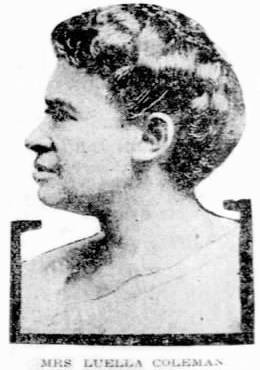 |
| Image from obituary, 22 July 1917, Pittsburgh Press |
In October 1918 the now-married 37 year old Jessie Coleman Hendrickson was described in local papers as having "succeeded her mother as matron in charge." Jessie issued the familiar annual fall appeal for donations to get the boys through the winter months. She and her 41 year old husband John W. Hendrickson, a Georgia native, lived further up on Bedford Avenue. John was a porter or janitor at a steel mill.
By late 1918, Coleman had an outstanding debt of $1,600. Two years earlier, following reports of a donation scam in which cash was begged on the street ostensibly for Coleman, the Board had published emphatic denials that it ever directly solicited cash. But desperate times called for desperate measures. In January 1919 Samuel went knocking on doors to solicit monies, "armed with credentials from the chamber of commerce."
Although nine former Coleman residents had enlisted in the Army (though some never saw action during WWI), the Bedford Avenue facility was still providing care for nearly 50 boys. The state appropriated more funds for Coleman after the war ended, but still the facility struggled. A 1920 valuation indicated that Coleman held real estate totaling $9,000, furnishings $2,500, and personal property valued at $1,000. Its fixed indebtedness was set at $6,000 and current expenses were nearly $4,300.
Without Luella's steady, inspiring presence in the community to act as a magnet for donations, something else needed to be done. In March 1919 a ladies auxiliary was formed to actively coordinate outreach and solicit help, with Jessie listed as its secretary. The composition of the Board of Directors changed in the 1920s, with representatives from both the black and white communities joining together to help.
 |
| Photo included with 1921 retirement announcement |
In 1921 the Press announced that Samuel Coleman had retired to a farm near Butler, where he had been working on behalf of the home. A year earlier, Gertrude Gordon had written one of her typically grandiloquent pieces about Coleman, describing Samuel:
Since Mrs. Coleman's death he has become more feeble and now has retired from active work in the home, although he still lives there and is one of the board of directors. Much of his time now is given to painting. He is an artist of real ability and the china which blossoms into fruits and flowers and exquisite blending of colors under his hands is beautiful.Gordon's article also noted that the home was being managed by Mrs. Bettie Mae Nychkens "who has been been prominent in civil, social, and welfare work in the city for several years."
 |
| Pittsburgh Courier, 8 March 1924 |
After 1921, Jessie was never again mentioned. Her husband John Hendrickson would continue to be listed as Coleman's secretary and as a member of the Board of Directors.
 |
| Pittsburgh Courier, 22 December 1923 |
Samuel Coleman died on 20 December 1923 at Mercy Hospital from general peritonitis following acute appendicitis, which had necessitated an emergency appendectomy. Samuel may have married a second time to a lady named Mary Johnson, who was listed as his wife on his death certificate. She was not mentioned in his obituary.
Jessie was also not mentioned in her father's Pittsburgh Courier obituary, although her husband John was still organization secretary. He was always described as married in official records, but Jessie was not listed as his wife or next of kin. No other woman's name was associated with John.
Jessie's fate is unknown.
Both Samuel and Louella Coleman were buried at Highwood Cemetery on Brighton Road.
The charity they established continued to serve Black boys in the Hill for another twenty years. However, without their charismatic and inspiring presence, the facility did not receive the same volume of media coverage. The Colemans themselves were still revered for a while after Samuel died. In 1925 there was ample coverage of the first elaborate Coleman Home Founder's Day at the new Elmore Theater in the Hill. Community activist leader Mrs. Daisy Lampkin served as mistress of ceremonies at the event. Remarks were made by prominent Pittsburgh politicians, current home matron Mrs. Nychkens, and by none other than Gertrude Gordon of the Pittsburgh Press. Local celebrities aside, the success of the event had everything to do with Samuel and Luella, whose memories were still lovingly honored by the community. Subsequent but less elaborate Founder's Days were held in the late 1920s.
Once Gertrude Gordon left Pittsburgh in 1927, Press coverage documented occasional "human interest" angles connected to Coleman. Without Gordon as active media booster, those mentions were less specific and more replete with racial stereotypes. For example, on at least two occasions, local papers published stories in 1921 and 1926 about Coleman and Pittsburgh's Colored Home for Children receiving live thoroughbred fighting roosters that had been seized by police in cock fighting raids.
 |
| Pittsburgh Gazette Times, 4 June 1926 |
The birds were served to the children, as these photos published by the Post in 1921 illustrate. The lady standing at the table in the lower photo is Jessie Coleman Hendrickson, although in the Post she was (mis)identified as orphanage matron: "Mrs. Jessie Coleman Henderson" who gave the tough birds "an all day 'stewing'" and served them with "mashed potatoes, peas and other trimmings" that proved to be "....no match at all for the pearly white teeth of the hungry little Negro lads."

The Post added:
In fact, the boys, from the expressions on their faces, as they completed the task of disposing of the roosters, seemed perfectly willing to "fight" a flock of game cocks in this manner any day, though one dusky youngster as he struggled with a neck, opined that the "cocks must have been hatched from 'hard boiled eggs.'"
The last quote is clever. After all, gamecocks were surely tough to chew. But it's difficult to read the condescending descriptions of the boys and their enthusiasm for a free meal. The donations, although well-intentioned, fit stereotypes white society had about Black people. It was noteworthy that the birds were donated specifically to Pittsburgh's Black orphanages -- beggars wouldn't be choosy, after all, and poultry was generally considered a cheap, low status meal. It had also come to be associated with the Black population following the 1915 silent movie Birth of a Nation, a film which glorified the Ku Klux Klan and included a scene of a Black man primitively tearing into fried chicken with his hands. Those kinds of associations were seared into the collective consciousness, making their way into decades of racist tropes.
As a paper serving the Black community, Pittsburgh Courier was more even-handed in its coverage of Coleman "human interest" stories, and continued to mention social and church fundraising and publicize the home's needs.
 |
| Pittsburgh Courier, 8 March 1924 |
Differing attitudes toward social welfare gradually rendered the orphan asylums and industrial youth homes of the early 1900s obsolete. In 1948, Coleman was legally dissolved. There are no plaques marking its existence.
__________________
Many thanks to Linda Lopez for generously sharing her family story.
Please contact me if you have information, stories, photos, or a connection to Coleman Industrial Home or its founders. I'm also interested in related objects, especially art or china attributed to Samuel Coleman.
_____________________________
ADDITIONAL INFORMATION
Oseroff, Abraham. Report of the Allegheny County Committee Public Charities Association of Pennsylvania on subsidized institutions for the care of dependent, delinquent & crippled children. Pittsburgh, PA. 1915.
Pennsylvania Board of Public Charities. Annual Report of the Board of Commissioners of the Public Charities for the Year 1915. Harrisburg, PA. 1916.
Ramey, Jessie B. Child Care in Black and White: Working Parents and the History of Orphanages. University of Illinois Press; 1st edition. April 2012.
United States Department of the Census. Benevolent Institutions. U.S. Government Printing Office, 1911.
1977 oral history interviews with Kenny Clarke


