Showing posts with label Highland Park. Show all posts

28 August 2021

Gusky: The Story of Pittsburgh's First Elephant

Elephant trade card issued for Allen & Ginter brand cigarettes, 1890.
The Jefferson R. Burdick Collection, Gift of Jefferson R. Burdick, Metropolitan Museum of New York.

Edward Manning Bigelow wanted an elephant for Pittsburgh like a little girl wants a pony. He dreamed about it, imagined himself riding it, drew pictures of it in his notebooks, and created lists of names for it.

Okay, I’m exaggerating.

But Edward Bigelow really did want an elephant. And what Edward Bigelow wanted, Edward Bigelow usually found a way to get.

_______________________________________________________________

Someone told me it's all happening at the zoo...

Edward Bigelow
Palmer's Pictorial Pittsburgh, 1905
Bigelow began serving Pittsburgh in 1880 as its Chief Engineer. In 1888 he was appointed by his cousin, politician Christopher Lyman Magee, as Director of Pittsburgh’s new Department of Public Works. Bigelow wielded power in that position for the next 25+ years. His lasting legacy was the establishment of the city’s public park system, which earned him the unofficial title of “Father of Pittsburgh Parks.”
 
A believer in the era’s City Beautiful philosophy that sought to not only aesthetically but morally improve the lives of 19th century urban dwellers, Bigelow wrote in his 1889 Annual Report that public parks could persuade "….men of all grades of life to forsake the saloons in favor of more healthful and innocent relaxation."

These parks got poppin’ in 1889 when Bigelow outmaneuvered a real estate developer by convincing Pittsburgh heiress and expatriate Mary Schenley to use her family’s land to create a city park. She agreed to donate 300 acres of land from her family’s estate for that purpose, with an option for the city to buy 120 more. She also included a stipulation that the property could never be resold, and that the resulting park was to be named for her.

It had taken nearly two decades of roundabout discussions to get to this point and the Pittsburg Press rejoiced on behalf of Pittsburghers: “It is the place of all places in this city for a park, and if Chief Bigelow gets half a show, he will make a breathing spot of which Pittsburg may be proud.”

Indeed, Bigelow set to work immediately to shape that “breathing spot.” He hired crews to blast, grade, plant, and create bridle and walking paths through the “rugged, airy place.”

Workers creating a bridle path in Schenley Park, March 1908
Pittsburgh City Photographers Collection, University of Pittsburgh.

Such work would continue well into the new century, criss-crossing Schenley Park with roads, rustic bridges, and trails. The park would eventually boast a horseracing track, lakes, ponds, picnic areas, a music pavilion, sporting fields, and a golf course. And within a few years, industrialists Henry Phipps and Andrew Carnegie added value to the area by building their eponymously named plant conservatory and library/museum complex on the park fringes.

But in the beginning, Bigelow needed to find a way to encourage the public to visit this barely tamed wilderness. So…why not build a zoo?

Cartoon showing Bigelow imagining his Schenley Park zoo.
Pittsburg Press, 27 April 1890

Pittsburghers responded by enthusiastically donating critters. By August 1890, nine months after securing the land for Schenley Park, Bigelow found himself in possession of quite a menagerie. The inventory included two bear cubs, various red foxes and raccoons, a covey of prairie chickens, two “diminutive” donkeys, some bald eagles, and a “family of chameleons.” He also had a flock of South Down sheep on order, for that all-important pastoral aesthetic (and lawn maintenance).

Still, when it came to funding the new zoological park, Bigelow’s ambitions outstretched his resources. He didn’t exactly have a line-item appropriation to house and feed these animals (although that prairie chicken flock may have taken care of the foxes’ needs).

Bigelow also did not have an elephant for his zoo.

And he really wanted an elephant.

This obsession with getting an elephant wasn’t unusual for the time. Variety indicated a superior menagerie, and captive elephants were the pinnacle animal to have in a 19th century zoological collection. Pittsburgh’s local papers teased that the owner of a traveling circus was willing to sell his older male pachyderm for $3000 (about $60,000 today). Who knows if that was the going rate for an elephant, but it was apparently too spendy for Bigelow or his potential donors. Pittsburgh Daily Post claimed in July 1890 that a “certain gentleman” was willing to shell out less than half that amount, some $1200, for an elephant for Pittsburgh.

That gentleman was most certainly a Pittsburgher named Levi DeWolf. He had placed what amounted to an elephant want ad in the New York Clipper, whose masthead proclaimed it the “oldest American theatrical and sporting journal.” DeWolf’s ad was placed in late June 1890 and ran for two weeks.

Elephant want ad for Pittsburgh's new zoo.
New York Clipper, 5 July 1890

Although he was not identified as such in the newspapers, DeWolf was the brother of Esther Gusky, the widow of Jacob Gusky of local department store fame. Gusky’s Department Store was one of the first modern retail mega-successes of its kind in Pittsburgh, and it had made founder Jacob a wealthy man. Jacob was also a very generous man, and the city benefited from his hands-on philanthropy to the poor and working classes. He was particularly beloved for sponsoring toy-laden Santa visits to all the local orphanages on Christmas Day. When Jacob died at the age of 41 in 1886, his wife Esther vowed to continue his acts of public and private generosity. So her brother Levi DeWolf was acting as her agent in seeking an elephant for Pittsburgh’s zoo.

But newspapers cautioned Pittsburgh not to get its hopes up about the possibilities:

It is a very easy thing to promise an elephant to the park, but it is no means easy to buy one. Good elephants are not plentiful in this country, and people who own those that are here want enormous prices for them. One or two answers to the Clipper’s advertisement have already come in, but as yet nothing has been found that is satisfactory. Something will be found eventually, however, and ere the summer is over an elephant, tall and stately, will hobnob with the bears and burros and foxes of the Schenley park zoo.                ~Pittsburg Press, 7 July 1890

Lo and behold, the ad worked! It was announced in August 1890 that DeWolf had procured a “baby” elephant for the Pittsburgh zoological garden from a New York animal dealer named Donald Barnes. DeWolf explained to the Commercial Gazette:

I had wanted a baby, believing the changes of climate would not affect a young one as much as an old one, and that he would gradually become acclimated. Another reason was that a young one would be tame and could be trained to ride the children around the garden, as is done in the Philadelphia “Zoo,” and by changing five cents for a ride there might be a source of income to help if not entirely bear the expense of keeping up the garden. The idea in purchasing so expensive an animal as an elephant was that by starting the ball rolling other business houses might be stimulated to contribute an animal or two, and thus the city could have a collection of animals without it costing the taxpayers a cent.

No one knew how much of his sister’s money DeWolf spent for this elephant. One paper said $3500, while another said $2200. But, really, what price could be put on the joy an elephant would bring to Pittsburgh?

And anyway, good elephants were hard to find.

This one was initially described as a five-year-old male from India. An Asian elephant of that age is basically an early elementary school child, only just transitioning from dependency on its mother. The Press assured readers that this elephant was “…thoroughly tame. He had been used for a year or two as a beast of burden and is said to be as gentle and kind as a kitten.” The Pittsburg Dispatch concurred, noting that the elephant was “….5½ feet high and is well trained. He is said to be very gentle, and his last owner on the “coral strands” recommends him as docile and very fond of children.”

Illustration of rugged Schenley Park in 1890, including free range sheep.
Pittsburg Bulletin, 8 November 1890


Pittsburgh would have to wait several months for its “tame” elephant to arrive from India. Meanwhile, despite Bigelow’s ambitions, Schenley Park remained a rugged tract. Lasting improvements to make the park accessible were expensive and time-consuming, but local papers still encouraged people to visit.

It was a hard sell. But hey, at least there was a zoo!

Sort of. The Press damned with faint praise:


You can visit the zoo, Chief Bigelow’s happy family. To be sure, the elephant hasn’t arrived yet, and the tigers and lions are still roaming about the wilds of Africa, but the two cub bears are there. So are the two diminutive donkeys and the big eagle that stands majestically on a fence rail and screeches for liberty and the land of the free every time anybody approaches. These are there already, and the presence is a guarantee of good faith that the rest will show up in good time.

You could visit the zoo, sure, but what you'd see was a ramshackle assortment of wooden shacks populated by random animals. Society newspaper The Bulletin laid it out:

In fact the zeal of Pittsburghers to contribute some strange bird or quadruped to the Schenley Park “zoo” has been embarrassing to Mr. Bigelow and his assistants. There are as yet no adequate or suitable buildings for the housing, even in the summer, of the animals provided, and until this is the case, the Schenley Park collection must retain its rudimentary and somewhat melancholy form.

According to a 1943 history of Pittsburgh’s public parks, the zoo was at the top of Panther Hollow across from the merry-go-round, which would put it somewhere in the vicinity of today’s Bartlett Playground. It was so unimpressive in 1890 that some scoffed at its pretensions, as per this mocking piece in the Pittsburg Press:

So the ruler of the department of public works….waxed great and his heart was lifted up within him. And he said within himself, I will build a zoo, and it shall be called Chief Bigelow’s zoo, and shall contain beasts and birds and reptiles, both wild and tame… So the word went forth and the friends of the people gave gifts. And the same were valuable, and some were duplicates, and some were suffered to escape. And those that remained were taken and placed in the middle of a wide desert waste called Schenley park, and people took horses and carriages and risked their necks crossing the railroad to go and see them.

By mid-October 1890, with the promised elephant nowhere yet in sight, the other zoo animals were moved from their shacks in Schenley Park across town to “winter quarters” in the former Fifth Avenue Market House. This was a long, one-story, wooden multi-purpose building on the corner of Fifth and Miltenberger streets (destined to be demolished a few years later so Fifth Avenue High School could be built).

Pittsburgh Post, 15 October 1890
The apartment to be occupied in the old market house has been suitably arranged for the animals, cages having been built in tiers along the east wall. Conveniences for cleansing the cages and apparatus for heating the room have been put in, and the animals will have excellent winter quarters. There is at present no suitable place in the park for taking care of the zoological collection….The elephant donated by Mrs. Gusky is expected to arrive within a few days. Mr. Bigelow was notified that it is on the way, and he is expecting its arrival daily. When the elephant comes he will at once be housed in the market house for the winter. Chief Bigelow will probably make arrangements to have the new menagerie open to the public between certain hours on certain days of the week. 

One month later on 16 November 1890, Levi DeWolf traveled to New York City to fetch his sister’s elephant, fresh off the steamer ship Delcorno. 

DeWolf soon realized that bringing the beast back to Pittsburgh was going to be more complicated than anticipated. A custom-fitted howdah, or canopied carriage, was needed so Pittsburghers could ride on the back of their new elephant. There were no expert howdah makers in Pittsburgh, so DeWolf had to arrange for his new elephant to be fitted in Manhattan before bringing it home. 

Levi DeWolf, 1858-1915
Notable Men of Pittsburgh and vicinity, 1901
 
Let us pause for a moment to consider the beleaguered Levi DeWolf: a nice, Jewish guy from New York, baby of his family, never married, active in the local Elks, transplanted to Pittsburgh with his other siblings who’d all followed Esther here when she married Jacob Gusky. Levi had  spent his adult life as assistant manager for his late brother-in-law’s department store…and in doing his widowed sister’s bidding. He arranged excursions and donations for the many orphanages that Esther Gusky supported. He distributed freshly killed turkeys every November to the city’s poor for their Thanksgiving dinners. But it was surely next-level filial devotion to travel to Manhattan to close a deal on an elephant, fit it for accoutrements, and see it safely off to Pittsburgh on a train.

Levi may have wearied of all things elephant by this point, but the newspapers were having fun. The Commercial Gazette let Pittsburgh know what awaited the new elephant at the zoo:

….the whole establishment was stirring with the progressing preparations for the reception of the Gusky elephant, which will arrive from New York this evening. A room was being fitted up and the pachyderm will have an exclusive apartment entirely separated from the fierce sheep and donkeys. He will not be inducted into his new home, however, until the latter part of the week. In addition to the other furnishings of his apartment he will be provided with a stove, and efforts will be made to keep him comfortable with the semblance of an Indian temperature. The many attentions the elephant will receive from all indications will tend to make him conceited unless he possesses strong Democratic ideas. The latest importation from farther India is five feet six inches in height and weighs 5,600 pounds. He is eight years of age, and is still only an infant as elephants go. When he has had time to expand and rise he is expected to become great in proportions as well as in fame.

Yes. You read that right: in these newspaper accounts, the elephant had aged from 5 to 8 years in a matter of months. Who knows if any of the reporters had their facts straight? Then again, perhaps a different elephant had been sent.

Or maybe no one really knew anything about what they were doing.

Cartoon in Pittsburg Press, 26 October 1890

This maybe five-year-old, maybe eight-year-old elephant traveled on a freight train from Manhattan to Pittsburgh on 19 November 1890. Somewhere along the way the elephant officially acquired a name: Gusky. After being unloaded at the Duquesne freight station located at the Point, Gusky immediately became the star attraction in a parade, led by a brass band. This parade snaked through Downtown and detoured past Gusky’s Department Store at Third and Market Streets (where the PPG glass castle complex is today), then marched straight up Fifth Avenue for about a mile to the old market house. The Press commented on the “diminutiveness” of the elephant, which was referred to as a “baby.” The paper assured concerned readers that “Comfortable quarters have been prepared there, and a long winter’s rest with plenty of food will probably overcome the bad effects of the ocean voyage.”

Bigelow got his elephant. All of Pittsburgh rejoiced. And Gusky the elephant lived happily ever after.

Right?

Right???

You can stop reading here if that’s what you’d like to believe.

Excerpts from article welcoming Gusky in Pittsburgh Post, 20 November 1890
(Note illustrator's artistic license giving Gusky tusks. Only some male adult Asian elephants have tusks).

_______________________________________________________________

It's a light and tumble journey from the east side to the park...

The first elephant to arrive in the United States was the Crowninshield elephant in 1796, named for the ship captain who brought him from India to Massachusetts. Less than a decade later in 1804, a female Asian elephant arrived. She was purchased a year later by New York farmer Hachaliah Bailey, who named her Old Bet. Bailey made Old Bet the star of a traveling menagerie that toured the East Coast. 

Such captive displays of these enormous creatures were, well, enormously popular. Decades later, Hachaliah’s distant nephew James A. Bailey partnered with a fellow named P.T. Barnum to add performing elephants to a traveling circus.

Captive elephant illustration, Pittsburgh Commercial Gazette, 29 November 1890

Getting an elephant across the mountains of Pennsylvania would have been a daunting task. The first elephant thought to have visited Greensburg and Pittsburgh was a male named Columbus, also owned by Hachaliah Bailey, in 1819.

An 1819 advertisement for the first elephant to visit western Pennsylvania.
Pittsburgh Gazette

Today we understand that elephants are self-aware, emotionally complex creatures who form intense familial and community bonds. Female elephants in the wild live their entire lives within close-knit family groups, and males can stay with their herds into their second decade of life before embarking on solo bachelorhood. Elephant herds can contain more than 50 animals, and the creatures are nomadic by nature. 

And today we recognize that placing elephants in captivity results in significant mental and emotional harm for the animals. Restricted space and limited opportunities for exercise, constant stimuli of visitors and noises, and wooden, metal and concrete man-made housing can cause debilitating stress. The resulting trauma is manifested in what is called stereotypic behavior that includes rocking, swaying, pacing, weaving, and head-bobbing.

Mahouts are the traditional handlers who work with captive Asian elephants. Most forge deep emotional bonds with the animals under their care. Their informed relationships with elephants help mitigate damage from living in captivity, and their expertise is often based on generations of traditional familial knowledge passed down from fathers to sons (and occasional females). For centuries, mahouts accompanied elephants given as gifts to European rulers.

Royal elephant with mahout c. 1660. Ashmolean Museum, University of Oxford.

There was no mahout accompanying Gusky the elephant to Pittsburgh in 1890. If there had been, the mahout could have immediately set Pittsburgh straight about one important detail: contrary to all published reports, Gusky was a girl. You wouldn’t think it would be that difficult to figure this out once Pittsburghers laid eyes on the elephant. But for decades afterwards, even though the city realized it had a “lady elephant”, local newspapers would still refer to Gusky as a male.

Workers at Pittsburgh’s Schenley Zoo in 1890 had never handled an elephant before, but no one seemed worried about the lack of experience. The philosophy was that elephants were basically really big cows who had appendages of unusual size and if you could handle livestock, you could handle an elephant.

Boy or girl, baby or juvenile, the city was nonetheless wildly excited about its elephant’s arrival. Pittsburgh City Council adopted an official resolution on 8 December 1890 to thank Mrs. Gusky for gifting an elephant for the Schenley Park zoo.

Pittsburgh City Council resolution from Pittsburgh Municipal Record, 1890, no. 724

Gusky managed to survive the stress of marching through the city behind a brass band and was made to feel at home (according to 19th centuiry Pittsburgh standards) at the old Fifth Avenue Market House. She remained there for nearly six months, during which time visitors came from far and wide to gawk and marvel. On 2 May 1891 it was announced that she would be moved soon to the newly refurbished Schenley Park zoo. Workmen had made considerable progress at building roads and otherwise civilizing the park -- or at least enough progress that it was deemed suitable for an elephant. Gusky’s transfer was accomplished quietly later that month in the early morning hours, without a street parade to mark the occasion. By mid-June, she was keeping cool in the city heat by flapping her ears and tossing hay around, much to the amusement of visitors.

At Bigelow’s suggestion, a likeness of Gusky was featured in the gala July Fourth fireworks display at Schenley Park. Pittsburgh would have oohed and ahhhed as the twinkly elephant moved her ears and trunk “in process of combustion” in the night sky. 

You know you’re famous when you’re included in a Pittsburgh fireworks display. But let’s face it, major pyrotechnics aren't an elephant's choice of a good time. We can assume Gusky wasn’t at all impressed by the explosions in her backyard, and in fact was probably terrified by the noise.

It’s not clear whether Gusky earned her keep by giving rides in the new Schenley digs right away, but in 1894 the Pittsburgh Post announced that Esther Gusky had donated a “fine big saddle” for Gusky that could carry eight children. She also donated livery for the elephant’s keeper so everyone looked spiffy. Rides on Gusky cost 5¢ each. 

In these early years, Gusky was also occasionally taken from the zoo to participate in community street parades. On one occasion in 1896 she bore two riders dressed like clowns, who may have regretted that particular life decision: “They looked anything but jocular, and the expression of fear made it extremely ridiculous,” wrote the Commercial Gazette.

In September 1895 another elephant was loaned to the Schenley Zoo. This was a mature female circus performer with the undignified name of Miss Dazzle who was allegedly 80 years old. Given the shortened life spans of captive elephants, Miss Dazzle was most certainly not 80 years of age. But at the time  conventional wisdom held that elephants lived to be 100 years old, so it was assumed that Miss Dazzle was quite the grand dame. 

What was indisputable was that Dazzle dwarfed Gusky in size. Gusky was still described as a “baby” and her diminutive size charmed rather than awed Pittsburghers. The press was fascinated by the “monstrous” Dazzle and speculated that she was the largest elephant currently in captivity.

Although it’s possible that Gusky may have “met” other elephants passing through Pittsburgh in circuses, it’s more likely that Dazzle was the first of her species that the little elephant had a chance to engage with since coming to Pittsburgh.

These headlines and Pittsburg Post excerpts set the elephants up for conflict that didn’t exist:

Pittsburgh Post headline excerpt, 30 September 1895

Miss Dazzle was introduced to Miss Gusky without any formalities, and the two great brutes behaved very becomingly. Each displayed more or less of the curiosity characteristic of the sex, Gusky being particularly inquisitive in the matter of sizing up her guest, but without any unmannerly demonstrations. Last night the keeper said they were apparently well satisfied with each other’s society, and no trouble is anticipated if discretion is shown by the attendants in not rousing Miss Gusky’s jealousy by undue attention to the monstrous Miss Dazzle.

Dazzle, thought to weigh some 9,000 pounds, immediately became a star attraction. Reporting a week after her arrival, the Post seemed bemused that the elephants were actually getting along:

Gusky was the queen of the zoo until the arrival of Dazzle, but the latter seems to absorb the major share of attention, and the strange part of it is that Gusky isn’t showing the least symptom of that jealousy, which carping and ill-natured critics always ascribe to the sex. She has, in fact, taken quite a liking to the dazzling creature that shares her lodging, and Superintendent Burke says that the “baby” shows a great deal of uneasiness when Dazzle is led out for a promenade or to get a drink of a few tubfuls of water.  

What we’ve since learned about elephant behavior explains that the isolated juvenile Gusky recognized the older Dazzle as a dominant matriarch. Having been on her own for nearly five years, she seems to have been content and even happy to hang out with Dazzle.

The elephants were moved into a large, heated barn at Schenley Park for the winter months. It must have been close quarters since the barn also housed the zoo’s lions. While Schenley Park continued to expand, Gusky’s living circumstances were not part of the overall improvement plan. For instance, in April 1896 the Commercial Gazette published a feature story about Sunday afternoon in the parks. It included a haunting description of what life was like for the now 11-year-old elephant. Despite free peanuts and apples tossed by visitors, living conditions for Gusky and Dazzle (misnamed Basil) were hardly ideal:

Pittsburgh Commercial Gazette headline, 13 April 1896

But poor Gusky, the elephant that delights the hearts and elevates the minds as well as the bodies of children, was almost neglected. She is stationed in a low, dingy shed -- a good home in everything but the distance from her visitors. She was too far away from the chain to be fed with peanuts or apples, but Basil, the huge elephant loaned the park, had every opportunity to get filled to repletion. She was too stingy, however, to save anything for Gusky and the latter is still hungry. Next Sunday Gusky will be taken from the shed, surmounted by a howdah and given a chance to gain the appreciation of boys and girls by carrying them on her back. The other elephant has no howdah, nor is it likely she will get one. This is where Gusky gets square.

An elephant was usually held captive by means of a chain around one of her legs that was in turn connected to the ground. The Schenley elephants were thusly tethered and displayed in a pen, separated from the public by a barrier chain.

It's not clear how long Dazzle remained with Gusky. They may have only been together for a few months, until circus season started again in the spring. At that point Dazzle would have been reclaimed by her owners and taken on the road to dazzle audiences, leaving Gusky alone and isoalted once again.  

Gusky did occasionally get relief from the confines of her pen and tether. An April 1897 Daily Post article described how she was led on daily walks along trails in Schenley Park. 

That's right: Gusky took a daily constitutional in Schenley Park. 

She didn't seem terribly enthused about the stroll, however, and kept twisting her head to look around nervously. Eventually it was determined that Gusky's hypervigilance was due to being stalked by a fierce free-range billy goat from the Four Mile Run area. 

This goat had an agenda:

….the goat would slip up the hill behind Gusky and butt her on the legs. This happened daily for a long time, and every effort of the elephant and her keepers to stop the nuisance was of no use. But Thursday morning the culprit was captured. Gusky turned around just as the goat was breaking for her. The buck had a good start and was advancing at full speed. The speed was so fast that the animal could not stop and the victim ran right into Gusky’s trunk. The elephant lifted its tormentor into the air and, with a great swing, threw the goat far down the hillside into the ravine. As yet no one has ever taken the trouble to learn whether the goat was killed or not.

Gusky was, seriously, the G.O.A.T.

_______________________________________________________________

Just a fine and fancy ramble to the zoo....

In 1895 Bigelow's coustin and local Republican political boss Christopher Lyman Magee made the first of two donations ultimately totaling $125,000 to create an expanded, modern zoo. “No more interesting or instructive institutions can be found in the great cities of the world than the Zoological Garden,” wrote Magee when he announced his donation.

This zoo was to be built across town from the old zoo at Bigelow’s pet project, the new Highland Park. Bigelow needed to attract people to the park, which not co-incidentally was at the terminus of new trolley lines that his cousin Magee owned major interests in. There was thus certainly personal incentive at play, since creating destinations of public interest like parks and zoos would encourage Pittsburghers to use the revenue-generating transportation infrastucture. Bigelow also recognized that to hold its own among other 19th century urban centers, Pittsburgh needed something grander than the shabby old Schenley Zoo.

Schenley Zoo from Pittsburgh Exposition, 1894. Western Pennsylvania Exposition Society.

Reports about the condition of Schenley’s elephant house illustrated how horrible things had become. Despite the best efforts of cats kept on the premises for rodent population control, and copious application of poisons, rats had overrun the place. A rat colony nested in the sawdust insulation layer between the double walls of the wooden frame buildings. They emerged at night to steal food from the animals -- and to torture Gusky. “Several times they caused Gusky to become panic-stricken,” wrote the Pittsburg Post in May 1898. “The big elephant refused to lie down at night out of fear of their attacks. On one occasion they chewed the calloused skin from her feet.”

Schenley Zoo elephant house. Pittsburg Post, 12 June 1898

Thankfully for Gusky's toes, a new and improved zoo was planned consisting of a long, tall, imposing one-story building with two wings, to be designed by Chicago architect J.L. Silsbee. 

Highland Park Zoo postcard, c. 1903

Sitting atop a denuded hillside in Highland Park, the building was reached via a 120-foot terraced staircase. The elephant room to the left of the eastern entrance was a “great, airy, well-lighted and well-ventilated” room 80 x 45 feet and 12 feet high, with skylights, cement floors, and enameled tile wainscotting. Pipe rails divided the room, marking space for three elephants on one side and other large animals yet to arrive on the other, possibly including a giraffe. The lions lived one room over.

Highland Park Zoo c. 1900. Carnegie Museum of Art Collection of Photographs.

On opening day 14 June 1898, Gusky was the zoo’s sole pachyderm. That would soon change. Four months later in October, two more elephants and two elephant specialists arrived at the new zoo.

Pittsburgh Post-Gazette, 3 November 1930
Ernest Tretow was only 27 years old when he came to Pittsburgh, but he’d already spent half his life an animal trainer. His career path was set at age 14 when he began working with world famous exotic animal dealer Carl Hagenbeck in their native Hamburg, Germany. When Tretow accepted the head trainer position at the new Pittsburgh Zoo, he contracted with Hagenbeck to supply the zoo with animals.

An interview Tretow gave to the Press upon assuming his duties in October 1898 revealed his philosophy about working with elephants, his favorite animal:

The elephant even in it haunts is not a fierce beast, unless he is injured, and he then becomes very savage. In training all animals we always try kindness first, using all sorts of inducements to get the beasts to obey you. When this fails we are compelled to bring the whip into play. The latter, however, is not a good thing, as it often angers the subject and he is then less likely to do your bidding. It is not difficult to train an elephant, and although they are very large and heavy, they can be trained to almost anything. The native is the best adapted to train the beasts, as the animals seem to understand their speech better than that of any other person. In the training of the elephant all that is needed is a little patience and the result will be pleasing. The animals really display intelligence.

With Tretow came Cetoua (sometimes written as Cetona). He who was described as a “cornack,” which was another term for mahout. The papers described Centona as Cingalese, from Ceylon. Today we understand that he was a native of Sri Lanka, an island south of India. But to 19th century Pittsburghers, Cetona was so exotic that he might as well have come from another planet.

The mahout Cetoua, Pittsburg Press, 28 October 1898

Pittsburgh papers were as fascinated by Cetoua as they were by the new elephants, and were especially bemused by his fashion and footwear preferences. Readers were treated to regular updates about whether Cetoua wore shoes or stockings, and one paper shared his assertion that “shoes gave him corns.” This excerpt from a Press article is typical of the wonder and 19th century judgement that Cetoua faced upon arriving in Pittsburgh:

Mr. Tretow took the Cornack to his hotel, but the man attracted so much attention that the proprietor put him out of the house. The only English word that he knows is money. He smokes cigarettes almost constantly, and rice is his principal article of food. He puts a handful of cayenne pepper and a handful of salt into his rice. He is averse to wearing shoes and stockings. A pair of shoes and stockings were purchased for him yesterday afternoon, but when they were handed to him he threw them out of the building. He became homesick as soon as he arrived in the city and wanted to start for his home yesterday afternoon. However, when he was taken to the zoo he became contented. He was informed that his photograph would be taken. He went into the zoo building and arranged his toilet by washing his feet. He did not put any water on his face.

Ernest Tretow and Cetoua took charge of an expanded Pittsburgh elephant collection that included Gusky and newcomers Punchy and Phoebe.

Elephants identified as Punchy (left), Phoebe (center) and Gusky (right) by zoo.
Image from The Pittsburgh Zoo: A 100-Year History, 1998.

Punchy was described as a large female weighing 6,000 pounds who was nearly two feet taller than Gusky. She was thought to be near 50 years of age.

Cetoua met Punchy’s train at the East Liberty rail station and startled the neighborhood when he jumped on the elephant’s back and rode her two miles to the new zoo. 

Illustration of Cetoua riding Punchy through East Liberty and Highland Park.
Pittsburg Press, 30 October 1898.

Punchy came to Pittsburgh via Hamburg from her native India, where she was a beast of burden and hard labor. A 1900 Pittsburg Post article described conditions in her native land: “There they work elephants in the rivers moving lumber. They wade into the water and handle great logs with their trunks. Punchy served an apprenticeship at this. Her growth has been stunted by her early hardships.” We can’t know if Punchy’s growth had been stunted, but Tretow had no qualms about continuing to use her for labor. The same article detailed how Punchy helped workmen by yanking out multiple zoo fence posts sunk six feet into the ground: “Punchy cleared the whole ground of posts last week, and never said a word. There was no bossing of a gang of men with profuse profanity. She just wrapped her trunk around a post, and yanked it out….”

Punchy was the gift of Christopher Lyman Magee and wife Eleanor. The other new elephant was named Phoebe, although she was sometimes listed as Bebe. Like Punchy she arrived in October 1898, but received much less press coverage so archival information about her is limited and, frankly, conflicted. For instance, in photos from this period (see below), the elephant identified by the Pittsburgh Zoo as Phoebe has pronounced tusks. That's typical only for some male Asian elephants, not female ones. It's possible this identification was a mistake, and perhaps there was actually another male elephant present around this time who was either an Asian male or even an African elephant. It was once thought acceptable to mix Asian with African breeds, although this is no longer done due to concerns about EEHV virus transmission. 

On the other hand, maybe Phoebe was renamed Bebe upon arrival when it became apparent that she was a he! According to limited contemporary press coverage, Phoebe was smaller and presumably younger than Gusky. In some sources she (he?) was also noted has having been a donation from the Magees.

In the way that elephants do, these three may have formed a family unit at the zoo, sharing close quarters in the new building. There were no press reports of conflict -- and since elephant fights made for good copy, we have to assume they sorted out any relationship difficulties. 

Ernest Tretow poses with three elephants, c. 1900. Possibly Punchy is to the right, Gusky lying down at center, Phoebe on left.
Image from The Pittsburgh Zoo: A 100-Year History, 1998.

The elephants were brought out to perform stunts and tricks for visitors at 2 PM each day. Punchy was the most skilled, but Gusky was a fast learner and Phoebe seemed eager to try.

Ernest Tretow with a trained elephant, c. 1900, probably Punchy.
Image from The Pittsburgh Zoo: A 100-Year History, 1998.

But this family unit didn’t last long. Phoebe or Bebe died of “acute stomach trouble” in November 1900. Her (his?) hide was donated to the Carnegie Museum. Punchy died two years later in March 1902 of what was termed “old age.” The newspapers recounted the challenging task of removing her remains from the elephant house, and spared no detail about dismemberment for preservation and display at the Carnegie Museum. There were even pictures!

RIP, Punchy. Elephant being skinned for Carnegie Museum collection. Pittsburg Post, 16 March 1902

Were the elephants assassinated? As wild as that seems, the turn of the century was an unsettled time at the zoo. Querulous Superintendent Bigelow, always primed to go public with grievances should he feel slighted, made a sensational claim in 1904 that an unnamed city employee critical of his policies had embarked upon a campaign of poisoning various zoo animals -- including the two elephants! However, that assertion soon faded without evidence.

But then Cetoua left. Claiming homesickness, he returned to his home in Ceylon in 1899. The papers claimed he had a contract and was going to return to settle in Pittsburgh with his family, but he was never seen again.

Our girl Gusky was on her own once more.

_______________________________________________________________

And the elephants are kindly but they're dumb.....

After Punchy’s death, the newspapers began remarking on Gusky’s behavior.

So Gusky remains the only resident of elephantine proportions in the parks. 


Gusky, who was first to come and who was thought at one time not long for this world. Visitors to the zoo have noticed the envious weaving motions Gusky makes with her head. It gets on one’s nerves to watch her, and it is a nervous affliction common to many elephants. Weaves is the popular name and chorea the scientific. 


When E.M. Bigelow was director of public works Gusky developed the complaint. Mr. Bigelow was disappointed in the animal, and, fearing that she might not stay long within our midst, consulted the animal trainer of Barnum’s circus. The trainer made a trip to Schenley park, where Gusky was then domiciled, and after examining her elephantship pronounced her sound in every other respect, predicted a long lease of life, and said that many circus elephants had this same complaint in a much more aggravated form, stamping one foot in unison with the head motions. So it is comforting to know that in spite of Gusky’s nervousness she bids fair to “remain in our midst” for some time to come. ~Pittsburg Post, 16 March 1902

What the above excerpt makes clear is that those manifestations of anxiety -- what animal specialists today would recognize as stereotypic captive behavior -- began when Gusky was still a very young elephant living at the Schenley Park Zoo between 1891-1898. By the time the Post article was written in 1902, Gusky was thought to be 15 years of age.

Her vigorous head-swinging was commented upon again by the Post in 1907:

Gusky, the lone elephant of the zoo, continues to move her head to and fro as if rolling with the waves. It is a well-known fact that practically all animals in captivity indulge in some kind of perpetual movement. The theory has been advanced that Gusky’s movement was acquired while she was crossing the ocean in a ship.

Pittsburgh Commercial Gazette, 16 November 1915

Although they could not explain the causes, experts of the era recognized that even in an otherwise healthy animal, such repetitive behaviors persisted unless circumstances improved. Even if additional stimulation was added, it would be difficult to completely extinguish the behaviors once they’d become as habitual as Gusky’s had. 

Gusky's steady deterioration in captivity was painful for Pittsburgh to observe. In 1915 when potential appropriations to improve the zoo were discussed, Gusky’s situation was specifically cited, but nothing was done to consistently and effectively improve her situation. 

The Director of Public Works in 1918 told the zoo to put Gusky to work by harnessing her to a plow in the city’s war gardens. To their credit, zoo officials insisted this could not be done. The Post report further detailed how untenable her situation had become, noting that Gusky “…is tethered closely four ways, and this is the only way they can keep her, the keepers say. For years the Pittsburgh public has viewed the elephant—always tied up tight.”

For better or worse, Ernest Tretow was at least a constant presence as Gusky’s keeper. He remained with the zoo until resigning in 1922 over a salary dispute (although he would later return). He did his best to care for Gusky, but his methods were primitive by today’s veterinary standards. The papers would occasionally inform readers about Gusky’s corn removals, callus trimming, and biannual manicures done with chisels and hammers. The elephant’s podiatry woes were likely made worse because of limited freedom of movement and the cement flooring.

"In the Manicure Parlor at the Highland Park Zoo." Pittsburgh Gazette Times, 22 April 1915

There was also considerable interest in how much Gusky ate and drank.

"Gusky at dinner." She was apparently so well-fed that she grew tusks...
Pittsburg Gazette, 17 Nov 1901

The Plain Speaker, 26 September 1922
Gusky was made to perform tricks that included posing on command, operating a see-saw, and blowing on a mouth organ. There was also the odd story like one that appeared via wire services in 1922  claiming Gusky had developed a taste for eating straw hats. The article appeared some months after Tretow left the zoo.

There were unsuccessful attempts to permanently expand Pittsburgh’s elephant collection after Phoebe and Punchy died. But other than an occasional loaner elephant housed at the zoo, it appears that Gusky suffered alone in captivity for over twenty years. 

In July 1923, a new three-year-old female Asian elephant was brought to the zoo. The occasion prompted a Pittsburgh Post editorial chiding officials to make good on the obvious needed improvements to the facility:

Gusky, the big elephant, has stood long enough tethered to a single spot of cement floor to establish a strong indictment against Pa Pitt as an animal keeper. Grownups can look back to their childhood when they saw Gusky tied to the same stake. The proper enclosure to allow her greater freedom and an opportunity to exhibit more as she chose, should have been provided long ago. Nothing tied to a stake can remain interesting for any length of time. The young elephant to cross the sea to live at the zoo should not be permitted to enter a career such as Gusky has endured.

One paper speculated that Gusky was now a “motherly old elephant” who could take the new baby - named Gloria Swanson for the glamorous 1920s Hollywood movie star - “in charge, teaching it the etiquette of zoo life.” 

A new elephant arrives at the Highland Park Zoo, to be named Gloria. Pittsburgh Post, 11 July 1923

It wouldn't be surprising if decades of solitary captivity had impaired Gusky’s ability to bond with other elephants, but newspapers reported that she and Gloria “would stand for hours with their heads together and their trunks interlocked in demonstration of their close affection.” Perhaps Gusky finally found comfort in matriarchal love with little Gloria.

But it was not to last. Three years later on 17 May 1926, the zoo announced that Gusky had died in the night. She had been suffering for nearly a week after paralysis of the trunk robbed her of the ability to take in nourishment. While keepers hand-fed her as best they could, she was too enfeebled to rally. She finally fell over “with a terrifying cry” and the end came in a matter of hours. 

Gloria was reported to be “almost unmanageable” when Gusky fell, for she “trumpeted plaintively and tried desperately to reach her old companion." Gloria then exhibited decreased appetite and agitation, tossing straw and bedding and straining at her chain. The zoo staff thought these were signs of grief -- and they were probably right given what we’ve since learned about how elephants mourn and honor their dead. The most poignant commentary came from a headline in the New York World: “Gusky lies in 12-foot grave, Gloria grieves alone.”

Gloria wasn’t the only one who grieved, as local papers devoted considerable space to telling Gusky’s story. But the press never could get things right about Gusky, even at the end. To be fair, there was no easy fact-checking access to digital archives in 1926. But the inconsistencies in reporting Gusky’s age are nonetheless startling. Locally, the Press said she was 85 while the Post and Gazette-Times claimed she was 65 years old. The story was subsequently picked up by wire services and newspapers from Miami to Missouri split the difference, reporting that Gusky was 75 years old. The Press even claimed that Gusky had been around in “Civil War times” and was subsequently presented to the Schenley Zoo by Esther Gusky in 1888!

If Gusky was 5 years old when she came to the Schenley Zoo in 1890, she would have been about 40 years of age when she died in 1926. That is entirely consistent with the life span of an Asian elephant in captivity today -- and surprisingly so back then, when conditions were much worse for captives. Gusky truly was the G.O.A.T., with fierce survival instincts and staying power.

Some interesting tidbits emerged in the newspapers obituaries. A fellow named James O’Neele was identified as Gusky’s keeper “ever since she became city property.” There were also mentions of a “bewildered” Gusky being brought into the Gusky department store as an advertising stunt in her earliest days. A Press anecdote recounted her strength and likely frustration with captivity: “Gusky got loose from her chain several years ago, pulled the posts of the strong iron fence around her big stall up out of the concrete and twisted heavy iron pipe rails into knots.” And while never renowned for purposeful exertions like Punchy, Gusky was apparently called upon at least once as a laboring beast: “Another time a heavy load of lumber, horse-drawn, stuck in the mud on its way to the zoo. Gusky was led out to the load, put her big head against the rear of the load and pushed it out apparently without effort.”

Unlike her predecessors at the turn of the century, Gusky’s remains were not turned over to the Carnegie Museum. Her five-ton carcass was moved by workers from the John Eichleay Jr. Company (an engineering company still in existence today) onto a truck trailer. “Burying an elephant is largely a matter of mechanics,” Press readers were told. “Chains and cables, ropes, pulleys and a powerful gasoline motor were used to pull and tug and twist and turn the massive weight across the floor, through two doors and out to the trailer. Moving a building would have been a simple matter compared with this task.” Perhaps this last bit came straight from the source, for in fact the Eichleay Company had moved its fair share of buildings. 

It took workers two days to dig the 12 x 12 foot grave behind the zoo, somewhere off Stanton Avenue on a wooded hillside near Carnegie Lake and an old bandstand, overlooking Washington Boulevard. “Some future generation may unearth her bones and startle the world with the information that elephants once roamed western Pennyslvania,” joked the Press. “This is possible unless Gusky’s human friends mark her last resting place with a permanent tablet, that will pass her history down to their descendants.”

So far as I know, there is no such tablet marking Gusky’s grave in Highland Park. Save for reminiscences like this one, she’s been long forgotten, or conflated in memory with the many elephants that came after her at the Pittsburgh Zoo.

But for 35 years, Gusky was a constant presence for generations of Pittsburgh kids who fed her peanuts (or straw hats) and rode on her back. Her life bridged the old-fashioned gay ‘90s with the early decades of a new century shaped by the Great War and social change; her life ended in the raucous 1920s. She outlived Edward Manning Bigelow, Esther Gusky and her brother Levi DeWolf, and all of her companions save little Gloria.

Gusky passed in Pittsburgh’s collective consciousness from a diminutive “baby” to a wise old maternal elephant. Pittsburgh parents remembered her from their childhoods, and they took their own kids to visit her. 

 Pittsburgh Post, 7 January 1903


It should be a cautionary lesson to us that Gusky’s life was spent in a captivity so lonely and traumatizing that equally abiding collective memory centered her self-comforting repetitive behaviors. 

Modern debates about approaches to elephant conservation are powerful and passionate. Gusky's life serves as a reminder to always do better, and to be intentionally kinder to the animals whose lives we are stewards of.

Gusky, c. 1886 -1926
Pittsburgh Press, 17 May 1926


_______________________________________________________________


Thanks to Pittsburgh City Archives for sleuthing the Gusky proclamation, and to Paul Simon for writing At the Zoo.  

For more information about elephant rescue and conservation efforts, check out these charities.

28 May 2015

Quiet, pleasant and self-possessed: Sarah Jane Negley Mellon

If you're from Pittsburgh, you know the name Mellon.

The name seeped into my consciousness at an astonishingly early age. I vividly recall being 5 years old and placing my chin on a walnut handrail after clambering up a marble step to peer into display cases at the Carnegie Museum. 

Scaife miniature dioramas, Carnegie Museum of Art

Scaife miniature dioramas, Carnegie Museum of Art
I left astonished vapor Os on the glass as I gazed into the miniature rooms installation, newly-bequeathed from the estate of a lady I learned was named Sarah Cordelia Mellon Scaife. Those displays (still on view at Carnegie Museum of Art) exactly reproduce the dining room, bedroom and library from Penguin Court, the family's former 'country home' in Ligonier.

I didn't know then that I was looking at three inch tall Chippendale chairs covered in petit point needlepoint, a mahogany dining table, or wee 18th century collectible silver pieces from Europe. I just knew that I was entranced.

And of course I couldn't know that Sarah's father Richard B. Mellon had always been the showiest of the famous Mellon brothers. He likely nurtured his daughter's sense of grandeur from the cradle. He did, after all, arrange for the Pittsburgh wedding of the century when Sarah married Alan Magee Scaife in 1927.

At age 5, I knew nothing of the dissipated, privileged, alcoholic life Sarah is said to have led. I couldn't know that Sarah's son Richard Mellon Scaife was even then carrying on the legacy of alcoholism and would ratchet the family's reputation to moral depths with monied bullying behavior. Nor could I predict that (once sober) he would eventually become one of this country's most generous and influential donors to conservative causes. I didn't know that his sister Cordelia's well-intentioned environmental concerns likewise masked support of ardent nativist organizations over the decades -- but then again, that wouldn't become public knowledge for years.

I surely couldn't have known that Sarah's grandfather, Judge Thomas Mellon, had cautioned against precisely this kind of privileged existence when he wrote in his 1885 memoirs: 
The normal condition of man is hard work, self-denial, acquisition and accumulation; as soon as his descendants are freed from the necessity of such exertion they begin to degenerate sooner or later in both body and mind.

What I did know, even at age 5, was that a different kind of life was lived by the sorts of folks who had the money and hubris to reproduce their houses in miniature. And I wondered about what kinds of lives those were -- not simply in terms of material possessions, but about how the world must seem to such people.

Growing up surrounded by the Mellon name in Pittsburgh

To kid-me, a family name such as "Mellon" seemed pretty funny: it conjured up images of posh, well-dressed fleshy fruit. My childish deductive reasoning skills led me to assume that this family must be like some PBS high-brow version of Mr. Potato Head. 

I soon recognized that these Mellons were omnipresent. You couldn't live in Pittsburgh without knowing that. Whenever I encountered something fancy in my hometown, be it a staggeringly grand bank, college, building, or parks, it more often than not bore the Mellon name.

At some point in my childhood, I learned that the Mellon family had established one of my favorite places on earth: Idlewild Park. Insulated by innocent pleasure, I was grateful to them for that. I had no idea that Judge Mellon had prudently created the park in 1878 for the sole purpose of providing a destination to increase profits for his already-existing narrow-gauge railroad.

Postcard of bridge spanning Lake Bouquet leading to Flower Island at Idlewild Park.
Ligonier Valley Railroad tracks would have passed near here.

I also had no idea that one of Sarah Mellon Scaife's foundations had funded the opening of the children's section of the Pittsburgh Zoo in 1949. I just knew I liked crawling in that big old whale's mouth, which was disgustingly and delightfully spongy (although it had admittedly seen spongier days by the time I was visiting in the mid-1970s).

There were other parks, ones I thought were meant mostly for grown-ups. A showpiece of the mid-century downtown Pittsburgh Renaissance movement, Mellon Square was constructed as a Modernist urban oasis by Sarah and her brother Richard King Mellon. It was dedicated to their father Richard B. Mellon and their uncle Andrew Mellon in 1955.

Mellon Square dedication, October 18, 1955.
Heinz History Center, Allegheny Conference on Community Development Photographs


The younger Mellons footed half the $7.8 million bill for this park. The combined visions of Pittsburgh architects Mitchell & Ritchey and landscape artists John and Philip Simonds were responsible for the urban open space, built over a six story parking garage. Nine giant bronze basins weighing 3,500 pounds each were used for the central fountains that I flicked water from. Those basins were considered the largest single bronze castings made at that time.

Mellon Square, Pittsburgh

Mellon Square, Pittsburgh
 
My family visited Mellon Square, situated mid-way between Kaufmann's and Gimbel's department stores on Smithfield Street, whenever we shopped downtown in the 1970s. It was still in good enough repair then to conjure my mother's memories of the park as a chic working-girl gathering place from earlier decades. She'd buy me a raisin-filled cookie from the Jenny Lee Bakery just below the square, then let me amuse myself while she had a cigarette. I'd pretend that each carefully landscaped section was a room in my make-believe mansion, then I'd hop-scotch around on the groovy terrazzo paving (reportedly those designs came from a suggestion by Sarah Mellon Scaife) and fantasize about climbing the magical cascading fountain. All this, while my mother smoked and rested for what seemed like an eternity.

My Mellon progression: from dollhouses, amusement parks and fruit to later childhood associations with cookies, urban adventure, and impatience.

In my adolescence, the Mellon name was associated with something unattainable: attending benefit steeplechase races at Richard B. Mellon's Ligonier Rolling Rock estate. The Rolling Rock Hunt Race Meeting, whose proceeds benefited the Pittsburgh Rehabilitation Institute, was attended by the monied, class-skipping students of my high school. I was poor and uncultured, and had never skipped class in my life. So I didn't understand why Rolling Rock was a Thing. It certainly wasn't a Thing for this truck-driver's daughter to attend, so woe is me, I never went. 
 
I nevertheless felt a vague sense of loss when the races were shut down in 1982.

When I moved to Highland Park as a young adult in the mid-1980s, my first apartment was in a home at the corner of Mellon and Bryant Streets. For well over a decade, I studied and worked across the street from Mellon Institute, an imposing classical limestone building ringed with 62 enormous Ionic columns that kid-me had believed was a sinister fortress in the heart of Oakland.

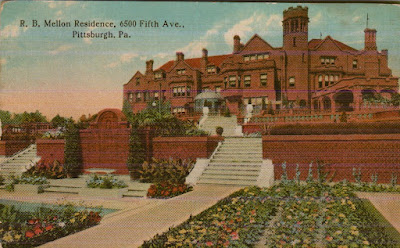
I occasionally took myself to Mellon Park in Shadyside. The park is all that's left of Richard B. Mellon's 65 room mansion, built in 1909. His family had it demolished in 1941. 


By then the mansion had passed its period of usefulness, desirability, and chic (that 1927 Mellon-Scaife society wedding reception notwithstanding). Now Mellon Park encompasses the mansion's grounds; remaining gatehouse; a Tudor Revival mansion dating to 1904 and given as a wedding gift to the Mellon-Scaife newlyweds; and a circa-1912 mansion belonging to Charles D Marshall of Bethlehem Steel. The buildings are today leased from the City of Pittsburgh as the campus for Pittsburgh Center for the Arts and Phipps Garden Center. It's come a long way under careful stewardship; back when I roamed the area, the park was just beginning to emerge from a period of seediness and disrepair.

Oddly enough, bits and pieces of the old RB Mellon mansion can be found scattered around Western PA. Many structural and fine architectural elements made their way to Mount Saint Peter Church in New Kensington (LINK to more photos). These lovely statues which grace the Broderie Room at Phipps Conservatory in Oakland once stood in the mansion's gardens. The girls are probably grateful to be inside and removed from the elements, because Pittsburgh's industrial climate clearly did their complexions no favors!
 

Phipps Conservatory Broderie Room

As a history-loving adult, I came to understand how ubiquitously present the Mellons were in the development of this city and nation. Silly me, it was more than just Mellon parks and dollhouses. This family dramatically shaped Pittsburgh's economic and civic character, and its influence extended far beyond the city.

Only a few other families could influence urban or national destinies to such an extent in the modern era.

And even fewer managed to hold onto their money and influence the way the Mellons have.

The Mellon family

Although there are four distinct branches descending from the legendary Judge Thomas Mellon, I'm unsure how many Pittsburghers know (or care) which Mellon is which. Given that few descendants even carry the Mellon name today, genealogical clarity and historical perspective are that much more difficult to achieve.

Famously private, for the most part Mellons and their kin have kept mostly to themselves in a removed, rarified social sphere. Because of this insularity, even the most famous Mellon individuals don't signify in the collective Pittsburgh consciousness. They are not instantly recognizable the way other local tycoons like Henry Clay Frick and Andrew Carnegie are.

Andrew W. Mellon, c. 1920

There are stand-out Mellons, to be sure. 

Take the wealthiest Mellon, Andrew, a Gilded Age venture capitalist who became the longest-serving Secretary of the Treasury and eventually President Hoover's economic scapegoat in the lead-up to the Great Depression (rightly or wrongly depending upon your read of history). Andrew also built, designed, gifted and endowed the National Gallery of Art in Washington DC to which he  donated much of his personal art collection (as would his two children). 

But because Andrew Mellon deliberately disassociated his name from that institution he created (unlike Frick and Carnegie, who kept their names connected to their philanthropic cultural efforts), the nation's wonderful museum is not commonly associated with the Mellon legacy.

If you're on the look-out, you might spy his name on this bench that surrounds a fountain on a traffic island at 6th Street and Pennsylvania Avenue, between the west wing of the National Gallery and the former Newseum. It's in plain sight but bland and usually overlooked.. Rather like Andrew Mellon, actually.


What Pittsburghers do remember about the Mellons are the salacious details. There are...a lot of them.

  • Andrew Mellon's cuckolding, and his subsequent very public divorce from Nora McMullen, 24 years his junior, rocked the gossip columns in 1912. His marital woes brought him a lifetime of embarrassment. The Mellon children, Ailsa and Paul, were caught in the crossfire and suffered emotionally.
Nora McMullen Mellon by James Jebusa Shannon, 1910
National Gallery of Art
  • The specifics of Sarah Mellon and Alan Scaife's extravagant 1927 wedding still leave readers slack-jawed in amazement. According to contemporary accounts, proud papa Richard B. spent $100,000 to build and decorate a pavilion at his East End mansion for the wedding feast and ball. R.B. Mellon's personal sense of style was exemplified by a hat-rack made of mirrors and buffalo horns and half a taxidermied buffalo head (yes, half), both of which he kept on display as mementos of his youth in the untamed West. Let's assume that these items were rendered less conspicuous by decorators who transformed the mansion into what contemporary newspaper accounts described as "a scene rivaling the beauty of a fairyland bower."  The multiple reception areas of the mansion were decked out with tapestried walls; red velvet hangings lined with gold satin; a faux-marble dance floor; tons of flowers and greenery; seven-foot wide chandeliers; silver candelabras; crystal urns filled with silver fruit; Italian mirrors lining the walls; and gold bird cages suspended from the centers of archways (I could find no mention of the birds living in these gilded cages). The pièce de résistance must have been the blue bridal canopy suspended from the ceiling to act as an artificial sky, festooned with silver stars and flowers twinkling in reflected light from walls of mirrors. Or maybe it was the lighting illuminating the estate's life-size statuary that surrounded an artificial lake (no doubt including the above-mentioned girls now living at Phipps Conservatory, where today they witness comparatively down-scale nuptials).
    Sarah Cordelia Mellon Scaife, 1940
    Gerald L. Brockhurst,
    Carnegie Museum of Art

  • Sarah's daughter, Cordelia Scaife May, scrupulously shunned publicity but left a legacy brimming with gossip. There was an early, disapproved-of marriage and subsequent divorce. And there was all that fuss about her then-boyfriend former Allegheny County District Attorney Robert W. Duggan: his political scandals, their hasty marriage likely orchestrated to legally avoid being compelled to testify against him during a federal corruption investigation, and questions surrounding his sudden death (accident? suicide? murder?). Cordelia characterized her mother as "just a gutter drunk" but also noted that she and her brother Dick were no better.  Cordy May's lifelong championing of environmental and sustainability causes, her many private but generous philanthropic efforts through her Laurel Foundation, and her backing of conservative anti-immigration/population control causes (including funding recognized hate groups) through her Colcom Foundation are her legacy.
  • Three of the four adopted children of Richard King Mellon (son of Richard B.) managed to slide under the media radar. But the youngest of his two sons, Seward Prosser Mellon, made headlines in the mid-1970s related to a horrific custody battle with his ex-wife. The potential trauma inflicted upon their daughters (who were first abducted by their troubled mother after she left a treatment program, then re-abducted a year later at gunpoint by Mellon's employees outside their mother's home in NYC), rivaled that inflicted on Ailsa and Paul Mellon during Andrew Mellon's custody battle at the turn of the century. A grand jury found that the forcible removal of the girls to Pennsylvania was not subject to prosecution given the previous conflicting custody rulings involving competing jurisdictions of New York and Pennsylvania. Federal law was on "Pross" Mellon's side since the federal kidnapping statute specifically exempted parents. Given his ex-wife's well-documented personal difficulties, plus alleged threats to the girls' safety by organized crime, Pross Mellon and his second wife were able to keep custody of and raise his daughters. The case is often cited in discussions of custody conflicts that result in parental child-napping, and eclipses his many good works, including the largest single gift of land ever made to the nation in 1990. The Mellons, they don't do divorce quietly.
  • Matthew T. Mellon, Sr., grandson of the eldest of the Mellon sons, obtained a PhD in history and was an American Studies professor at University of Freiburg from 1928-1939. His dissertation was published as Early American Views on Negro Slavery, hailed as a ground-breaking treatise of the views of some of the founding fathers on slavery. Despite that, and despite his charitable generosity and reported kind character, if he is mentioned at all these days it is in the context of his Nazi connections. He attended the Nuremberg Day exercises in 1936 as a personal guest of the Führer, and very much respected the revitalization of Germany under Hitler's rule. To his credit, he voluntarily left Germany before the outbreak of the war and did not support the subsequent Nazi regime, although he remained a Teutophile all his days.
  • His brother William Larimer Mellon Jr, gets lost in the gossip despite his astounding humanitarian efforts. Reflecting upon the Mellon monies and a life of privilege, Larry Mellon once stated "Wealth really can't work for you. Either you get a cockeyed notion of your own importance or you get an inferiority complex. I guess [the latter] is what I had. Once I got the idea that dollars were foolish, the people chasing them seemed foolish." Inspired by Albert Schweitzer, Larry Mellon decided to return to college in his late 30s to become a physician. After graduating from Tulane University at age 45, he and his second wife Gwen established l'Hôpital Schweitzer in 1956 some 90 miles northwest of Port-au-Prince, Haiti. They devoted the rest of their lives to serving the people of that horribly impoverished country, working in an atmosphere of mutual respect for Voodoo priest-healers whose cultural practices traditional missionaries would have immediately tried to expunge.
  • Western Pennsylvania music lovers have never gotten over the closing of the Graffiti Showcase Cafe, a venue for live music for 26 years, when the entirety of the former Oakland warehouse housing Grafitti was purchased by Richard M Scaife's son David in 2000. David Scaife had been storing his multi-million dollar collection of luxury automobiles in the adjacent car boutique. He ultimately decided it was time to evict the rock-n-roll riff-raff so he could peacefully use the remainder of the warehouse for more fancy car storage space.
  • Other Mellons have became punchline-famous because of their associations with the moral failings and political machinations of characters on the national stage. Witness, for example,  the obsession of Sarah's son Richard Mellon Scaife with the Clinton family, which went on for decades. Or consider how the mental competency of Rachel Lambert "Bunny" Mellon (a Mellon by marriage, she was the second wife of Andrew Mellon's son Paul) was called into question over her support of now-disgraced Senator John Edwards.
  • And then there are drugs. Peggy Hitchcock (daughter of Margaret Mellon Hitchcock, a sister of Matthew and Larry mentioned above) was married for a time to 1960s American counterculture leader Walter Howard Bowart, whom she met through mutual friend and former lover Timothy Leary. Yes, THAT Timothy Leary. Peggy Hitchcock participated in Leary's early psychedelic experiments. She introduced Leary to her brother William "Billy" Mellon Hitchcock, and he in turn became the Daddy Warbucks of the Counterculture. Billy made the family's secluded Millburn, New York estate available to Leary and his team of Harvard researchers, where they famously examined psychedelically-altered states of consciousness. So it's not a stretch to say that we have the Mellon family money to thank for LSD. Hitchcock himself kept his distance from Leary and his trippy team, and eventually evicted them from the "Big House" with things got out of control. However, he himself bankrolled an extensive black-market LSD manufacturing and distribution operation from the West Coast. He was fined and received a suspended sentence for his efforts after providing crucial testimony against some partners.
    https://blogs-images.forbes.com/nathanvardi/files/2018/04/0130_matthew-mellon-crypto_1080x1080.jpg
    Matthew Mellon II in 2018. Ethan Pine for Forbes Magazine
  • All that makes international fashion mogul Matthew Taylor Mellon II's (3x-great grandson of Judge Thomas Mellon through his oldest son James) investments in Bitcoin and contributions to Julian Assange’s bail fund look tame by comparison. Matthew Mellon died at age 54 in 2018 in Cancun, Mexico, where he'd gone to check into a rehabilitation clinic to address his long history of substance abuse. It's not known if the fee was paid with cryptocurrency.

Even the venerable institutions associated with the family make news when scandal hits. Mellon Bank, then Pennsylvania's largest banking institution, dis-invested in the Pittsburgh region during its time of need in the early 1980s. It became the target of steelworker ire culminating in disruptive demonstrations, boycotts and mass withdrawals of funds. The church that Richard B. Mellon built, East Liberty Presbyterian, became one of several targets of protests by the controversial Denominational Ministry Strategy (DMS).

Judge Mellon would be dismayed by it all. Then again, Judge Mellon was no prize.

Ubiquitous Mellons

For me, a childhood of passing familiarity has led to a lifetime of fascination. A direct line of correlation can be drawn from kid-me peering through windows into a miniature Mellon world in 1969, to adult-me reading articles and biographies about the family. 

I can now extemporaneously follow various Mellon lineages, dissect Mellon accomplishments and scandals, and marvel at how this one family has disseminated its reputed $12 billion wealth and influence. 

But for all that this makes me an unintentional font of Mellon trivia, the family still exists for me in a world apart, one separated from my understanding and experience by more than glass.

The other day as I was walking in Highland Park I came across a memorial. It had been erected in 1912 by Sarah Negley Mellon to honor her grandparents, Alexander and Anna Maria Burkstresser Negley, who were buried there in unmarked graves along with many other nameless Pittsburgh pioneers. I'd walked past this grove many times in the six years I lived in Highland Park. Even as I half-remembered old jokes about the haunted grove in the park, I was haunted by other musings. 

Here, I thought, perhaps here is something I can actually relate to.

Forget the dollhouses of that other Sarah Mellon, or the myriad Mellon parks, businesses, and mansions built by the Mellon men. 

Put aside the scandals. 

Instead, take heed of this: a monument to one woman's love of family, and her desire to honor the past. 

But who was this woman?

Sarah Jane Negley

This much, I knew: Sarah Jane Negley Mellon was an heiress descended from multiple Pittsburgh pioneer families who once owned nearly all of the East End.

The family of her grandfather Alexander Negley had settled in eastern Pennsylvania, but Alexander moved westward to Pennsylvania to soldier during the battles of the Seven Years War. Like the earliest Mellons, Alexander originally settled in Westmoreland County. After harrowing skirmishes with Indians, he resettled his family in the more hospitable Pittsburgh area. His farm, Fertile Bottom, extended along the Allegheny River up over most of what is now Highland Park and the city reservoirs. His son Jacob married Barbara Anna Winebiddle, a descendant of the Taubs (who owned property in present-day Shadyside) and Winebiddles (who owned property all around today's Bloomfield, Friendship, Lawrenceville, and Downtown areas).

Reservoir I loop, Highland Park Pittsburgh on the site of Alexander Negley's farmhouse Fertile Bottom

Jacob and Barbara Negley's combined property holdings encompassed most of modern East Liberty (once actually known as Negleytown) and the adjacent East End. Their 1808 red brick farmhouse, known as the Negley Mansion, once sat at what is now the corner of Stanton and Negley Avenues. They continued to add to their property, farmed, established a bank, ran a general store called the Black Horse Tavern, and operated the first steam-powered gristmill east of the Allegheny Mountains. The Negleys built the first of an eventual five churches on the same property that their grandson Richard B. Mellon would one day enshrine as the present-day Gothic-style cathedral of East Liberty Presbyterian Church.

But by the time the ambitious Thomas Mellon came looking for a wife, the Negley fortunes were in decline. Despite his commercial and proprietary successes, Jacob Negley had borrowed heavily against his property for investments. That gamble worked against him following the economic downtown of 1819. He died deeply in debt. Only the financial support of family friend Congressman James Ross allowed the Negleys to keep their property.

Jacob and Barbara Negley had a dozen children, though only eight survived to adulthood. Tenth child Sarah Jane Negley received her share of the family money in the 1830s when it was divided by Ross into parcels for each of Jacob Negley's surviving children/heirs. Her inheritance was not an inconsiderable amount of land.

Sarah Jane Negley Mellon, Carnegie Library collection

The young Sarah Jane attended school in a frame building built by her father in 1819, near today's East Liberty Presbyterian Church. She was 'finished' at the Edgeworth Ladies' Boarding School in Braddock, where she benefited from an exceptionally well-rounded education in addition to polishing the necessary social skills for a woman of her position. For $200 a year (paid three months in advance) Sarah Jane would have studied reading, writing, arithmetic, grammar, composition, geography, astronomy with the use of globes, natural philosophy, chemistry, history, and plain and ornamental needle work. Music, drawing and painting, and French cost extra. The school noted that "To study, coercive means are not employed, reference is made to the heart as well as the head, and the study of every branch, and the proportion of time given to it, will be subservient and tributary to useful and moral and religious improvement."

The title pages of Sarah's school books were copied by her son James and can be found in the Heinz History collections:


Thomas Mellon came a'courting in 1841. 

Photograph of Thomas Mellon, circa 1840s.

Looking back on the day they met in her parents' parlor, Mellon would later write a dry, clinical appraisal of Sarah Jane's charms and their courtship in his memoirs:

I took her in at a glance; and now, after over forty years, can well remember how she looked then, even to the fashion of her hair and every minute particular of her dress. I see her now in the mind's eye, as she stood there in the sunlight which was struggling through the window curtains giving me a full view of her appearance--quiet, pleasant and self-possessed. I remember thinking to myself, in person she would do if all right otherwise. I remember also of its flitting across my mind, whether this might be the one of destiny!

Apparently she was "all right otherwise" because Thomas Mellon decided to pursue Sarah Jane.

Was it love at first sight? Did he know in an instant that Sarah Jane was "the one of destiny"?

Doubtful. This was a relationship which appears to have been based on mutually calculated,  emotionally-detached appraisals. Even writing in retrospect what stood out for Thomas Mellon was that, all things considered, this 27 year old heiress was a good catch.

She would "do."

We can't even guess what Sarah Jane thought of her suitor, for she did not record her impressions for posterity. She didn't turn Thomas away, but then again, neither did she encourage him.

The way Thomas describes their courtship is intriguing for the boorish but earnest picture it paints of him, and the enigmatic portrait presented of Sarah Jane. Thomas Mellon pursued his intended via weekly chaperoned visits at the Negley Mansion over six long months. He persisted in the face of little if any enthusiasm from Sarah Jane, whom he saw as polite and conversational, but distant and discouraging of intimacy. She flatly ignored attempts at flattery and flirtation, leaving poor frustrated Thomas lamenting that he was made to feel "...that to talk love would be out of place and might subject me to to ridicule."  

By the end of his six months a'wooing, Thomas Mellon no doubt wryly ruminated over the observations of his close friend Richard Beatty, who had passed over Sarah Jane for a younger Negley sister because Sarah was "....too independent for him, had no elasticity in her composition, and did not seem to appreciate gentlemen's attentions."

Even Sarah Jane's small talk seemed to get on Thomas' nerves, for he notes in his memoirs:

I was not there to take lessons in flora culture or botany, or to learn the history of birds, fishes or butterflies. I did not want to spend evening after evening in admiring pictures in her album, or in having items read to me from her scrap book. But to her credit I must say that she never inflicted any music upon me, as she professed no special efficiency in that accomplishment.

Apparently the Negleys didn't pay extra for those music lessons at the Edgeworth Ladies' Boarding School.

Thomas finally reached his limit. Seizing an opportunity when their chaperone was out of the room, he one day declared his intentions to Sarah Jane, voiced the hope that she felt the same, then "....took a kiss unresisted and said that would do, and I was satisfied; and left her abruptly, feeling unnerved for conversation."

What was it about this "quiet, pleasant, and self-possessed" woman that set the steely-eyed and practical thirty year old bachelor off course, yet kept him coming back for more? Thomas Mellon assures us in his memoir chapter entitled "Courtship and Marriage" that Sarah Jane's attitude was not born of coquetry. She was not playing hard to get. She seems instead to have been one who naturally kept her own counsel and was always emotionally reserved. 

She certainly didn't adopt any coquettish airs once they were engaged, either:

At my next weekly visit we met on closer terms and more cordial feelings; the wall of separation was removed and I applied to her mother for her consent, and received a ready and satisfactory answer to the effect that as we had agreed she knew of no objection. I then applied to my affianced to set the day, suggesting a week or ten days as sufficient interval. This she opposed with some surprise, and insisted on six weeks. We finally compromised on a month, and accordingly the transaction was consummated on the 22d of August, 1842. The details of the wedding are uninteresting; all such ceremonies are pretty much alike. Her distant and independent attitude, so well maintained during our preliminary acquaintance, had made me sometimes fear a cold and unsympathetic disposition; but I found her nature quite the contrary, her feelings warm and abiding, but undemonstrative.

No record exists as to how Sarah Jane Negley characterized her husband, the man who described their marriage as a "transaction" that was "consummated." We don't know if she, too, found recounting the details of their 1842 wedding "uninteresting." Nor do we know what she thought of their then-novel honeymoon trip to Niagara Falls, returning by way of Boston, New York City and Philadelphia.

Their wedding trip made quite an impression on Thomas, though, who states that neither of them had hitherto traveled much (Sarah Jane previously having been on a "boat excursion with some friends" to Louisville). Thomas devoted an entire memoir chapter to their trip. In it he mentions his wife twice, book-ending the chapter with comments about her at beginning and end. 

It's not that Sarah isn't present throughout--he makes consistent use of first person plural pronouns when describing their travels. But the chapter is all about their itinerary, not their intimacy. 

Only a comment following a frightening adventure on the Pennsylvania Canal when their boat almost plummeted over a dam on the Juniata River near Harrisburg reflects the experiences of his new wife: "In this crisis I first noticed my wife's entire command of her feelings in the suppression of every sign of fear or alarm." 

It's hard to tell whether Sarah Jane's preternatural self-possession unnerved or impressed him. Perhaps it did a bit of both.

Mid-1800s canal boat along the Juniata Division of the Pennsylvania Canal
Juniata County Historical Society


Married life of Sarah Mellon

The newlyweds moved in with Sarah's mother and some Negley siblings who'd remained in the family home. Interestingly, Thomas Mellon heaps unreserved praise upon his new mother-in-law, whom he found to be "....agreeable and pleasant...a kind mother possessed of superior qualities and sound, practical good sense...."  He would later claim that never was there "....the slightest unpleasantness or misunderstanding ever occurred between us" throughout their lives. Mrs. Negley would in fact live out her final days with Thomas and Sarah Jane, bequeathing the bulk of her considerable real estate holdings to Sarah Jane and other descendants (thereby providing the foundation for lucrative Mellon real estate development in the East End). 

Thomas Mellon warmed up to his new wife, whom he described as taking "....full possession and master of the situation, not the least discouraged through without any company or help...." when the couple moved into a rented home downtown. Things were looking up, especially since "....my wife was herself a good cook and not in the least averse to work....we were all in all to each other. Such was the beginning of my married home life."

Heinz History Center Detre Library and Archives

Thomas got back to work quickly after their honeymoon. He recalled that "....since marriage, the last important event of my life was consummated, and nothing left to distract my attention from business, I could feel that I was fairly settled...."

Did Sarah Jane feel "fairly settled"?  Did she grow to like, or love, her husband?

The couple moved back in with the widowed Mrs. Negley when Sarah was pregnant with their first child in 1844. A few years later, they moved nearly next door into a home Mrs. Negley gifted them.

Children followed in rapid succession. Their two daughters did not live past infancy, and another son died at age 9. Thomas had his acknowledged favorites, but we don't know if Sarah had a favorite among her surviving sons. We don't know if she longed for a daughter to replace her lost baby girls.

The education and supervision of chores for their five surviving boys seems to have been left to Thomas's oversight.

After nearly a decade of marriage, Thomas and Sarah Jane built a new home for their growing family on Negley land adjacent to their existing cottage, with an eventual address of 401 Negley Avenue. Surviving photos reveals a stolid farmhouse, described as white with green shutters.

Mellon family home from 1851-1955, 401 N. Negley Avenue, Pittsburgh.
  Pittsburgh City Photographer Collection, University of Pittsburgh

The Judge author and descendant James Mellon describes a dark and sturdily decorated Victorian interior. Bedrooms were on the second floor and formal entry, parlor, dining room, study and kitchen occupied the first floor. One of Sarah and Thomas' grandsons, William Larimer Mellon, essentially grew up in the house from 1868 on. In his memoir, Judge Mellon's Sons, he described how "....every kind of activity associated with a farm, including the slaughtering and dressing of hogs, was regularly carried on there. Yet it was not really a farm but a country home."

In The Judge, grandson William Larimer Mellon described his grandmother, our Sarah Jane:  

My grandmother, her voice was a little stronger...a little bit sharper...She had a little blue in her eyes....When I knew her, her hair was gray. It had been dark. She was an unusually kind person but a very energetic woman. Very energetic. She ran the house. She had some servants, but she was the main engineer by a long shot...was a tremendous worker...walked fast...one of those people who put up apple butter and everything else, all the same day...just a regular worker. She was very friendly always, and would bake cake for you or anything of that kind.
According to William, Sarah Jane maintained a large household comprised of memorable characters:

My grandmother ran the home. But, since she likewise had duties to her church and to charity, she kept control of the household through old Mrs. Cox, who was called housekeeper. Mrs. Cox compensated for my grandmother's gentleness by a certain quality of character which she must have inherited from some Simon Legree among her ancestors...Her nose and chin came close together for lack of teeth; so, as she sucked at her short-stemmed clay pipe, nose and chin and pipe seemed to form a trinity of features. As a little boy, I found it difficult to believe that anyone as tough-fibered and ferocious (on provocation) as Mrs. Cox ever could have been a beautiful girl. Yet such was the legend in the family. She was a connection of the Negley family. Soon after her marriage her husband had died and my grandmother had taken her in. She had stayed on, making her own place as the years passed--and a valuable place it was...There were a number of servant girls...because there was a vast amount of household work....The staff, which Mrs. Cox headed, included old Harriet, who was a kind of principal maid, supervising the chamberwork of lesser maids.

Portrait of Mrs. Thomas Mellon (Sarah Negley), 1896
Théobald Chartran, Carnegie Museum of Art

Sarah eventually acquired a sizable staff to supervise. By necessity she would have become removed from day-today housework once she and Thomas became pillars of their community and she gravitated to a prominent social role outside the home. 

But Sarah remained connected to the goings-on at home. She had to, if this anecdote from William Larimer Mellon describing his involvement in "....a parasitical business based on selling the produce of my grandparents' country place" is any indication of what life was like in household filled with entrepreneurially enterprising men and boys:

The wagon had come down to me from my uncle Andrew; it had been prominent in an older phase of the business; to wit, the egg department. One of the worst scrapes my father got into as a boy was through an egg deal with the grocer down in East Liberty. One day my grandmother had driven up to the grocer's door on a shopping expedition. When the man came out to greet her, Grandmother ordered some dozens of eggs, complaining, as she did so, at the reluctance of her hens to lay. That grocer, caught off guard, made some remarks through which Grandmother found out that most of the eggs he sold at his store came from her own poultry house! The guilty entrepreneur was little James Ross Mellon, my father. He got a hiding for that--but only because he had been too greedy. Grandfather, I suspect, always was delighted when his boys, including me, engaged in any kind of business; even though we did it as a kind of play. He liked aggressiveness and initiative in men. 

It's tempting to think that through all the bustle of testosterone-driven family life, Sarah Jane remained vastly competent, cool, and collected -- if also emotionally detached and undemonstrative.

Circa 1887 at the latest. From Judge Mellon's Sons by William Larimer Mellon

How did she feel when she found out that her sons were stealing eggs from her henhouse and vegetables from her garden to sell for profits that came from her own pockets? Was she secretly amused, and perhaps even a bit proud of their ambition? Or did she make sure the boys got well-deserved hidings?

It's hard to imagine any such shenanigans getting past Sarah Jane. Photos published from family collections reveal that she possessed as steely and arresting a stare as that of her legendary husband Thomas. Although Judge would lose his sight in old age, Sarah Jane's gaze remained steady and appraising.

Sarah's position in the growing East End community was as much matronly as mannered. Her grandson recalled:
Many a night I was awakened by hearing someone pounding on a door or calling out to arouse my mother or grandmother. Paddy Clark or Tommy Thompson had been kicked by a mule! Invariably the excuse for such a uproar was: "We are afraid he's going to die." The women would dress, and prepare poultices and the victim would get a drink of whiskey. Many a laborer got a drink to compensate him for a kick; and no kick was ever fatal.
Did Sarah recognize that her nursing was probably secondary to Paddy's or Tommy's desires for a wee dram?

Did she understand how her husband's grief for their deceased children left him vulnerable to the Victorian charlatans who practiced Spiritualism? If so, there was probably little she could do to stem his exploration of the supernatural. Upon retiring, the 77 year old Judge essentially separated from her for five years and headed West to explore new business opportunities. One family member or another spent time with the aged Judge during this sojourn in Kansas and Missouri, and several witnessed how Judge Mellon consorted with mediums and attended séances. His interest may actually have been sparked by a former servant of Sarah's, whom grandson William Larimer described as
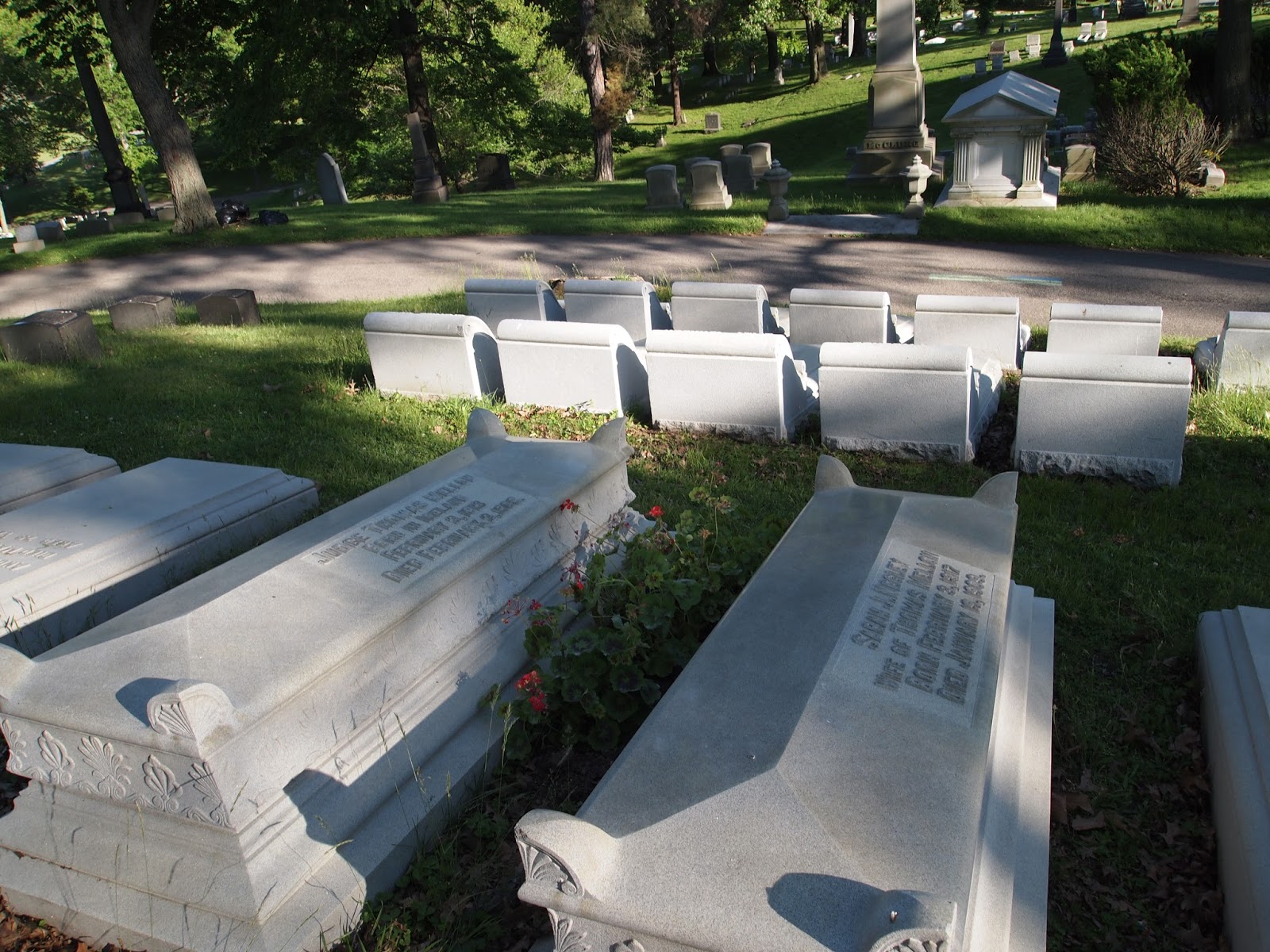
....a young girl named McLean who had been brought into the home in 401 Negley Avenue (who) came under the influence of this mania which was then sweeping the country. She began to be associated with strange noises. Mysterious rappings were heard in the house but only in the presence of this girl. Whether she was a victim of someone else or whether she was a conscious or unconscious fraud, her supposed powers excited a number of people in Pittsburgh, and there were repeated tests with the result that the child came to be regarded as a "natural medium." The effect on the girl was far from wholesome and, on medical advice, she moved eventually to a new environment.

What did Sarah Jane think of this girl's supposed affinity for the otherworldly? William Larimer's parents were not believers, and he wrote sympathetically but scathingly in his memoirs about his grandfather's doty adventures with Spiritualism. He believed the old man's sentimentality had been taken advantage of. Did Sarah? Eventually even Judge Mellon himself concluded "There's nothing to it" and returned home.

Was Sarah Jane curious about the mysteries that the Spiritualist world purported to reveal? Did she sympathize with the Judge's quest to connect with their lost children?  If not, would she have dared to tell him, to scoff at him? Did she want to say "told you so" when all was said and done?

And, really, did she miss the Judge while he was gone those five years?

The Mellon private family archives contain private written material and memorabilia which no doubt shed more light on Sarah Jane's personality -- including the scrapbooks which so infuriated her husband when they were courting. It would be lovely to curl up with those books to see what she collected, to learn what held her interest and curiosity. We know from published family accounts that one scrapbook contained images of presidential log cabins. Others were filled with religious and inspirational maxims.

In the absence of access to such cherished family material, Sarah Jane must remain aloof and ultimately unknowable to history while her husband Thomas commands center stage. 

We can only guess at her inner life. 

But that's probably as she would have liked it. Sarah was a woman of her times. Being quiet, pleasant, and self-possessed would do.

In The Judge, another quote from grandson William described how the Mellon marriage evolved...or rather, how it bobbed placidly in place on the surface for decades:

The wedded union of Thomas and Sarah was exemplary in its sense and practice of loyalty and duty, in the perfect old-fashioned way; but...it was not a case of tender love and sentiment....They roomed and slept together and never were separated...[but] they were not lovers, not even company for each other, just good domestic partners...

His wife was a tender-hearted and capable of full sympathy, but not of grievous suffering. She was motherly and dutiful, but more stoical. It was the way of the Negleys.
The couple took a grand tour of the United States and Mexico in 1886, after the Judge returned from his five year business/séance odyssey out West. No canal boats this time -- they traveled in style in a private rail car, with various sons and daughters-in-law and grandchildren joining them along the way. James Mellon described a travel journal from the family archives that Sarah Jane kept about this family trip, noting that 
....her lively, articulate travel log gives us our only firsthand encounter with the woman who shared Thomas Mellon's life for sixty-four years. Ma emerges from the page as an uncanny observer and accomplished story-teller. She writes with authority and conviction about landscape, history, the people she encounters, and their customs. Her observations on geology and agriculture reveal a startling command of these subjects, reinforced by a vocabulary that extends even to Latin names. Clearly, some of her schoolbook learning at Edgeworth Seminary had not faded.

Some personal material related to Sarah Jane does exist for public access. The Senator John Heinz History Center in Pittsburgh retains the papers of Sarah Jane and Thomas' second son, James R. Mellon, a collection open to researchers. In addition to diaries and valuable historical documents, the collection includes two hand-written letters from Sarah Jane, plus the title pages from school books that once belonged to each of his parents (see above for Sarah's). 

In May 1864, in separate letters both the Judge and Sarah Jane responded to their then-18 year old son's desire to join the Union Army for a 100 day enlistment. James was away at college. Stirred on by patriotism and inspired by a recruitment lecture, the impressionable young man assumed that parental consent for his enlistment would be a given. 

It wasn't.

Sarah Jane piled on to the scolding that James received from his father. Such effrontery, to even consider the idea:

My dear son, look to God and ask directions with no one-sided view of the matter and will guide you aright. I had thought you were a boy of stronger mind and better sense or I never would have allowed you to go from home. You are a poor, misguided boy and that you will find both to you and your parents' sorrow....My dear son, abandon the idea and come home as soon as you can...Come home, come home. Wait not for anything. I can't write any more but the same over and over again come home! Except this love your devoted mother S.J. Mellon


Sarah Jane's infamous detachment has been thrown to the winds in this passage. She sounds like any other mother lighting into her son for what she thinks is a bad idea. And to the Mellon parents, enlistment in May 1864 was indeed a very bad idea. The controversial then-Lieutenant General Grant had been newly appointed as commander of the Union Army and the Battle of the Wilderness had just concluded, resulting in more than 25,000 casualties. 

Despite admonishments from his parents, James didn't come home. But neither did he join the Union Army.

Other than these glimpses, the public is left with only the name and limited understanding of the life of Sarah Jane Negley Mellon as filtered through others' experiences. A gossipy 1888 book entitled The social mirror: a character sketch of the women of Pittsburg and vicinity during the first century of the county's existence alphabetically categorizes the women of the city according to the qualities of beauty, intelligence, musicality and artistry, charity, wealth, moral do-gooding, and positions of social standing that they best exemplify. We find Sarah Jane under the Mellon listing in a chapter entitled "Women of Wealth":

It is quietly whispered among their friends that Judge and Mrs. Mellon, of Negley Avenue, are not worth more than six or eight millions. Mrs. Mellon was a Miss Negley, and their beautiful home and large grounds, full of rare statuary, are part of her father's estate. The pride of the lawn is an immense copper beech tree, under whose spreading branches in the summer time the family and their guests love to gather. Beside the paternal roof Mr. Thomas Mellon has built his home, and just opposite, on Negley Avenue, James Mellon, another son, is established, the three places, all as perfect as wealth can make them, a veritable earthly paradise. Mrs. Judge Mellon is a lovely woman and fairly idolized by her husband and sons...   

There you have it. She was lovely, and her family adored her, and she had a nice big tree and a fancy house. The rest of the Mellon entry describes two of her daughters-in-law.

What Remains Behind

Judge Mellon's private memoirs were made public by his family, providing invaluable insights into the private life of this couple. 

But Sarah Jane's private letters, scrapbooks and travel journal, those few documents we know she left, remain within the control and interpretation of her descendants. This is not surprising for such a self-contained woman, and is to be respected, despite the regrets it engenders for the curious historian! 

We are also left with very little in the way of physical artifacts to remember Sarah Jane by. That's a shame considering the century's worth of astounding history she orchestrated by providing a serene life behind-the-scenes for the Mellon men. This isn't an unusual circumstance for women throughout history, of course.

Negley Mansion, Edgeworth Ladies' Boarding School, and the Mellon "country home" on Negley Avenue are all long gone. 

A farmhouse built by grandmother Anna Maria Negley following her husband Alexander's death still exists in Highland Park. It likely knew the tread of Sarah Jane's feet when she came to visit, but it was not her home. 

That "immense copper beech tree" is no more. 

Only the stone gateposts remain from the Mellon home, half-hidden in the ivy near a split-level cul-de-sac along Negley Avenue.

Stone from the Mellon gatehouse on Negley Avenue


There is a grave, of course, in Section 19 of Allegheny Cemetery. Sarah Jane lies beside her husband, not far from their three children who died young and another son who died of tuberculosis in early adulthood. The Mellon graves rest just above those of Sarah Jane's parents and other Negley kin.

Grave marker for Sarah Jane Negley Mellon (1817-1909), Allegheny Cemetery

Graves of children Sarah Emma (1847-50), Annie Rebecca (1851-52)
Samuel Selwyn (1851-62) and George Negley Mellon (1860-87).


There was an obituary, too. But not surprisingly, it is more about everyone else in her life.

Mrs. Sarah Jane Mellon, widow of former Judge Thomas Mellon, died at 7:30 o'clock this morning at her home, No. 401 North Negley Avenue. Mrs. Mellon would have been 93 years old on February 3. Her passing was sudden but peaceful. From apparently the best of health, the well-known aged woman dropped into a slumber last evening and quietly slept away her last hours on earth. With the death of Mrs. Mellon, the old East Liberty valley loses the last of its pioneer residents. Her husband, the former jurist, died suddenly on February 3 of last year, while preparations were being made to celebrate the ninety-fifth anniversary of his birth. Mrs. Mellon was born in the district which she had so long called home, on February 3, 1817. Her father was Jacob Negley and her mother had been Anna Barbara Winebiddle. The histories of both families are closely interwoven with that of Pittsburgh. In the early days, while East Liberty still was a separate borough, Mr. Negley conducted a grist mill there and with his brother kept a stall in the old Diamond market, making trips with his grain twice a week. Both families owned much land in the East Liberty Valley, which they used for farm purposes. On August 24, 1843, the dead woman was married to Thomas Mellon, then a rising young lawyer at the Allegheny county bar. On their wedding trip, they journeyed through Canada and this event is chronicled in an entertaining style by the deceased jurist in the history of the Mellon family, which he published a few years before his death. Judge Mellon was the founder of the Mellon National Bank, and as his sons reached maturity, he took them into partnership. There are but three children surviving this union living at this time. They are James R. Mellon, president of the City Deposit Bank, in East End; Andrew W. Mellon, president of the national bank bearing his name, and Richard B. Mellon, vice president of the same institution. Besides these, 10 grandchildren and six great-grandchildren survive. Mrs. Mellon was an active member of the East Liberty Presbyterian Church, the site for the edifice at the corner of Penn and Highland avenues in the East End having been given to the congregation by Judge Mellon. Despite her advanced years, she took great interest in charitable work, the Home for Aged Protestant Couples, of Wilkinsburg, being the special object of her benefactions. 19 Jan 1909
And there is that granite monument in Memorial Grove, smack dab in the middle of Highland Park.

Negley Monument, Memorial Grove, Highland Park Pittsburgh PA


Is this really a burial ground? Conflicting stories exist as to where Sarah Jane's grandparents Alexander and his wife were buried. There are some claims that they were re-interred on the spot beneath the marker in Highland Park, having been moved there. One story claims that they were originally buried downtown Pittsburgh at Smithfield and Sixth Streets, at what became the German Evangelical Protestant Church church (just around the corner from today's Mellon Park). The church and a cemetery were established on family property granted by descendants of William Penn in 1792. That cemetery was closed in 1860 when the site was needed for further urban development. When the downtown burial ground, then called Smithfield Street Cemetery, was closed, remains were removed to Troy Hill and not a Highland Park burial ground.

From Troy Hill, a subsequent closing in 1888 meant the poor souls were re-interred one more time, to the Smithfield East End Cemetery in Squirrel Hill, now maintained by Homewood Cemetery. 

I suppose what with all this moving about of bodies, it's not surprising that a mistaken reburial to East Liberty got attached to this story. Still, the Negleys are not listed among the burials at Smithfield.

It certainly is startling for modern park-goers to find what may be a grave site in their midst, and someone along the way must have tried to deduce an explanation. But in fact, it's not unusual for rural communities like old Negleytown to have had their own burial grounds. The modern urban landscape grew up to surround it, but the graveyard was there first. Somewhere in Highland Park lie the Negleys with their many friends and neighbors. The memorial stone indicates that the remains of some 50 other East End pioneer families are interred therebaouts, although I have not been able to find a comprehensive list.

One side of the monument reads: Sacred to the memory of those noble Christian pioneers who moulded the character of this community in its struggling and formative period. This monument marks the center of a burial ground located on the former homestead of Alexander Negley, where are interred about fifty early settlers of the East Liberty Valley. 

 And on the other side:

In memory of Alexander Negley, born in Germany 1734, of Swiss ancestry, came to Eastern Pennsylvania 1739, served in the war of the Revolution, settled on site of Highland Park 1778, died Nov. 3, 1809, and his wife Mary Ann Burkstresser, born in Bucks County, Pennsylvania, June 20, 1741, died June 17, 1829, both interred here. Erected by their grand-daughter, Sarah Jane Negley Mellon

In this era when a woman was most known by her husband's name, as Mrs. So-and-so, it's hard not to make too much of the fact that Sarah used her own names on this marker.   


Whither, Sarah?
Sarah Jane didn't make a marriage of passion. She was by all accounts a pleasant, dutiful mother and grandmother, but not a doting one. She traveled little. She devoted herself to church and community. She didn't seem to collect much beyond platitudes, trivia and memories in her scrapbooks -- nothing like the grand homes or art that her offspring would acquire. She didn't design or fund the building of mansions or imposing buildings.

This was a woman who had the means to do anything she wanted, and then some. But she seems to have remained the same quiet, pleasant, self-possessed, keen-eyed observer of the world whom Thomas Mellon met in 1841.

Perhaps her detachment only went so far. If we are to take the singular monument in the middle of a city park as testimony to anything, it's this: connections mattered to Sarah Jane Negley Mellon. Honoring family and accomplishments mattered.

I don't know how Sarah Jane would regard the checkered reputations of her descendants, but I certainly think she was proud of her own past. Her legacy remains forever entwined and eclipsed by that of the men in her life, just as Judge Mellon's actions and desires shaped the core of her adult experiences.

As to the rest, we must imagine and wonder, for we have no miniature dollhouses to prompt imagination. Sarah might have been the dullest of them all, but we'll never know for sure. The grand too often eclipses the ordinary, usually to the detriment of our historical and human understanding.
_____________________________________________________________

SELECTED SOURCES and SUGGESTED READING
Brown, Abram and Alex Morrell. 175 Years Later, The Mellons Have Never Been Richer. How'd They Do It? Forbes Magazine. July 21, 2014.
Cannadine, David. Mellon: An American Life. New York: Vintage. 2008.
Croushore, Jeffrey S. Images of America: Idlewild. Arcadia Publishing. 2004.
Dietrich, William S. II Andrew Mellon: Son of a judge. Pittsburgh Quarterly. Fall 2007.
Edgeworth Ladies' Boarding School, Braddocksfield near Pittsburgh The Pittsburgh Gazette. August 17, 1832.
Fitzpatrick, Dan. Mellon family's legacy lives on, Pittsburgh Post-Gazette, June 30, 2007
Kaiser, Robert G. Money, Family Name Shaped Scaife, Washington Post, May 3, 1999.
Karakatsanis, Costas G. How Sarah Mellon Scaife and Family Helped Transform the Museum of Art. CMOA Blog. February 19, 2016.
Hersch, Burton. The Mellon Family, The: A Fortune In History. William Morrow & Co; April 1978.
Koskoff, David E. The Mellons: The Chronicle of America's Richest Family. New York: Thomas Y. Crowell Company. 1978

Mellon, James. The Judge: A Life of Thomas Mellon, Founder of a Fortune. Yale University Press. May 24, 2011.
Mellon, Paul. Reflections in a Silver Spoon. New York: William Morrow  and Company. 1992.
Mellon, Thomas. Thomas Mellon and His Times. Pittsburgh: University of Pittsburgh Press. 1994.
Mellon, William Larimer. Judge Mellon's Sons. Privately printed 1948.
Mellon Park
Mellon Square
Nevin, Adelaide Mellier. The social mirror: a character sketch of the women of Pittsburg and vicinity during the first century of the county's existence. society of to-day. Pittsburg, Pa: T.W. Nevin, 1888.
Paris, Barry. Song of Haiti. Public Affairs. May 1, 2000.
Paris, Barry. Song of Haiti: The Lives of Dr. Larimer and Gwen Mellon Pittsburgh Post-Gazette Sunday Magazine. September 17, 2000.
Potter, Chris and Dan Roth. Pittsburgh's Colcom Foundation plays major role in immigration-control debate. Pittsburgh Post-Gazette. February 15, 2015.

Scaife Miniatures Placed on Display, Pittsburgh Post-Gazette. February 14 1969.
Tanfani, Joseph. Late heiress' anti-immigration efforts live on.Los Angeles Times. July 25, 2013.
Trebay, Guy.Inside Bunny Mellon's World. The New York Times. November 19, 2014.
Weiss, Anne. Lavish Splendor Marks Brilliant Mellon Nuptials Pittsburgh Press. November 17 1927.