 |
| The Historical Dilettante |
When I was a kid back in the 1970s, I regularly read a column by long-time Pittsburgh Post-Gazette staff writer Win Fanning entitled "Of Cabbages and Kings." Mr. Fanning covered the television beat and his curiously-titled column was replete with TV trivia and programming notes. I was intrigued by the by-line sketch of the bespectacled author chomping on a cigar, and with impeccable kid-reasoning I decided I ought to become a journalist (if I didn't become an archaeologist or a nurse or a veterinarian instead) so I could create my own perplexingly-titled column fronted by an enigmatic, cool self-portrait.
My career aspirations didn't quite turn out the way I planned. But I do maintain this oddly-titled blog, and I do have access to photography filters. No cigar or shades, though.

I ain't got nothing on Win. I know that.
Anyway, when I was older I realized that Fanning had titled his television errata column after a line in Lewis Carroll's poem The Walrus and the Carpenter. It's a dark poem recited by Tweedledum and Tweedledee to Alice, and features the aforementioned Walrus and Carpenter blithely chatting up some oysters before devouring them. Walrus leads off the discussion by announcing to his buddy and the listening oysters:
"The time has come," the Walrus said,
"To talk of many things:
Of shoes--and ships--and sealing-wax--
Of cabbages--and kings--
And why the sea is boiling hot--
And whether pigs have wings."

(Illustration by John Tenniel)
As a grown-ass, educated woman I'm certainly now far better equipped (with Mr. Google by my side) to understand literary references and to even make my own. But I've never lost my cultural curiosity (pop or highbrow, depending upon my mood). I'm forever wanting to experience and know things, and to tap into the experiences of others.
With that as prologue, here's my point: it's the end of the year and all the cool kids are making their best-of lists. I've never been good at ranking but I still can't resist the lure of list-making. This, then, is my year-end hodgepodge. It's less "best-of" and more a partial recounting of the cabbages and kings that made my synapses fire and inspired me to learn this past year.
And so the time has come, the blogger said, to talk of many things....
 Let's talk theater first. The year 2015 was a good one for seeing plays that made me think. Take, for example, My Fair Lady at Pittsburgh Public Theater. I took my daughter to see this production in January, not because it's a favorite of mine, but because she'd read George Bernard Shaw’s Pygmalion in school and we thought it'd be fun to see the derivative musical. I'd not have gone on my own, despite (or maybe because of) having watched the movie many times as a kid when it came around annually on
one the networks (When I try to explain to my kids that we had three choices for screen entertainment back in the day, they stare at me with compassion and pity). My Fair Lady features vivid characterizations, witty lines and catchy tunes...but damn, this show makes me twitch. Time Magazine declared in a 2014 article about the 50th anniversary of the film that My Fair Lady "isn’t misogynistic—it’s about misogyny.” My teen agreed that this was true because she felt the show wasn't about a guy changing a girl, but rather about a girl struggling to maintain her personal integrity and sense of self in spite of the manipulations of a controlling guy. It's a fine but important distinction. When you back up and view it from that perspective, My Fair Lady becomes way more than a quaint period piece. Its themes reflect and transcend attitudes from many time periods, and its satire of class prejudices resonate with contemplative modern audiences who recognize their own social attitudes.
Let's talk theater first. The year 2015 was a good one for seeing plays that made me think. Take, for example, My Fair Lady at Pittsburgh Public Theater. I took my daughter to see this production in January, not because it's a favorite of mine, but because she'd read George Bernard Shaw’s Pygmalion in school and we thought it'd be fun to see the derivative musical. I'd not have gone on my own, despite (or maybe because of) having watched the movie many times as a kid when it came around annually on
one the networks (When I try to explain to my kids that we had three choices for screen entertainment back in the day, they stare at me with compassion and pity). My Fair Lady features vivid characterizations, witty lines and catchy tunes...but damn, this show makes me twitch. Time Magazine declared in a 2014 article about the 50th anniversary of the film that My Fair Lady "isn’t misogynistic—it’s about misogyny.” My teen agreed that this was true because she felt the show wasn't about a guy changing a girl, but rather about a girl struggling to maintain her personal integrity and sense of self in spite of the manipulations of a controlling guy. It's a fine but important distinction. When you back up and view it from that perspective, My Fair Lady becomes way more than a quaint period piece. Its themes reflect and transcend attitudes from many time periods, and its satire of class prejudices resonate with contemplative modern audiences who recognize their own social attitudes.But with that said, we drew the line at revisionist theory proposing Eliza as a feminist archetype. True, she espoused choices and articulated what she would and wouldn't stand for. But we still found her limits cringe-worthy since she ultimately allowed herself to remain with a guy who consistently treated her badly. Neither my daughter nor I lust for vengeance, so we (regretfully) rejected the urge to imagine Eliza flinging those slippers at Higgins' head as the curtain fell. But we both dared hope that if Eliza really felt the boor was worthy of her time that she'd embark on a campaign of sensitivity training to rival Higgins' transformative efforts on her...and that she'd walk out the door for good if it wasn't successful.
Heady stuff for a musical, to be sure, but our post-mortem discussion enhanced the show for me. I learned that sometimes twitching in one's seat at a musical can be good for a soul (if you can sit still long enough to figure out what's so unnerving).
 And then there were original productions, like Grist for the Mill, produced by Dog and Pony Show Theatricals. I get out to see live theater far less than during my pre-parenthood days, back when I actually worked in the seedy Pittsburgh drama underworld. I'm usually supportive if a friend is performing, but even then I must admit that part of my watching brain is distracted by assessing production values and another part of me is preoccupied with vague wishes that I was still walking the boards. But during this performance of a short story written and
performed by local theater phenom Lissa Brennan, I was wholly present and riveted to her words and performance. Despite having known the playwright over many years, this was the first time I'd had the opportunity hear her voice as a dramatic writer. I loved the concept and execution of this piece. The fun Lissa had as writer/performer with language and storytelling was evident and energizing.
And then there were original productions, like Grist for the Mill, produced by Dog and Pony Show Theatricals. I get out to see live theater far less than during my pre-parenthood days, back when I actually worked in the seedy Pittsburgh drama underworld. I'm usually supportive if a friend is performing, but even then I must admit that part of my watching brain is distracted by assessing production values and another part of me is preoccupied with vague wishes that I was still walking the boards. But during this performance of a short story written and
performed by local theater phenom Lissa Brennan, I was wholly present and riveted to her words and performance. Despite having known the playwright over many years, this was the first time I'd had the opportunity hear her voice as a dramatic writer. I loved the concept and execution of this piece. The fun Lissa had as writer/performer with language and storytelling was evident and energizing. |
| Maria Kolivaska Minnaji |
I was drawn to other productions for different reasons. Back when I worked as a psychotherapist, I felt it crucial to maintain a supportive foundation by willingly bearing witness to my patients' painful histories. Psychologist Alice Miller has eloquently written about the empowering nature of what she termed an 'enlightened witness' in the lives of the abused. An enlightened witness supports a victim in the transition to becoming a survivor by sitting with the stories, and that in turn helps to mitigate powerlessness, preserve and pursue hope, and break the cycle of perpetual abuse. I can vouch for the value of sustained active listening, however 'New Age' that may sound, because I saw firsthand how it facilitated healing. Although I no longer work as a therapist, my cultural choices are often guided by a conscious decision to bear witness to mankind's internalized inhumanity through readings and presentations related to slavery and the Holocaust. I feel a moral responsibility to do this because it's crucial for me to understand the worst of history in order to combat modern-day injustices. Plus as a parent, I feel it's part of my job description to be informed enough to connect the dots with my kids.
And so I went to see For the Tree to Drop, produced by Pittsburgh Irish and Classical Theatre. This was the world premiere of a play also written by the talented and hard-working Lissa Brennan (Okay, seriously, not a stalker fan-girl...personal connections will tear me from the vast suburban cultural wasteland every time). Inspired by Antigone but set in the antebellum/early war-torn South, this play's focus on maintaining dignity and grace in the face of slavery's dehumanization echoed my long-held beliefs about the power of an enlightened witness.
Later in the year, we took our teen and tween to see The Diary of Anne Frank at Pittsburgh Public Theater so they could also bear witness. Anne Frank's diary tops the list of a half dozen formative books from my adolescence. I've visited Anne Frank Huis in Amsterdam and I think I've probably read every biography and analysis of her life and history that's been published. This was the second production of the play that I've seen, and while I have some personal issues with how Anne is written, I am pleased that her story continues to be told.
In addition to these and other local productions, I got to take in some theater while traveling. I am not much for the overblown emotionality of musicals, although I do appreciate the talent on display. But Gershwin is my man, so I was thrilled to take in a preview of An American in Paris on Broadway last spring in NYC. This is a far more morally ambitious production compared to the movie, thereby allowing a layering of modern sensibilities and circa-1951 post-war perspectives that I appreciated.
 |
| Cardinal Wolsey's and Henry VIII's Hampton Court Palace |

I don't tend to see a lot of movies but I took in a few this year. The 1942 classic Casablanca was live-scored by the Pittsburgh Symphony and I do so love that film, so off we went. In addition to the characters we've come to know and love, Casablanca, famously featured Morocco and Paris (albeit both created on a soundstage); WWII not just as the setting but as a cultural phenomenon; and the nobility and moral conflicts of La Résistance française even as such were playing out in real life in France. All of that outweighs the romantic schlock that drives the plot -- which is a good thing because otherwise I'd not be able to stand it! Plus there's the witty and infinitely quotable dialogue. And let's face it, Ingrid's costumes are fabulous.
I was worried that live scoring might prove distracting. Pittsburgh Symphony played along with the score, with the orchestra situated onstage directly beneath the projection screen and Guest Conductor Emil de Cou following the film on a monitor. It was impossible for the musicians to play throughout the entire film as they would have interfered with some key dramatic moments, so the original score dominated in certain scenes. Because of that, at times it didn't seem as though this was the best use of a full orchestra. As it turned out, the symphony didn't distract since our attention was thoroughly riveted by the film. My family thought the best moment was when the small Rick's Cafe band was augmented by the full PSO swelling into patriotic majesty during La Marseillaise.
This is an iconic film and always enjoyable as such, but the magic was enhanced for me by watching this film in the very movie house where Pittsburghers first saw it back in the day.
 What we now call Heinz Hall was built as Loew's Penn Theatre movie palace in the late 1920s. Casablanca premiered in the same building in Pittsburgh on January 23, 1943!
 I like when things come full circle. Here’s looking at you, kid.
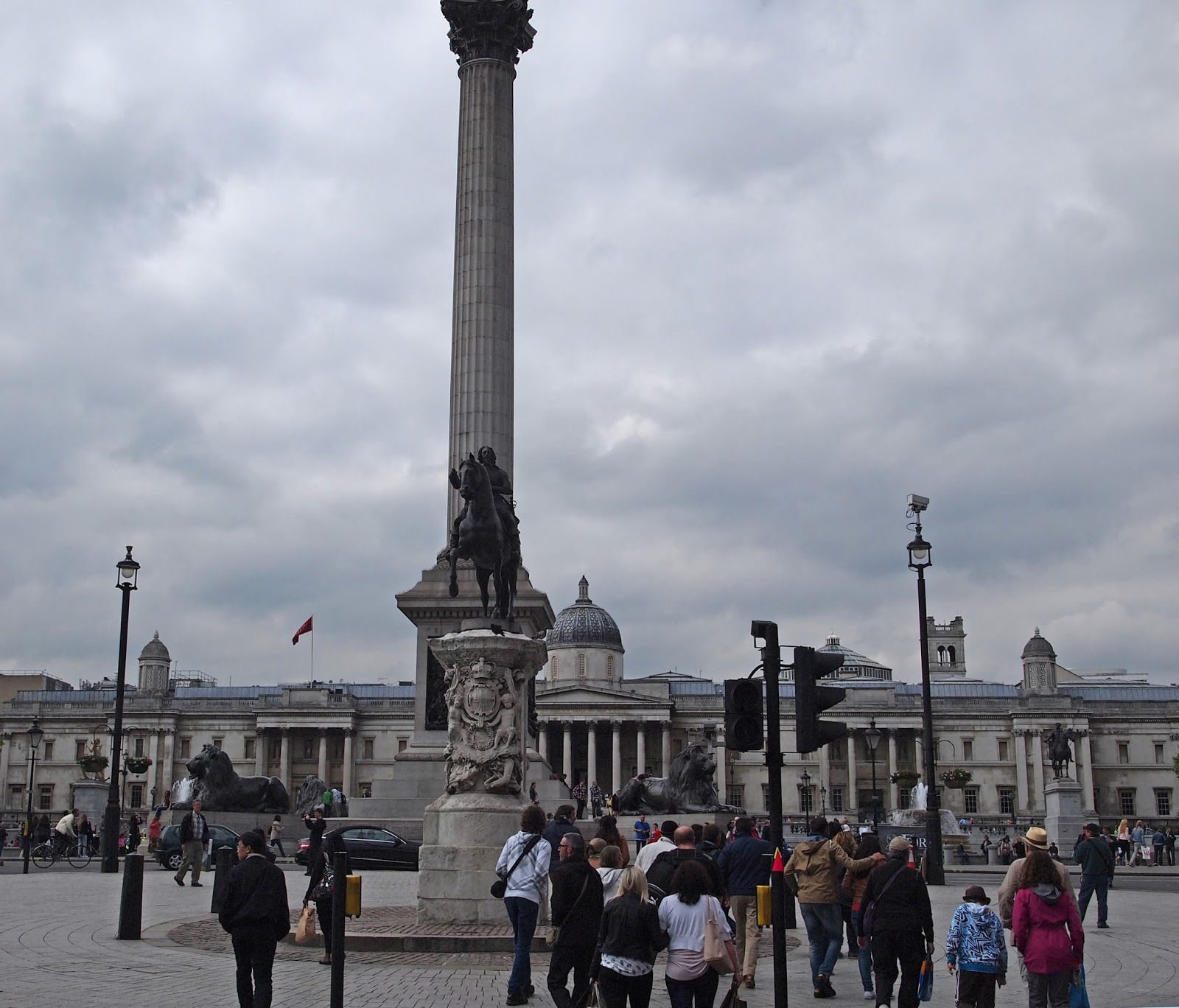 |
| Trafalgar Square, National Gallery in background |
 |
| Portrait of Adele Bloch-Bauer I, Gustave Klimt |
I'm nothing if not contrary so therefore it shouldn't shock that I am intrigued by revisionist Shakespeare productions. The play's the thing so don't mess with the man's words, but I'm fine with innovative productions. Purist period reproductions, deconstructed, whatever -- go for it. But damn it, your staging and costuming choices need to make cohesive, consistent and internal sense. A local production of Othello was well-acted and staged but I felt it abandoned that thread of production continuity with random costuming choices. National Theatre Live's filming of Benedict Cumberbatch's Hamlet was dramatically impressive (and he redeemed himself in my eyes for his overwrought pseudo-Khan with this performance). But the costuming and some staging left me puzzled. The play's the thing! In related news, I'm now a third of the way through my goal of seeing all of Shakespeare's plays performed live (What? I'm totally counting that Hamlet).
I attended several adult education classes at Carnegie Museum of Art this year: Picturing Across the Atlantic: The Beginnings of American Art with art historian Isaac King; John White Alexander's Murals for Mr. Carnegie's Museum and Their Survival in the Smoky City with Curator of Education Lucy Stewart and Chief Conservator Ellen Baxter; and Lasting Impressions: Van Gogh, Gauguin, and Fin-de-siecle Paris with art historian Clarisse Fava-Piz. I know better, but I still feel like CMOA was spying on my art history interests when choosing subject matter for its adult education programs this year!
I'm fascinated by the emergence of art and culture in the fledgling United States and how such coincided with the creation of our founding stories, particularly narratives attached to George Washington. Dr. King wove all these factors into a fascinating tapestry.
 |
| Thomas Hart Benton's America Today |
 |
| Thomas Hart Benton's America Today |
The Impressionist lecture series provided a great foundation for several art appreciation pilgrimages that I took later in the year. Since I usually avoid what's trendy, it's a little embarrassing that I claim among my favorite genres and artists one who'd also among the best-loved in popular culture. The world's obsession with Van Gogh has as much to do with gossiping about his dramatic life as it does with appreciating his actual art. There's a corresponding apologist attitude in art historian circles that tries to ward off speculation about Van Gogh's 'madness' in favor of solely focusing on the art. Good luck with that, I say, because I don't believe we do our collective understanding justice when we divorce any artist from his art, circumstances or times. That's not to say that every discussion about Van Gogh should begin and end with absinthe, ears and asylums! But a discerning study of his foreshortened life illuminates many of his artistic choices. My background as a psychotherapist specializing for a time in the treatment and research of bipolar disorder compels me to believe that Vincent Van Gogh's concurrent psychiatric and medical illnesses were pervasive and episodically dominating. He could function well enough for long periods and was not completely divorced from reality, but that reality was always filtered through the need to manage his episodes and symptoms.
This particular lecture coincided with the Carnegie's Visiting Van Gogh: Still Life, Basket of Apples exhibit, and it also served as a nice primer prior to my family's summer trip to Paris and Auvers-sur-Oise.
 |
| La Mairie d'Auvers and The Town Hall at Auvers by Vincent Van Gogh |
 |
| Auvers field and Wheat Fields near Auvers by Vincent Can Gogh |
 |
| Église Notre-Dame d'Auvers |
 |
| L'église d'Auvers-sur-Oise, vue du chevet by Vincent Van Gogh |
My personal appreciation of art has its foundations not in artistic theory or personal attempts at creating, but in an understanding of art as an expression of personal interests and influences; as a manifestation of social, religious and cultural influences; and as a method of historical record-keeping. The lesser-known figures of the Impressionist era are as interesting to me as the big names, so I was delighted to visit Discovering the Impressionists: Paul Durand-Ruel and the New Painting at Philadelphia Museum of Art and Gustave Caillebotte: The Painter’s Eye at National Gallery. Caillebotte's collection formed the core of the Musée d'Orsay, which I visited later in the summer. If he's widely known for anything it's for his patronage of the Impressionist movement, but Caillebotte was a precise, meticulous painter of dramatic perspectives. It was a joy to see so much of his work in one exhibit. Durand-Ruel was a shrewd businessman whose commitment to the Impressionist movement nearly bankrupted him, but retrospectively seems a stroke of genius. His approach to selling art (literally and figuratively) influences the market to this day. It was awe-inspiring to see the assembled collection and realize how many different artists and visions he brokered.
Audubon's Aviary: The Final Flight (Part III of The Complete Flock) at New York Historical Society was a different kind of visual treat. The Historical Society owns Audubon's original bird watercolors and illustrations, and this particular exhibit showcased preparatory watercolors for the double-elephant-folio print edition of his The Birds of America. It was thrilling to see the great naturalist-artist's work up close and view some of his techniques. The images were displayed in the order in which they were engraved, thereby allowing us to view them sequentially in the order Audubon created them -- just as the original subscribers would have done. The University of Pittsburgh owns one of the 120 complete double elephant folios of John James Audubon’s Birds of America known to exist, and I like to stop in at Hillman Library to ogle whatever image is on display when I'm there. (You can peruse the online images HERE).
 |
| Cathedral Church of St. John the Divine |
There have been other plays and movies and art, wondrous travels that I'm still sorting through, a renewed if intermittent interest in poetry, and above all books and music (both listened to and performed). All of these things have been the embodiment of joy...my antidotes when exposed to bottomless social media rage...what I've used to fill myself when drained by a world gone mad with extremist rhetoric. This embarrassment of cultural riches is something I feel so very, very lucky to have experienced, and that privilege has prompted me to think about what I can give back to the world. I'll finish up my cabbaging and kinging by mentioning one last event that is also serving as a personal beginning.
The We Can Do It! exhibit at Heinz History Center examined the Pittsburgh homefront during WWII with a particular focus on this city's industrial output. It offered detailed perspectives on a particular time and place, and I hope some of the pieces will remain on permanent exhibit.
 |
| My kids and father, We Can Do it, Heinz History Center |
I'm looking forward to the coming year. Perhaps I'll finally learn why the sea is boiling hot, and whether pigs have wings. Bonne santé!


