I recently read
Bienville's Dilemma by geographer and researcher
Richard Campanella, a wonderful collection of essays about the sublime and complicated city of New Orleans. I am normally a very fast reader but I took my time with this book. I savored each essay and my neurotransmitters frissoned as Campanella established connections that I had been straining toward in my readings about colonial and antebellum NOLA. Truly a wonderful book, and it even provided a delightful tidbit of information that set me off on a tangent: buffalo once roamed the wilds of Louisiana.
Maybe you knew that, but I surely didn't. I am captivated by this new knowledge, and not merely because it evokes tawdry images of bison wandering the Vieux Carré wearing "Who Dat?" caps, carrying go-cups, and baring their breasts for beads. (Although now that I've created that image, I'm having a hard time letting go of it...)
Certainly I knew that buffalo roamed the vast expanse of the Louisiana Purchase, but not that they hung out on the deltaic plains of Louisiana itself. Campanella details their presence in his essay "Forest Primeval Reconsidered." The first documented sighting of Louisiana bison occurred in 1699 when Canadian explorer Pierre Le Moyne, sieur d'Iberville et d'Ardillières, was charged with finding the mouth of the Mississippi River in order to further French interior trade interests. He described seeing "...three buffaloes lying down on the bank" which quickly disappeared into the bamboo brush near what Campanella posits was present-day Jackson Square. Iberville later saw a herd of some 200 bison upriver.
These animals, like many present-day New Orleanians, came from Somewhere Else. How did they get there? Based on eyewitness explorer accounts, it seems that bison had expanded their migratory range to the Gulf and Atlantic Coasts due to several natural and man-made factors. A long-term drought forced thirsty buffalo from the western plains into the Ohio River Valley, and from there many wandered south. The buffalo were also able to establish themselves further afield due to the massive Native population decimation due to lack of resistance to European-imported diseases; that in turn meant fewer hunters and diminished land
cultivation, allowing prime grazing grasses to spread and buffalo to roam.
So it came to pass that there were buffalo in Louisiana. And Iberville, lucky guy, was charged with domesticating those Louisiana buffalo and raising them for their wool.
Yes, really. The French were master traders, and hit upon the notion of cultivating herds of sweet, docile buffalo to free themselves from dependence upon Spanish and English wool imports. But let's face it, herding massive uncooperative wild beasts in the days before electric fences and tranquilizer guns was not an easy task. I'm guessing it's not an easy task even today. Even presuming one could successfully herd bison, the logistics of restraining a buffalo for live shearing are mind-boggling.
Iberville bribed some Native peoples with promises of weaponry, and he got a few head of bison that way. However, French plans for buffalo domestication and wool-gathering were doomed by the temperament and size of the beasts.
 |
| From
Antoine Simon Le Page Du Pratz, Histoire de la Louisiane (Paris 1758) from "How to Prepare Buffalo, and Other Things the French Taught Indians about Nature" by Christopher Morris in French Colonial Louisiana and the Atlantic World. Probably a calf but perhaps this illustration is a fantasy depiction of a sheared buffalo? |
After not hitting it big with the buffalo wool trade, the ever resourceful colonial-era French established a brisk trade in buffalo hides and meat.
Un boeuf savage was still plentiful in Louisiana some thirty years later after Iberville's failed buffalo ranch, as described by Jesuit Father du Poisson's observations of bison roaming in the Baton Rouge area
"....in herds over the prairies, or along the rivers...."
But so prevalent was bison hunting and trade that by the time the French sold their regained Louisiana lands to Les Américains in 1803, free range bison had been eradicated from the lower Mississippi.
And we all know how the story of bison on the rest of the North American continent ends. A species that once roamed these lands in the tens of millions was reduced to an estimated 23 known survivors in the wild by 1902.
 |
| From
Francisco Lopez de Gomara, Historia General de las Indias (1553) in
"How to Prepare Buffalo, and Other Things the French Taught Indians
about Nature" by Christopher Morris in French Colonial Louisiana and the
Atlantic World. |
Prior to reading all this, the extent of my knowledge was that white people nearly hunted bison to extinction in the 19th century, and that the birth of a white buffalo calf is considered a prophetic blessing for many Native American and Canadian First Nation tribes.
Arguably stranger than the notion of Louisiana bison are Western Pennsylvania bison. As anyone knows who's ever tried to purchase a level backyard lot in these parts, PA ain't no plains state. Still, we've got bison up in here. In fact, according to the Penn State College of Agricultural Sciences, bison once roamed the mountain slopes and valleys of Pennsylvania at least until 1801, which is when this state's last native free range bison was shot.
I have a vague childhood memory of peering from a distance at a few scraggly buffalo at Allegheny County's South Park in the early 1970s. My breath clouding the closed car windows and my as-yet undiagnosed near-sightedness left me vastly unimpressed by this experience. I couldn't tell if the lumps in the distance were buffalo or dirty rocks,
but my father assured me they were buffalo.
He was right. At one time, there were herds in Allegheny County kept on public display at both North and South County Parks.
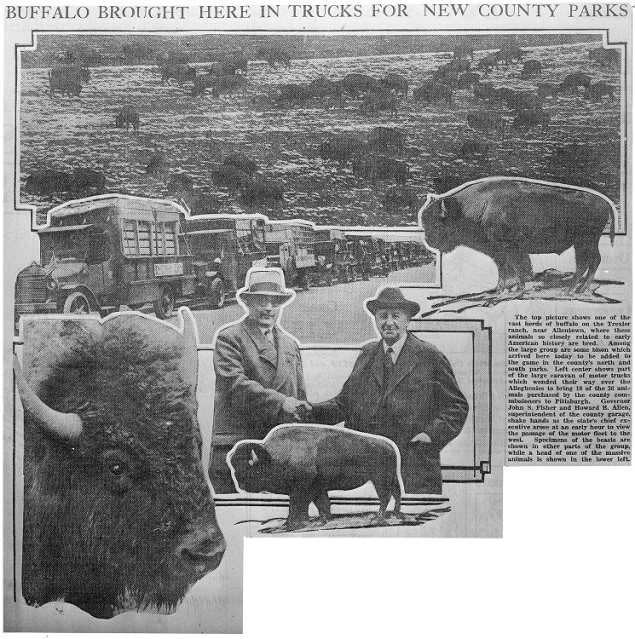
Thirty-six bison were imported to Pittsburgh in 1927 to bolster visitation to those newly created public parks, with the expectation that Native Americans could be recruited to care for the beasts. The animals were trucked in from a Schnecksville PA preserve founded in 1906 as part of a big game conservation effort, a site known today as the Trexler Nature Preserve and home of the Lehigh Valley Zoo. The starter herd consisted of 4 large bulls, 3 medium-sized bulls, 3 young males, 3 mature cows, 3 medium-sized cows, and 2 yearlings. Allegheny County paid $150 a head, with a half dozen beasts thrown in for free.
A 1927 Pittsburgh Press article described the cross-state buffalo odyssey:
The advertising angle of the caravan as it passes across the state with its burden of buffaloes is not being overlooked and large signs will tell any who stop to inspect the unusual caravan that they are intended for the new county parks in Allegheny county.
Buffalo product placement ops.
 |
| Pittsburgh City Photographer Collection,1901-2002. Historic Pittsburgh Image Collections |
Three families from the Blackfeet reservation in Browning, Montana were hired to care for the herd from 3 May 1928 to 25 March 1931.
 |
| Photo of Chiefs Big Beaver and Eagle Ridge with families posing with Mayor Charles H Kline & Parks Director Riis, May 2, 1928. Pittsburgh Post-Gazette |
|
From
a 1986 article in Carnegie Magazine:
In those early experimental days it seemed obvious that parks should have wild animals, and that the ideal caretakers or curators of wildlife would be real Indians. And so the county commissioners brought two tribes of Indians from a Montana reservation to live in the parks. Chief Big Beaver and his tribe went to North Park, and Chief Wild Eagle and his tribe went to South Park to tend the animals delivered there in 1927.
This was no small affair. Thirty-six head of buffalo were trucked in by means of a motor caravan, led by a tank. Reporters followed in private cars. Deer and other native wildlife from Pennsylvania were also provided as part of the Indians' herd. But the gesture ended badly. The Plains Indians found the winters here too severe, and left after one season. In North Park, the Indian "curators" of the herd did not so much protect it as use it the way their ancestors would have--for food and clothing. They were asked to leave. The romance of the American Indian could not survive in a county park.
Allegations of poaching and alcohol abuse against the natives were made. However, according to a 1931 Parks report cited in Oliver's Post-Gazette article, the Blackfeet themselves asked to return to their reservation, giving no specific reason other than a mention that Mrs. Big Beaver
"....was ailing and enduring considerable physical suffering." A Pittsburgh Post-Gazette article from April 1929 makes it clear, however, that there was little compassion involved when it came to dealing with the imported Native caretakers:
....Big Beaver may be requested to resign this fall to take the frequently recurring Indian problem off the minds of the commissioners.
Commissioner E. V Babcock threw the problem off his shoulders with one terse expression.
"Let's get them the deuce out of here."
"We keep these Indians all winter while they loaf," Commissioner Charles C. McGovern declared. "Now when we want them in the summer they want to leave."
Not surprisingly, an obituary for "Chief Big Beaver" doesn't mention anything about boozing or alleged bison poaching:
Aug 7, 1958
Eddie Big Beaver Services Set for Saturday Morning
Funeral services have been set for Saturday, August 9, at 10Am in Little Flower Catholic Church for Eddie James Big Beaver, Sr., 79, whose body was found in an irrigation ditch between Yakima and Toppenish, WA, early this week. Authorities believe his body had been in the ditch about six days before discovery. Big Beaver was a full-blood Blackfeet Indian who spoke excellent English and was regarded as a competent game-keeper, experienced in the handling of all kinds of animals and an experienced show man, having done this type of work in different sections of the US. In 1931, during his employment with South Park, a director for the Bureau of Parks described him as a “picturesque full-blood Blackfeet.” During his lifetime his activities were many and varied. In 1935 he and four other Blackfeet Indians were employed by Ringling Bros. Circus. He was also a one-time game warden at Pittsburg. In 1936 Big Beaver was requested to participate in the Natioinal (sic) Folk Festival at the Texas Centennial, an educational and cultural organization that brought together different Indian groups from many regions of the US In 1939 he was employed by the Twentieth Century Fox Film Corporation in the motion picture “Susannah of the Mounties.” Survivors include sons, Sam Wolverine, Eddie Big Beaver Jr. & Lynus; Daughters, Joyce Boy and Margaret Boy and 11 grandchildren. [Death was due to a fractured skull from a blow on the head.]. Obituary reproduced from http://prairiemary.blogspot.com
Big Beaver was a larger-than-life character, which was exactly what the newly created Allegheny County Department of Parks was looking for. Just as the colonial French had recruited Native peoples for their Louisiana bison farming plan, the County Commissioners wanted to promote their new "People's Country Clubs" and weren't above using the Blackfeet families as de facto sideshow attractions. That neither attempt at Native exploitation worked is poetic justice, I think, especially given the sustained prejudicial attitudes towards Natives.
Following the departure of the Blackfeet tribe, a 1931 Parks report opined:
....the money....was well spent...As was hoped, they drew to the parks and entertained thousands of delighted children and adults...It is, of course, to be expected that the red man sooner or later falls into the irresponsible ways of his people.
 |
| North Allegheny History Museum photo of Blackfeet tipi on Flagstaff Hill near buffalo paddock, circa 1931. Source: University of Pittsburgh's Digital Research Library Historical Pittsburgh Image Collections, Northland Historical Image Collection of the Northland Public Library |
The County was clearly not sentimental about anything associated with its buffalo management. Blaming fecund bison, by 1933 the Pittsburgh Press was writing articles like the charmingly entitled
County Finds Buffaloes Are Now White Elephants: This Unnatural Brand of Too Rapid Evolution Leads Commissioners to Believe the Only Place Poor Bison Are Wanted Is on Wooden Nickels (the article is a wee bit longer than its title). In it, the County Parks Director claimed that due to the complexities of caring and keeping of 39 buffalo when a herd of 20 would be sufficient, consultation with a game conservationist was in order. And so it came to pass that in December 1937, the next County Parks Director announced plans to shoot six of 18 bison to cull the South Park herd, donate the meat to the County Jail, and transfer one lucky live cow to North Park.
In North Park, the bison were confined to an area around Parish Hill bounded by Lakeshore Drive and Pearce Mill Road. This herd ultimately did not flourish and
"conflict among the older buffalo" was cited in a 1930 Parks report, which was soon dealt with by castrating the most aggressive bulls. A year later, a Parks report stated that having
"unsexed" a few bulls "....the bachelors and, hence, the herd life is much more peaceful." No word from the
"unsexed" bulls about how they felt about this development but it was likely cold comfort when a 1937 County Parks report stated that
"Expert authorities....assured the Department that Allegheny County has the finest specimens of buffalo and deer east of the Rockies."
Given regular culling of herds and
"unsexing" the bison no doubt appreciated the later development of reliable and non-invasive ungulate birth control.
Visibility problems hampered visitors from spotting the North Park buffalo, and in the 1940s the entire herd was trucked off to South Park. The newspapers of the day regularly reported on their escapades. Things didn't end well for a bull named Hitler and one has to believe that names are linked to destiny. From the Pittsburgh Press, January 21 1940:

 |
| Pittsburgh Press, 21 January 1940 |
Today a herd of buffalo remains at South Park (presumably not bearing the names of notorious European rulers). They were apparently on their break when we first visited, but my kids did claim to sighting 427 avian waterfowl, a dead frog, a groundhog, and a flock of turkey vultures that day. Oh, and this sign on the paddock (which was frankly a relief because I'd forgotten to bring any buffalo treats).
A second visit in July 2012 yielded an impressive view of the herd. If we counted correctly, there were 8 adults, 2 juveniles, 2 calves, and a lot of flies.
There have also been bison at the Pittsburgh Zoo as far back as the turn of the last century. Judging by the frequency of their press coverage over the years, the Zoo bison captured the public imagination in ways that the more anonymous bison herds at the County parks did not (exceptions made for Hitler and Napoleon). The Zoo buffalo were apparently prone to wandering.
 |
|
Pittsburgh Daily Post, 17 October 1915 |
Life for Zoo
bison wasn't all fun and games and merry chases. In 1906, two Zoo bison who had been separated from the herd due to mutual aggression apparently agreed to meet behind the parking lot to sort things out later:
In the dead of night, several days ago, the animals tore down the barriers and, with roars of rage, fought in the darkness. When they were finally separated both were bleeding from many wounds and the flesh along their flanks was ripped and town. The dead buffalo will be mounted and preserved at the Carnegie Museum. from The Pittsburgh Press, October 1906
Perhaps in revenge for that bison stuffing and mounting, in 1920 an irate mother bison attacked a 60 year old man who tried to pet her newborn calf:
"He was trampled before employees of the Zoo could reach him. Keeper Ernest Tretow and several laborers dragged him from under the hoofs of the angry mother and out of the pen." When another baby was
born in 1934 and twin buffalo babies in spring 1936, there were no newspaper reports of goring.
Lesson learned: leave the newborn baby bison alone.
 |
| Deer and buffalo paddocks (buffalo apparently on break), Pittsburgh Zoo, July 1930. Pittsburgh City
Photographer Collection, Historic Pittsburgh Image Collection |
Then there was the threat of the bison Anthrax epidemic of 1947 which killed two or three buffalo and resulted in the temporary closure of the Zoo. According to a Pittsburgh Press article
from November 24 1947, officials were quick to reassure the public then quarantine and sanitize the animals:
"The buffaloes...will be thoroughly scrubbed and disinfected." Public safety assured by a herd of sparkling clean buffaloes, the Zoo re-opened a month later.
My favorite documented Pittsburgh Zoo bison story concerns the consequences of a labor dispute and sit-down strike by zoo attendants in July 1951. Due to the strike the animals didn't get fed for a day, because apparently it's really hard to get scabs to cross a picket line to toss raw steak to the lions. A Pittsburgh Press report noted that the next day the buffalo scored:
"Only a few of the animals had been fed by noon today. These were the buffalo and deer whose attendants, although officially on strike, came around to the zoo early this morning to feed their charges."
The last public mention I can find of the Zoo herd is of a 75 pound bull calf born on 25 April 1991, bringing that herd count to seven. The bison herd had been evicted by 2003 when the Zoo closed its North American animals exhibit for expansion in keeping with its strategic plan. My inquiries of Zoo personnel as to where the bison went came up empty.
One might even say that I was buffaloed in my attempts to determine their fates.
I later learned that the Zoo's bison were humanely dispatched, having contracted a contagious disease that would not allow them to be integrated with other bison herds.
Today there are plenty of bison residing in Pennsylvania on privately owned ranches, but those herds are bred for their meat rather than maintained on exhibit for the public. The Allegheny County Parks and Pittsburgh Zoo bison were unique exhibits that tried to balance enclosure with encounter and education, albeit with mixed results.
ADDENDUM: Rick Sebak did a feature on the two big Allegheny County parks that includes a nice bit on the South Park bison herd. Check that out here:
WQED Multimedia: TV: It's Pittsburgh and A Lot of Other Stuff
________________________________________________
Fun bison facts:
- In the seventeenth century, French explorers in North America referred
to the new species they encountered as "les boeufs", meaning oxen or
beeves. The English, arriving later, changed the pronunciation to "la
buff". The name grew distorted as "buffle", "buffler", "buffillo", and,
eventually, "buffalo".
- The bison were all but extinguished in the United States by the end
of the 19th century. Before 1600, an estimated 30 million to 70 million
bison thrived in North America, according to the National Bison
Association.
- Bison can run at speeds up to 40 MPH.
- The average bison life span is 20-25 years.
- Numbers vary according to sources consulted, but today there are upwards of 500,000 bison in the United States.
____________________________________________________________________________________________________________________
Selected bibliography and further reading:
Agricultural Alternatives: Bison Production
Allegheny County Parks, Carnegie Magazine, July/August 1986
As bison return to Montana prairie some rejoice and others worry
Latodami Nature Center, North Park
Nurturing a historic herd of bison: Trexler Nature Preserve
Rare White Buffalo Killed on Texas Ranch
Settlement at Pine Creek: Part III by Larry and Susan Miller Pearce
South Park's bison herd is an unusual and cherished attraction
Campanella, Richard. ""Forest. Primeval”. Reconsidered"" in Bienville's Dilemma: A Historical Geography of New Orleans. University of Louisiana. November 4, 2008. Print.
Morris, Christopher.
"How to Prepare Buffalo, and Other Things the French Taught Indians
about Nature" in French Colonial Louisiana and the Atlantic World. Ed. Bradley G. Bond. Louisiana State Univ Pr. June 30, 2005. 22-42. Print.
Oliver, Judith. “Buffalo once had a home to roam in North Park.” Pittsburgh Post-Gazette. 9 March, 1997: VN

 happy about this and their goal was to limit French expansion into the Ohio Country, which had already been claimed by the Virginia Colony. Acting on orders from Virginia Lieutenant Governor Robert Dinwiddie, a 21 year old George Washington was sent north with eight men on a diplomatic mission to advise the French to evacuate the region. George's Incredible Adventure started in Williamsburg Virginia and ended at Fort LeBoeuf,
in what is now Erie
County Pennsylvania. The route we followed with George-on-a-Stick aligned mainly with modern highways such as Interstate 79 and U.S. Route 19, but there were some suggested rural scenic routes along the signposted Washington's Trail that are thought to more closely parallel the route Washington took in fall 1753. You can view a map of the Washington Trail at this LINK.
happy about this and their goal was to limit French expansion into the Ohio Country, which had already been claimed by the Virginia Colony. Acting on orders from Virginia Lieutenant Governor Robert Dinwiddie, a 21 year old George Washington was sent north with eight men on a diplomatic mission to advise the French to evacuate the region. George's Incredible Adventure started in Williamsburg Virginia and ended at Fort LeBoeuf,
in what is now Erie
County Pennsylvania. The route we followed with George-on-a-Stick aligned mainly with modern highways such as Interstate 79 and U.S. Route 19, but there were some suggested rural scenic routes along the signposted Washington's Trail that are thought to more closely parallel the route Washington took in fall 1753. You can view a map of the Washington Trail at this LINK.